
The Team Group MP34 512GB SSD Review: Refining Phison's NVMe Workhorse
Random Read Performance
Our first test of random read performance uses very short bursts of operations issued one at a time with no queuing. The drives are given enough idle time between bursts to yield an overall duty cycle of 20%, so thermal throttling is impossible. Each burst consists of a total of 32MB of 4kB random reads, from a 16GB span of the disk. The total data read is 1GB.
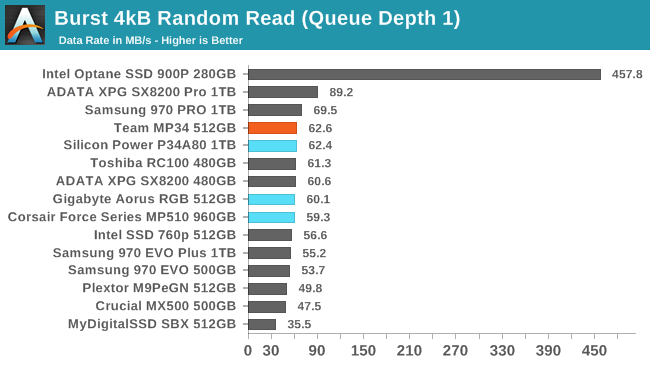
The QD1 burst random read performance of the Team MP34 is higher than previous Phison E12 drives of any capacity, but it's a pretty small improvement. We haven't seen a higher score from any other 512GB-class drive, but that's probably because we have not yet tested a 512GB-class Silicon Motion SM2262EN drive with Micron NAND; that combination has a big lead among 1TB drives.
Our sustained random read performance is similar to the random read test from our 2015 test suite: queue depths from 1 to 32 are tested, and the average performance and power efficiency across QD1, QD2 and QD4 are reported as the primary scores. Each queue depth is tested for one minute or 32GB of data transferred, whichever is shorter. After each queue depth is tested, the drive is given up to one minute to cool off so that the higher queue depths are unlikely to be affected by accumulated heat build-up. The individual read operations are again 4kB, and cover a 64GB span of the drive.
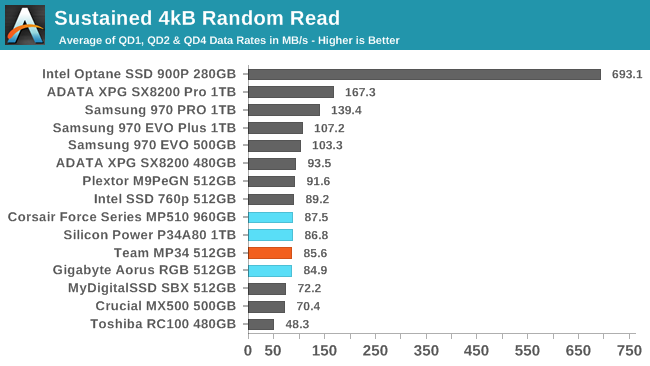
On the longer random read test, the Team MP34 and other Phison E12 drives fall even further behind the fastest TLC drives, but still have a clear performance advantage over the SATA entry-level NVMe drives.
 |
|||||||||
| Power Efficiency in MB/s/W | Average Power in W | ||||||||
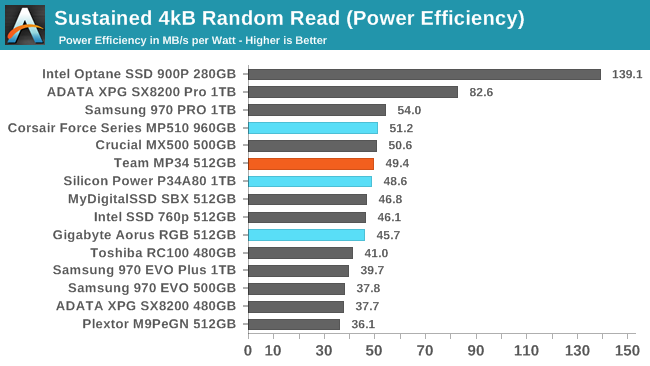
The Team MP34 and other Phison E12 drives have good power efficiency on the random read test, comparable to the SATA drive and the better entry-level NVMe drives. But the Silicon Motion SM2262EN drives stand above the rest, requiring only a bit more power than the E12 and providing significantly better performance.
 |
|||||||||
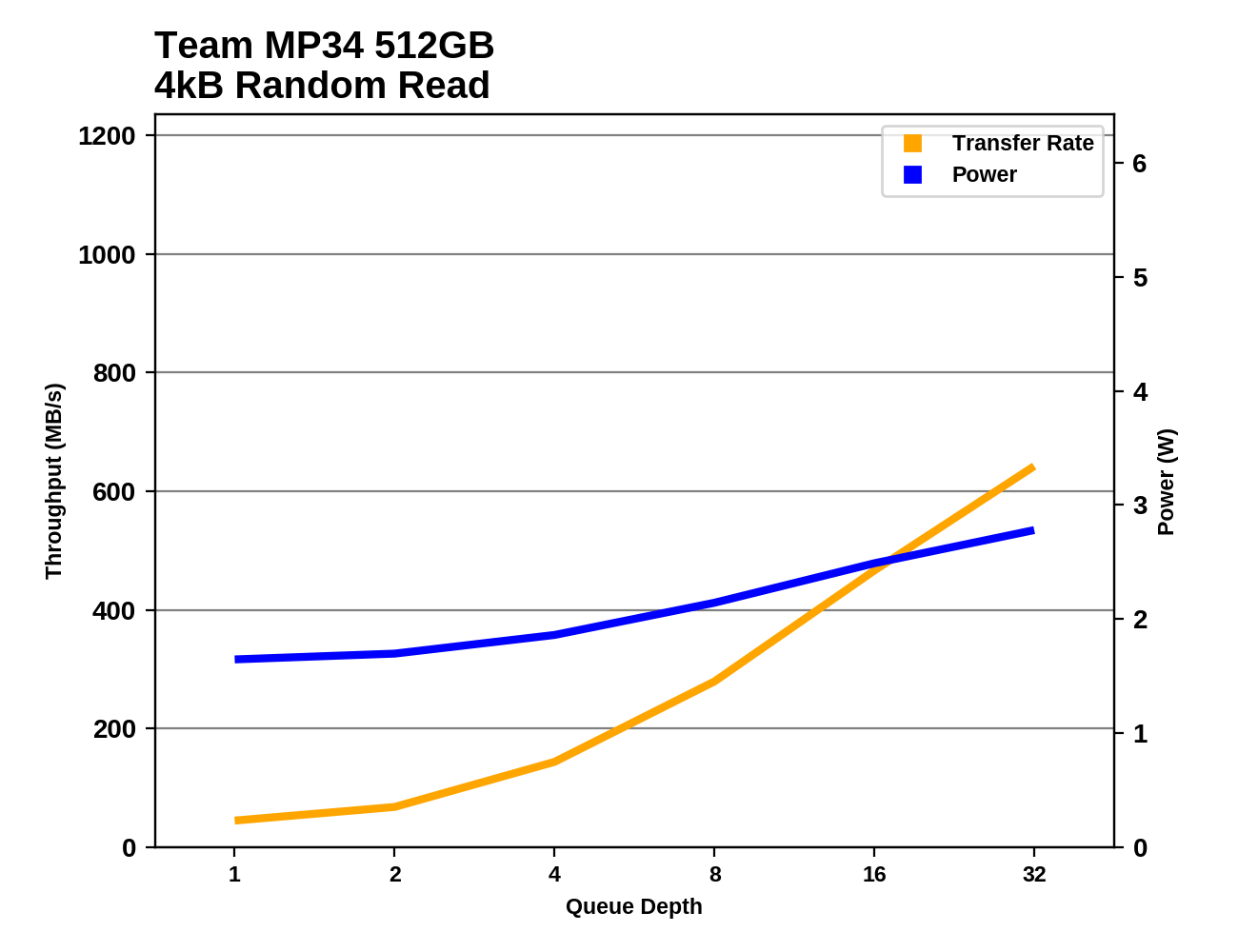
At higher queue depths, the 512GB MP34 provides equal or better performance to the other drives of similar capacity that we have tested. Most of the 1TB drives are significantly faster at those queue depths, and it is likely that the ADATA SX8200 Pro's lead carries over to the smaller models that we have not had the opportunity to test.

At lower queue depths where the Team MP34 is still delivering performance within reach of SATA drives, its efficiency is nothing special—plenty of those SATA drives can perform the same while using much less power. Once the MP34's performance scales beyond the SATA limit, there are only a handful of drives that offer similar performance for less power. However, there are also numerous options that hit much higher speeds while consuming basically the same power as the MP34 at QD32.
Random Write Performance
Our test of random write burst performance is structured similarly to the random read burst test, but each burst is only 4MB and the total test length is 128MB. The 4kB random write operations are distributed over a 16GB span of the drive, and the operations are issued one at a time with no queuing.
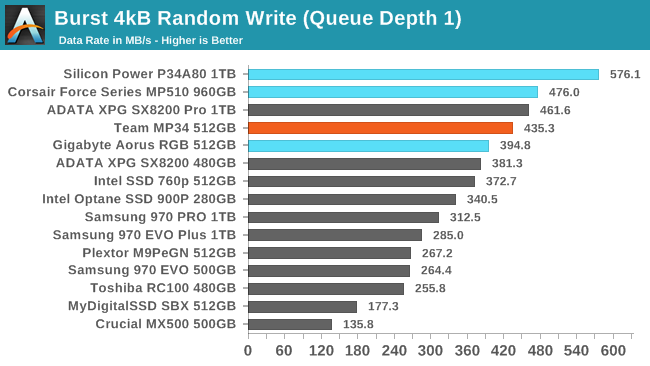
Phison's SLC write cache was already one of the fastest on the market, and the new firmware used by the Team MP34 improves burst random write performance by another 10%. The 512GB MP34's burst write performance is better than most 1TB high end drives.
As with the sustained random read test, our sustained 4kB random write test runs for up to one minute or 32GB per queue depth, covering a 64GB span of the drive and giving the drive up to 1 minute of idle time between queue depths to allow for write caches to be flushed and for the drive to cool down.
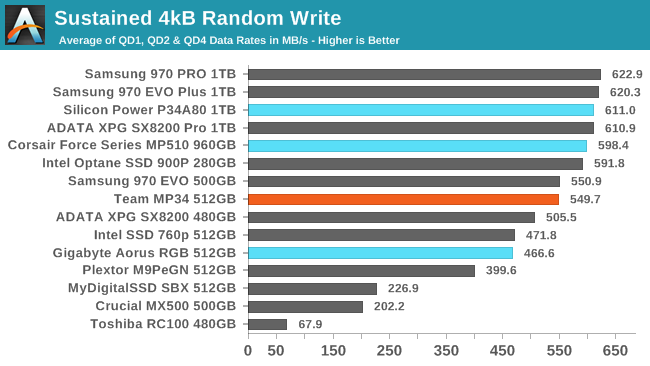
On the longer random write performance, the larger drives are unavoidably faster. But the new firmware in the Team MP34 brings its performance up to the level of the Samsung 970 EVO, a more significant increase than for the burst write speed.
 |
|||||||||
| Power Efficiency in MB/s/W | Average Power in W | ||||||||
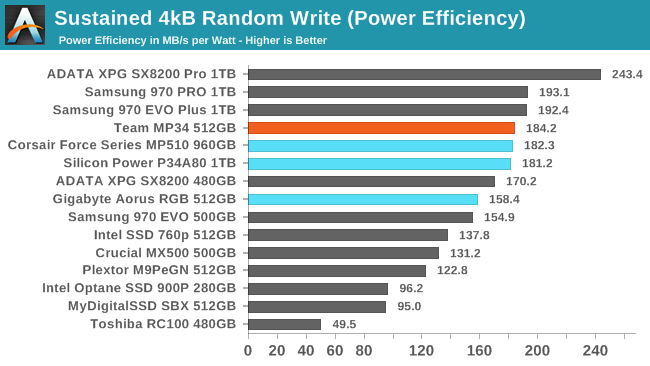
The improved performance of the MP34 over the Gigabyte drive with older firmware brings power efficiency on the random write test up to the level of the faster 1TB drives. The MP34 draws very slightly more power than the Gigabyte Aorus despite the latter's RGB LEDs, but the MP34's extra power is well-spent.
 |
|||||||||
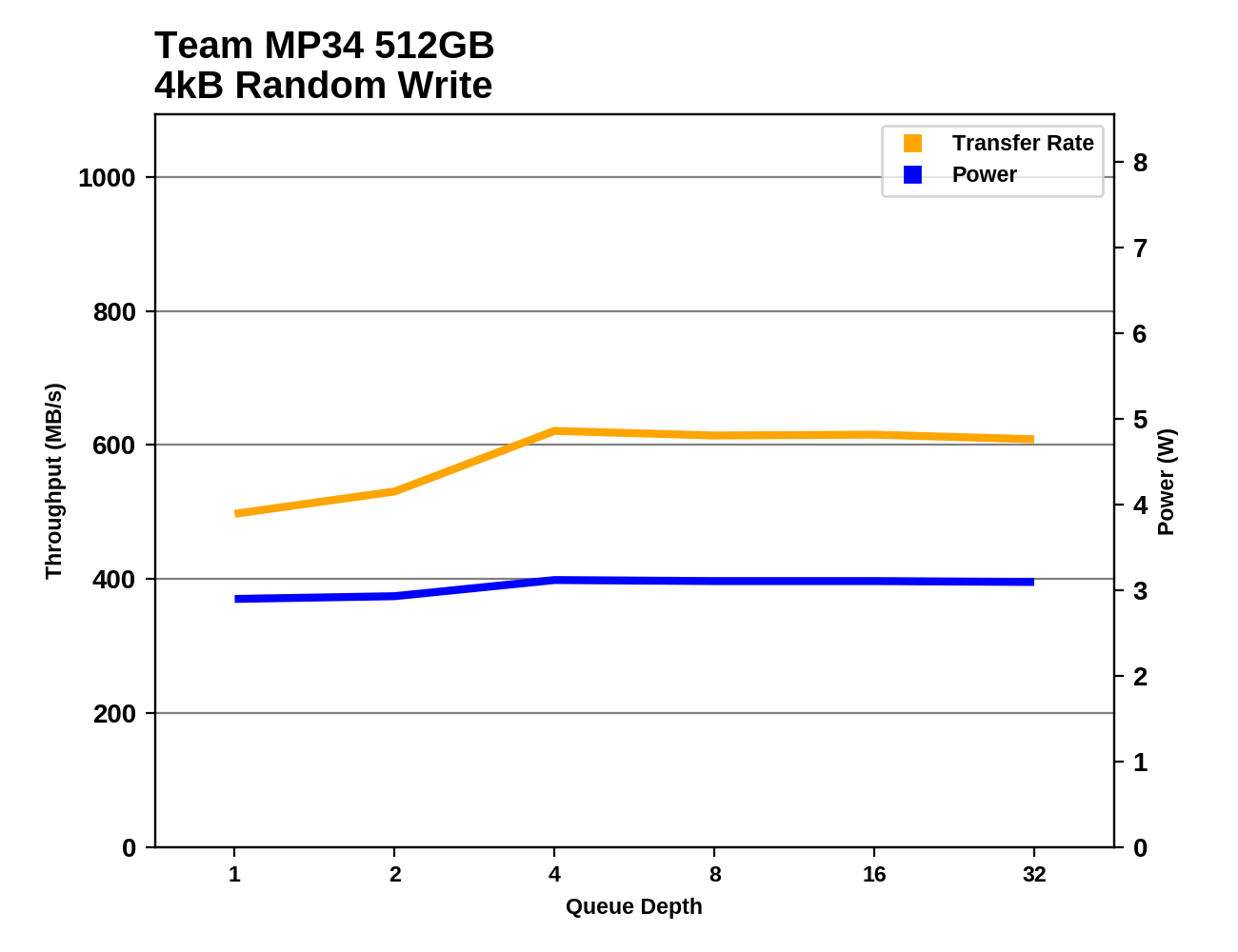
The Team MP34 is provides faster random writes than the Gigabyte Aorus RGB at all tested queue depths, and generally uses about the same power. Full performance is reached at QD4, which is typical for most drives.
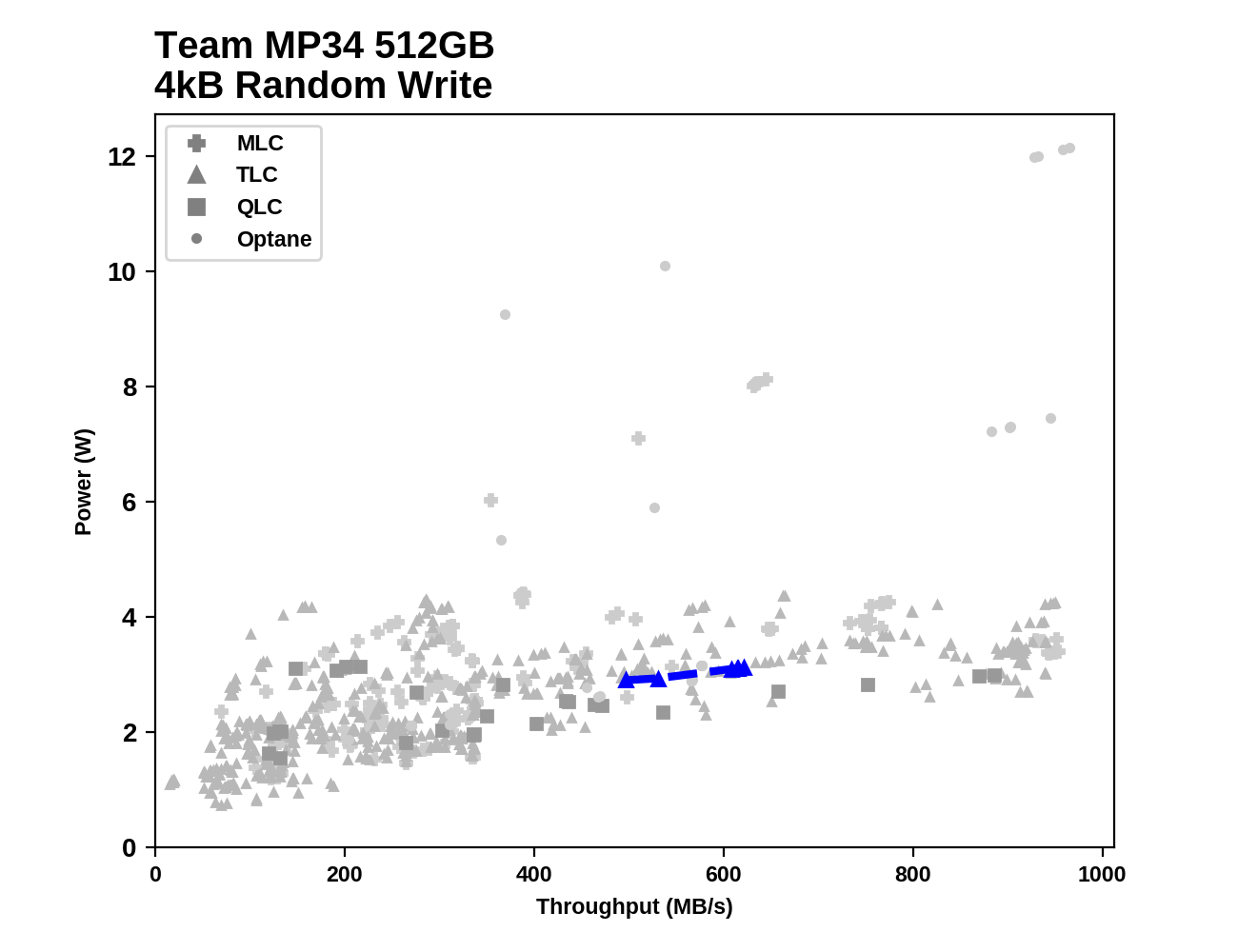
The Team MP34's performance on the random write test is well above SATA territory but the modest capacity prevents it from reaching the high speeds that 1+TB drives hit. Power efficiency is decent, but there are a handful of drives that can write to their SLC caches at similar speeds with significantly lower power.
Originally published at https://www.anandtech.com/show/14331/the-team-group-mp34-512gb-ssd-review (Wayback Machine).