
Intel 925X Roundup: Creative Engineering 101
- Posted in
- Motherboards
DFI LANParty 925X-T2: Features and Layout
| DFI LANParty 925X-T2 Motherboard Specifications | |
| CPU Interface | Socket 775 Pentium 4 (Prescott) |
| Chipset | Intel 925X/ICH6R |
| Bus Speeds | 200MHz to 300MHz (in 1MHz increments) |
| PCI Speeds | To CPU, 33.33, Auto |
| PCI Express Speeds | Auto, Fix 100-140 |
| DDR2 Speeds | Auto, 400, 533 |
| Core Voltage | 0.8375V to 1.85V |
| DRAM Voltage | 1.8V to 2.5V in 0.1V increments |
| Northbridge Voltage | 1.5V to 1.8V in 0.1V increments |
| Memory Slots | Four 240-pin DDR2 Slots Dual-Channel Unbuffered Memory to 4GB |
| Expansion Slots | 1 PCIe x16 Slot 3 PCIe x1 slot 3 PCI Slots |
| Onboard SATA/IDE RAID | 4 SATA 150 drives by ICH6R Can be combined in RAID 0, 1, Intel Matrix |
| Onboard IDE | One Standard ATA100/66 (2 drives) |
| Onboard USB 2.0/IEEE-1394 | 8 USB 2.0 ports 2 IEEE 1394 FireWire Ports by VIA VT6307 |
| Onboard LAN | 2 Gigabit LAN - Marvel 88E8053 PCIe and Marvel 88E8001 PCI |
| Onboard Audio | Karajan Module with Realtek ALC880 Codec with Independent Variable Sampling 8-Channel with SPDIF in/out |
| Tested BIOS | 925LC803 |
When DFI first introduced the LANParty boards a little over a year ago, they were not a name with which many Enthusiasts were familiar. However, since that time, DFI has earned a solid reputation as a maker of some of the best-performing and most sought-after boards available in the Enthusiast market. The 925X-T2 is DFI's second design for the Intel socket, following the highly regarded LANParty boards for socket 478.
The LANParty 925X-T2 keeps all the bells and whistles that made the original LANParty series so unique. This includes UV slots and ports, matching UV sensitive round cables, a flexible FrontX port box that will fit in a 5-1/4 bay and organize your ports, and the completely unique PC Transpo for carrying your desktop system to LAN parties.
There are also a couple of new additions to generation 3 of LANParty. DFI included coordinated UV sleeving for the other cables in your rig, and High-Definition audio is provided by a plug-in Karajan module. DFI tells us that the plug-in audio module allows the electrical isolation of the audio codec, resulting in a lower noise than you might experience with an on-board audio codec.
The rest of the features are a complete implementation of the 925X/ICH6R chipset, with the added benefit of two Gigabit LAN controllers. One LAN controller sits on the faster PCI Express bus and the other is on the PCI bus.
In overclocking, the DFI offers the widest range of voltages that you will see on any of the boards in the roundup. It is the only 925X with DDR2 memory voltage adjustments to 2.5V and a CPU voltage adjustment to 1.85V. These values should even put smiles on the faces of users who plan to use water-cooling or phase-change cooling. Northbridge voltage is also adjustable. Instead of making all the PCIe decisions for you, like boards that only offer Auto adjustments, or forcing extensive manual trial and error- like manual only controls, the DFI offers both options. You can let the board make the sliding ratio adjustments for you with Auto, or you can dial your own with manual PCI fix adjustments.
DFI also continues CMOS reloaded, which was introduced with the second generation LANParty and Infinity boards. This feature allows you to save several different custom BIOS set-ups so that you can easily recall custom BIOS settings for a particular overclock or settings for a different OS. Overclockers and users who run multiple operating systems will really find CMOS Reloaded to be a useful feature.
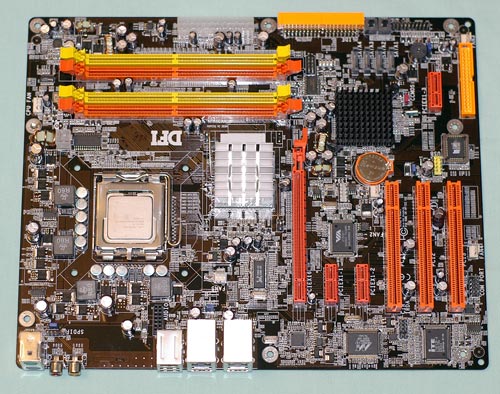
In general, the DFI is well-laid out for most cases, since it is a board that was designed to be seen in a side window case. One of the more annoying things about the layout is the board edge connector for IDE and the bottom edge floppy connector, which are only a little better located than the Abit. However, the diagnostic LEDs on the DFI are better located than the Abit. They are clear of obstructions so you can actually see the LEDs during boot. The 24-pin and 4-pin power connectors are both near board edges to the right of the CPU and are probably the best located of any board in this roundup. You don't even have to snake the 4-pin around the CPU as you do in some other 925X designs in the roundup. The Karajan audio module was a little flimsy in our early board, but DFI told us when we got the board that shipping boards would have a bracket to secure the module. That should take care of that issue.
As we have come to expect with LANParty boards, DFI continues to innovate with their flagship line of boards. The LANParty is clearly aimed at the computer Enthusiast who wants to show off their rig, and it makes no apologies for being brash and showy. No matter how much it glows, the LANParty boards wouldn't sell unless they also delivered top-notch Enthusiast-level performance, and DFI continues to lavish most of their attention on how the LANParty boards actually perform.
Originally published at https://www.anandtech.com/show/1431 (Wayback Machine).