
The ADATA XPG SX8200 & GAMMIX S11 NVMe SSD Review: High Performance At All Sizes
Random Read Performance
Our first test of random read performance uses very short bursts of operations issued one at a time with no queuing. The drives are given enough idle time between bursts to yield an overall duty cycle of 20%, so thermal throttling is impossible. Each burst consists of a total of 32MB of 4kB random reads, from a 16GB span of the disk. The total data read is 1GB.
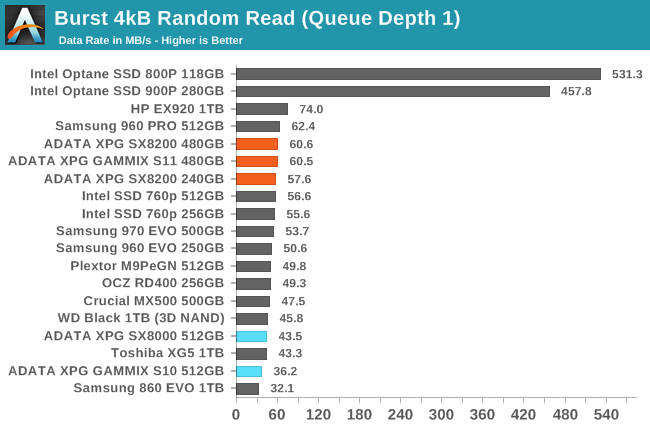
The burst random write performance of the ADATA SX8200 and GAMMIX S11 is excellent. The GAMMIX S11 is slightly faster than the SX8200, and they all clearly have very quick write caches.
Our sustained random read performance is similar to the random read test from our 2015 test suite: queue depths from 1 to 32 are tested, and the average performance and power efficiency across QD1, QD2 and QD4 are reported as the primary scores. Each queue depth is tested for one minute or 32GB of data transferred, whichever is shorter. After each queue depth is tested, the drive is given up to one minute to cool off so that the higher queue depths are unlikely to be affected by accumulated heat build-up. The individual read operations are again 4kB, and cover a 64GB span of the drive.
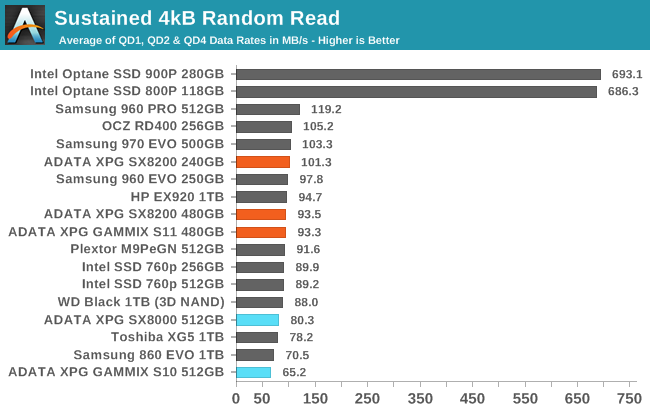
On the longer random read test, the newer ADATA drives aren't quite as close to the top of the charts, but they are still performing very well and are far faster than their predecessors.
 |
|||||||||
| Power Efficiency in MB/s/W | Average Power in W | ||||||||
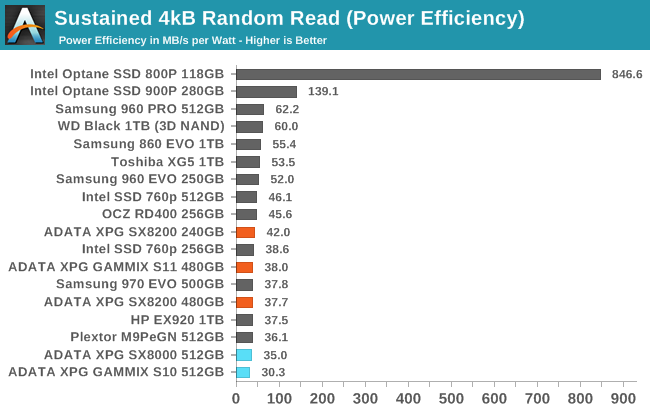
The SX8200 and GAMMIX S11 use more power than their predecessors and most competitors on the sustained random read test, but their performance is high enough that the efficiency scores end up only a bit below average for flash-based SSDs.
 |
|||||||||
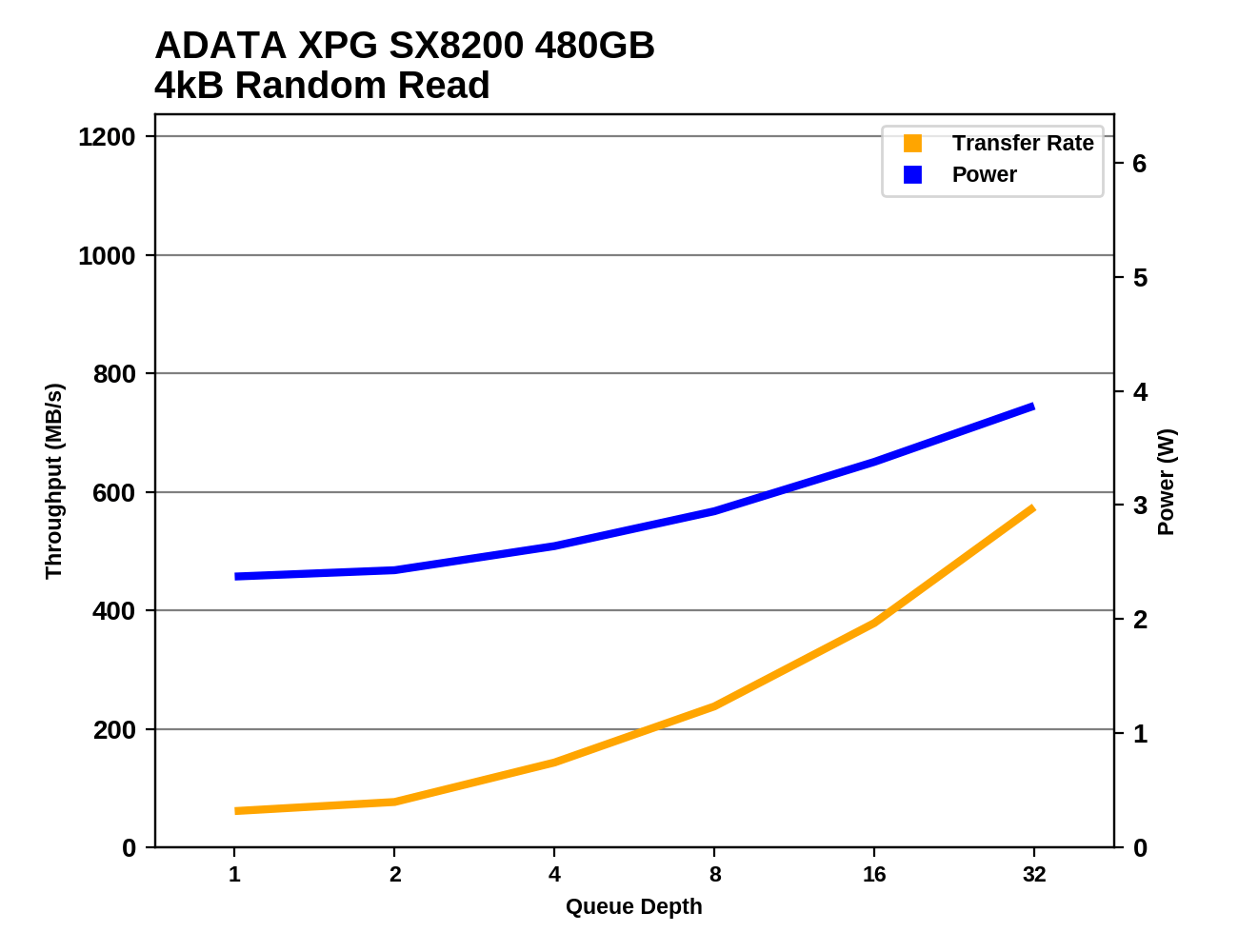
The SX8200 gains very little performance from QD1 to QD2, but then scales up reasonably well as queue depths increase. By QD32, only the smallest 240GB SX8200 seems to be starting to level off.
Random Write Performance
Our test of random write burst performance is structured similarly to the random read burst test, but each burst is only 4MB and the total test length is 128MB. The 4kB random write operations are distributed over a 16GB span of the drive, and the operations are issued one at a time with no queuing.
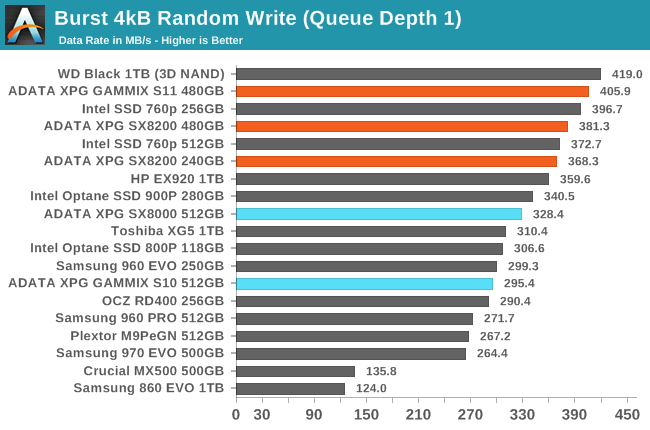
The burst random write performance of the ADATA SX8200 and GAMMIX S11 is excellent. The GAMMIX S11 is slightly faster than the SX8200, and they all clearly have very quick write caches.
As with the sustained random read test, our sustained 4kB random write test runs for up to one minute or 32GB per queue depth, covering a 64GB span of the drive and giving the drive up to 1 minute of idle time between queue depths to allow for write caches to be flushed and for the drive to cool down.
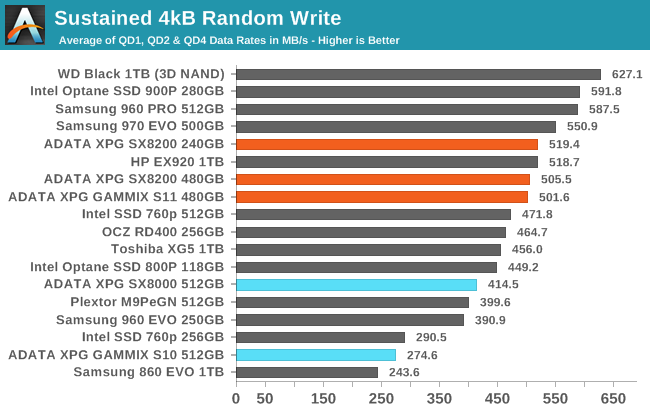
On the longer random read test, the newer ADATA drives aren't quite as close to the top of the charts, but they are still performing very well and are far faster than their predecessors.
 |
|||||||||
| Power Efficiency in MB/s/W | Average Power in W | ||||||||
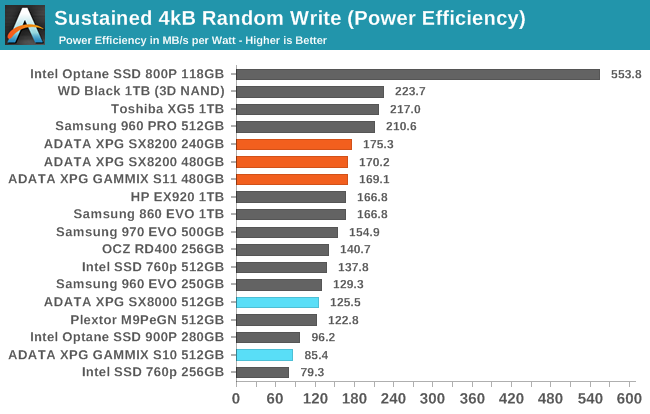
The power efficiency of the SX8200 and GAMMIX S11 on the sustained random write test puts them in the second tier of flash-based SSDs, with just two TLC-based drives producing higher efficiency scores. The previous generation of ADATA NVMe SSDs draw more power and deliver worse performance.
 |
|||||||||
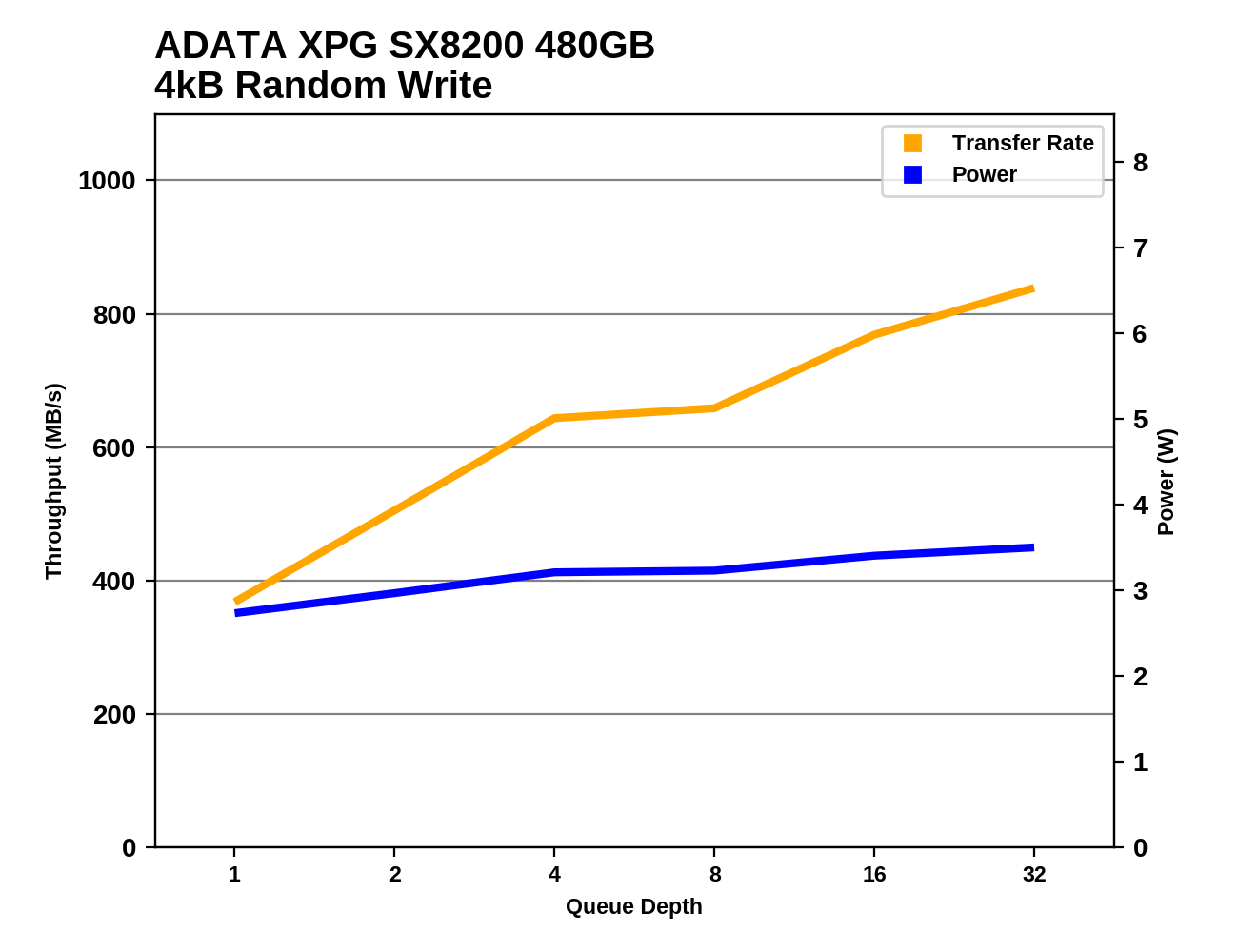
Where the GAMMIX S10 hit a performance plateau quite early and the SX8000 spent most of the random write test dealing with rough garbage collection cycles, the SX8200 keeps improving performance as queue depths increase. The 240GB SX8200 does lose performance during part of the random write test due to the SLC cache filling up, but it doesn't drop below the QD1 throughput and it recovers before the end of the test.
Originally published at https://www.anandtech.com/show/13112/the-adata-sx8200-gammix-s11-nvme-ssd-review (Wayback Machine).