
The ADATA XPG SX8200 & GAMMIX S11 NVMe SSD Review: High Performance At All Sizes
Sequential Read Performance
Our first test of sequential read performance uses short bursts of 128MB, issued as 128kB operations with no queuing. The test averages performance across eight bursts for a total of 1GB of data transferred from a drive containing 16GB of data. Between each burst the drive is given enough idle time to keep the overall duty cycle at 20%.
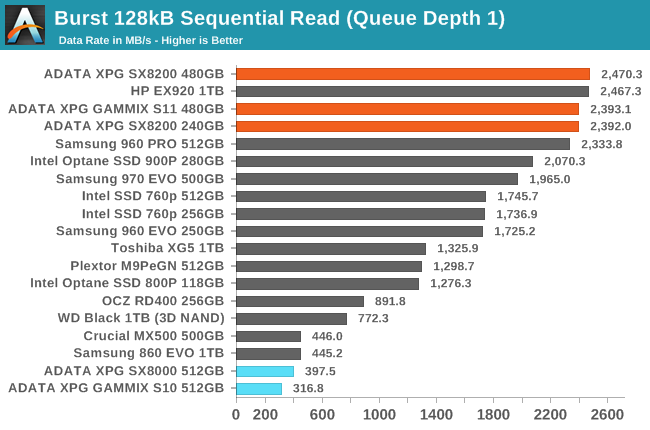
The burst sequential read performance of the ADATA XPG SX8200 and GAMMIX S11 is the exact opposite of how their predecessors behave. The newer drives provide the same fast performance we saw with the 1TB HP EX920, while the older drives are at the very bottom of the chart with only 15-20% the throughput of the SX8200.
Our test of sustained sequential reads uses queue depths from 1 to 32, with the performance and power scores computed as the average of QD1, QD2 and QD4. Each queue depth is tested for up to one minute or 32GB transferred, from a drive containing 64GB of data. This test is run twice: once with the drive prepared by sequentially writing the test data, and again after the random write test has mixed things up, causing fragmentation inside the SSD that isn't visible to the OS. These two scores represent the two extremes of how the drive would perform under real-world usage, where wear leveling and modifications to some existing data will create some internal fragmentation that degrades performance, but usually not to the extent shown here.
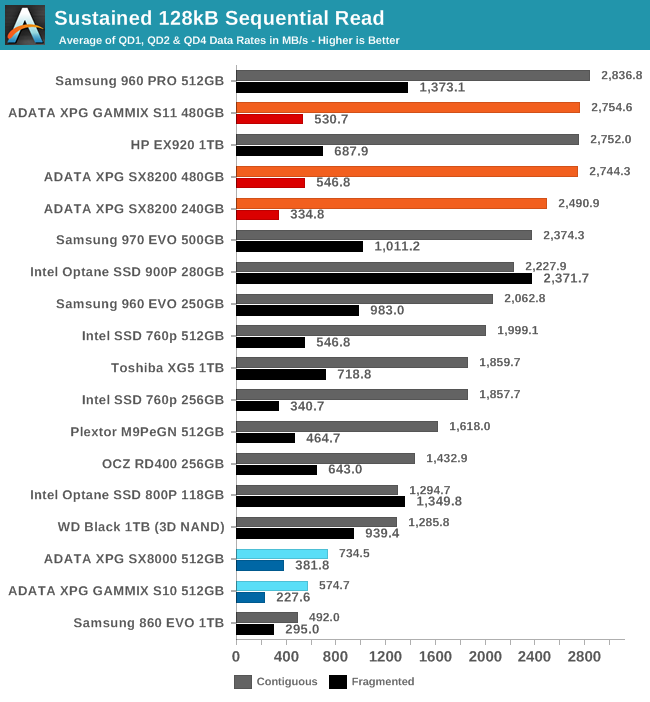
On the longer sequential read test, the SM2262 drives continue to dominate, but we find that they do not handle internal fragmentation as well as most other TLC drives. They lose proportionally more performance as a result of the fragmentation, but don't fall far behind the competition.
 |
|||||||||
| Power Efficiency in MB/s/W | Average Power in W | ||||||||
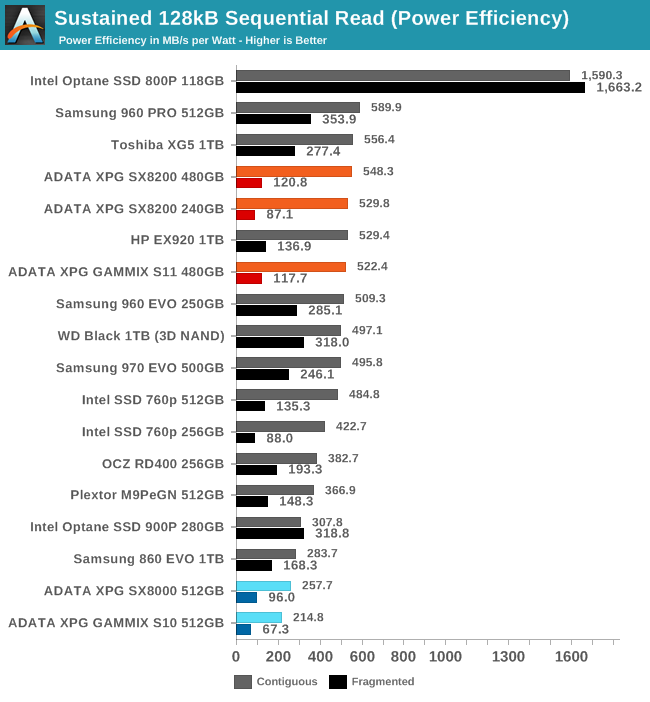
The power consumption of the SX8200 and GAMMIX S11 during the sustained sequential read test is a bit on the high side, but it's more than offset by the high performance, giving the drives some of the highest efficiency scores possible with flash memory.
 |
|||||||||
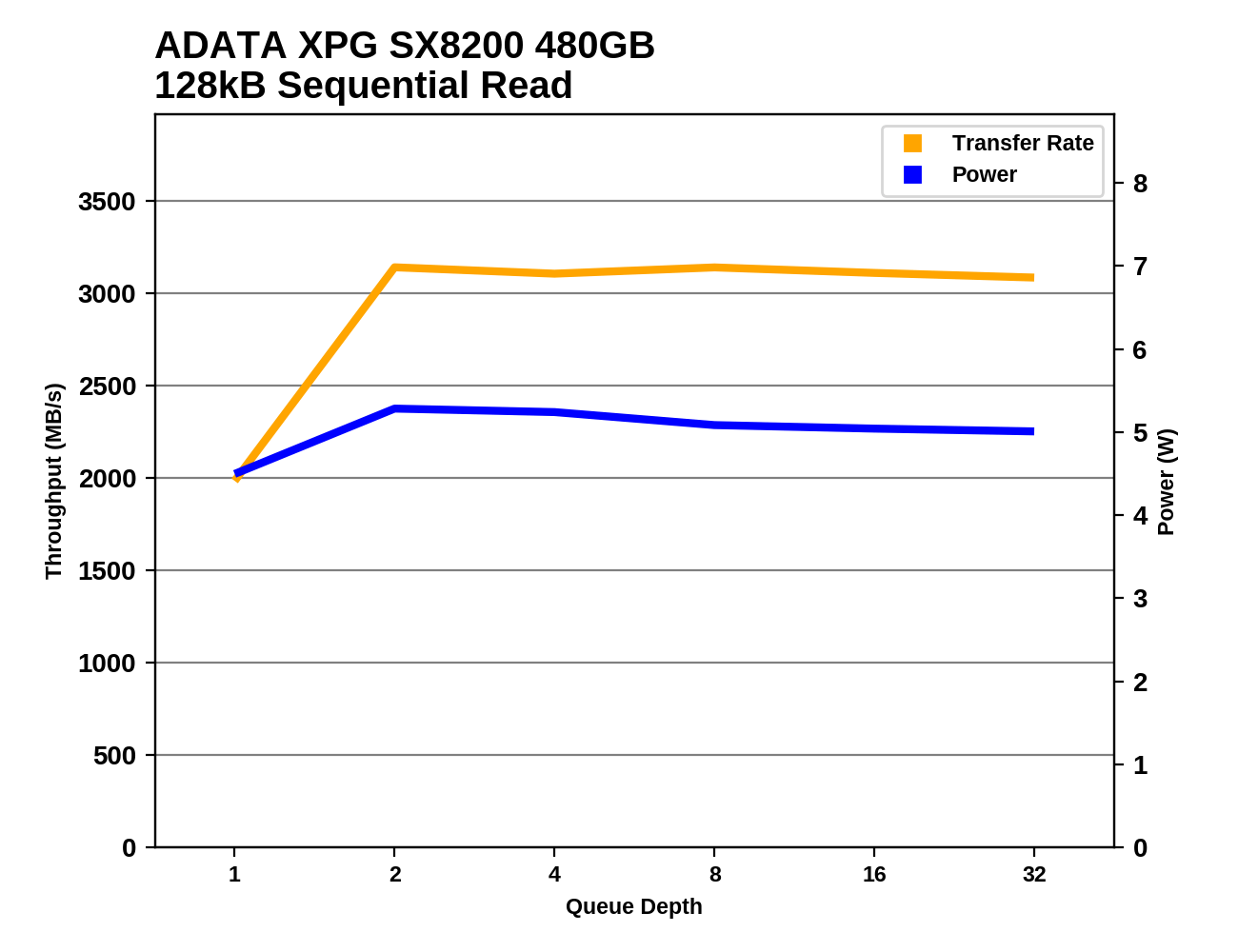
The SX8200 and GAMMIX S11 hit full sequential read speeds at QD2, and sustain them for the rest of the test. The 240GB model saturates at around 2.7-2.8GB/s while the 480GB drives match the 1TB HP EX920 in delivering about 3.2GB/s.
Sequential Write Performance
Our test of sequential write burst performance is structured identically to the sequential read burst performance test save for the direction of the data transfer. Each burst writes 128MB as 128kB operations issued at QD1, for a total of 1GB of data written to a drive containing 16GB of data.
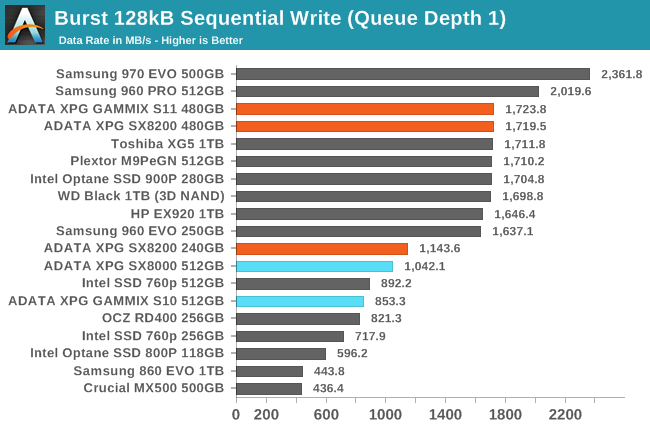
The burst sequential write speed of the 240GB ADATA XPG SX8200 is substantially lower than the excellent performance that the larger capacity manages, but both capacities are meeting their advertised performance specifications.
Our test of sustained sequential writes is structured identically to our sustained sequential read test, save for the direction of the data transfers. Queue depths range from 1 to 32 and each queue depth is tested for up to one minute or 32GB, followed by up to one minute of idle time for the drive to cool off and perform garbage collection. The test is confined to a 64GB span of the drive.
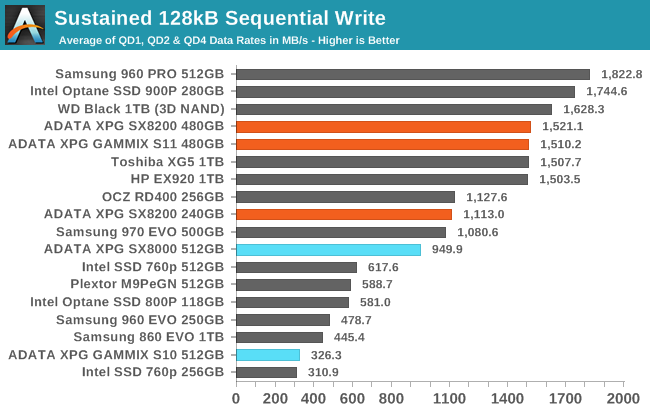
On the longer sequential write test, the 480GB SX8200 and GAMMIX S11 lose a bit of performance and drop slightly in the rankings, but the 240GB barely loses any performance. The drives are very competitive against other products from this generation, and put their predecessors to shame.
 |
|||||||||
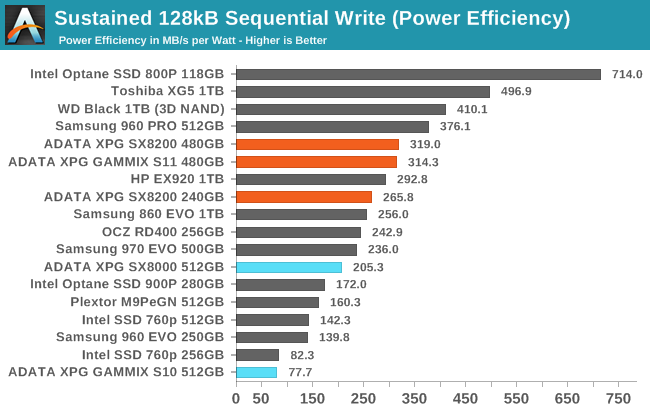
| Power Efficiency in MB/s/W | Average Power in W | ||||||||
The SX8200 doesn't set any power efficiency records, but it remains close to the top of the chart. Total power consumption is similar to other NVMe SSDs, so the efficiency scores are mostly proportional to performance.
 |
|||||||||
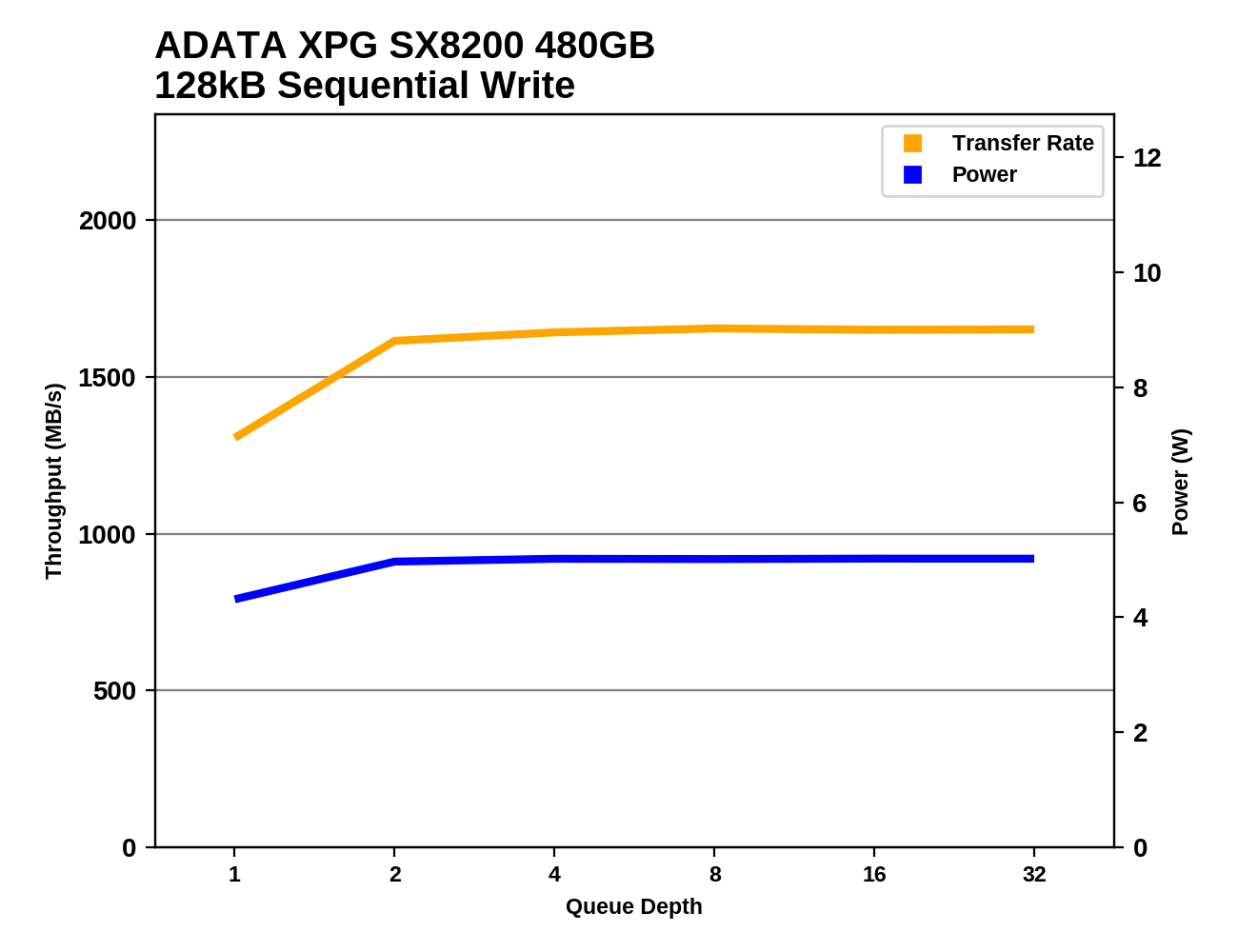
The SX8200 hits full sequential write speed at QD2, though for the 240GB model this is barely an increase over QD1 performance. Performance remains steady for the rest of the test, with no obvious signs of garbage collection stalling the SSD.
Originally published at https://www.anandtech.com/show/13112/the-adata-sx8200-gammix-s11-nvme-ssd-review (Wayback Machine).