
Previewing Maxiotek's MK8115 SSD Controller: Can DRAM-less Drives Make The Cut?
Sequential Read Performance
The sequential read test requests 128kB blocks and tests queue depths ranging from 1 to 32. The queue depth is doubled every three minutes, for a total test duration of 18 minutes. The test spans the entire drive, and the drive is filled before the test begins. The primary score we report is an average of performances at queue depths 1, 2 and 4, as client usage typically consists mostly of low queue depth operations.
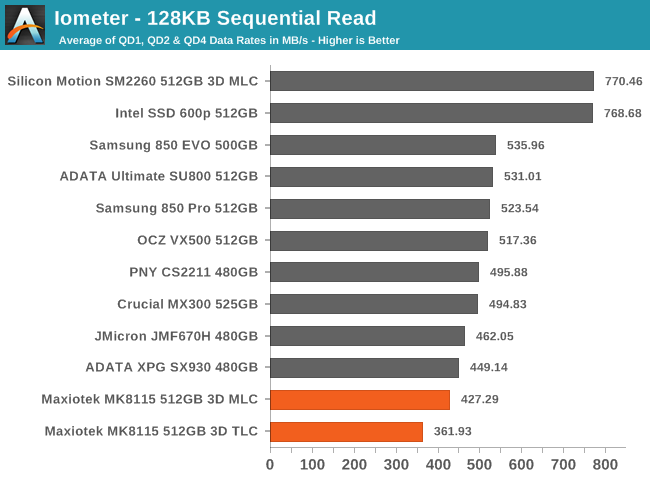
The two MK8115 drives land at the bottom of the performance rankings again for the sequential read test. They aren't really close to saturating the SATA 3 link at low queue depths, but both do at least offer significantly higher throughput than a SATA 2 link could provide, and the fact that the competition is limited by SATA 3 means the MK8115 drives fall behind by a smaller percentage than would otherwise be the case.
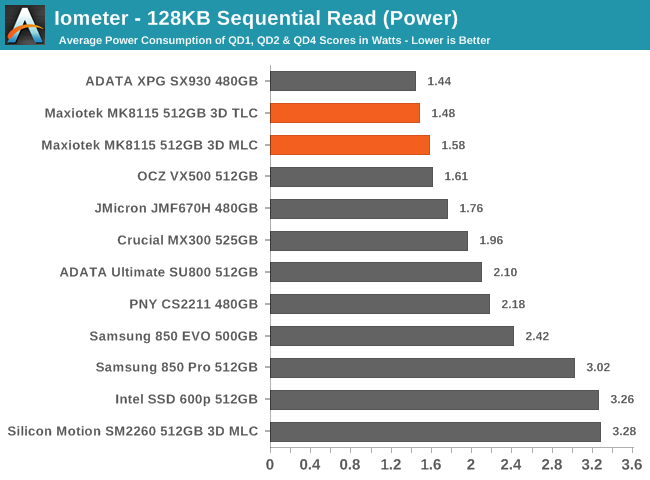
To go with their low performance the MK8115 drives offer almost the lowest power consumption, so the power efficiency is at least reasonable. The ADATA SX930 based on the JMicron JMF670H controller manages to deliver higher throughput with less power, so the lack of a DRAM cache seems to be hurting more than helping efficiency on this test.
 |
|||||||||
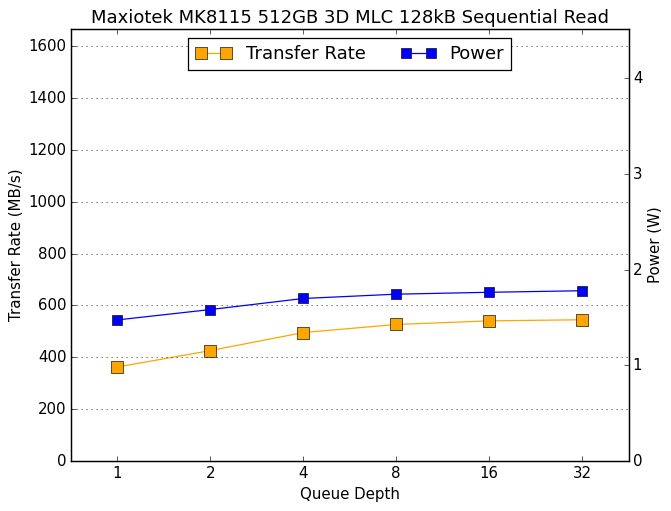
Like most SATA drives, the performance scaling as queue depth increases is mostly flat. There's slight performance growth all the up to QD16 while many SATA SSDs are able to offer their full sequential read throughput at QD2.
Sequential Write Performance
The sequential write test writes 128kB blocks and tests queue depths ranging from 1 to 32. The queue depth is doubled every three minutes, for a total test duration of 18 minutes. The test spans the entire drive, and the drive is filled before the test begins. The primary score we report is an average of performances at queue depths 1, 2 and 4, as client usage typically consists mostly of low queue depth operations.
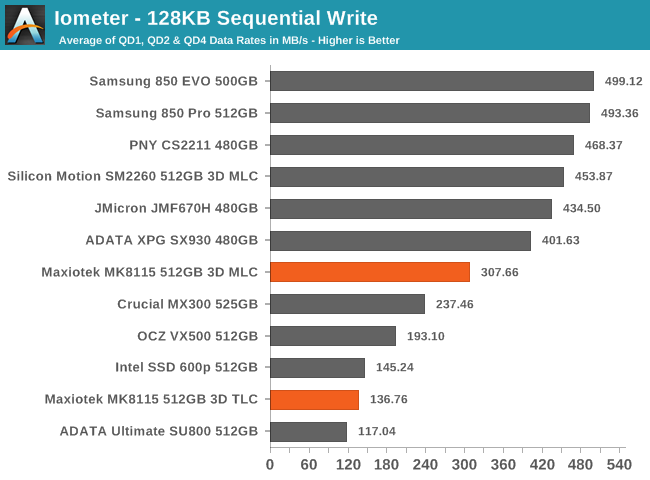
The sequential write test reveals one of the biggest gaps between the MLC and TLC based MK8115 drives. The TLC drive is almost the slowest drive on this test, but the MLC drive is more than twice as fast and outperforms most TLC SSDs while not quite matching typical MLC performance.
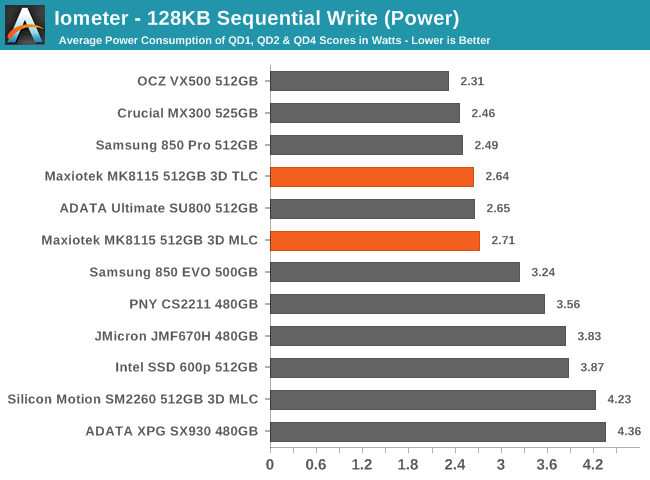
Both MK8115 drives had similar power consumption on the sequential read test, revealing the MLC drive to be far more efficient but still nothing great compared to the competition.
 |
|||||||||
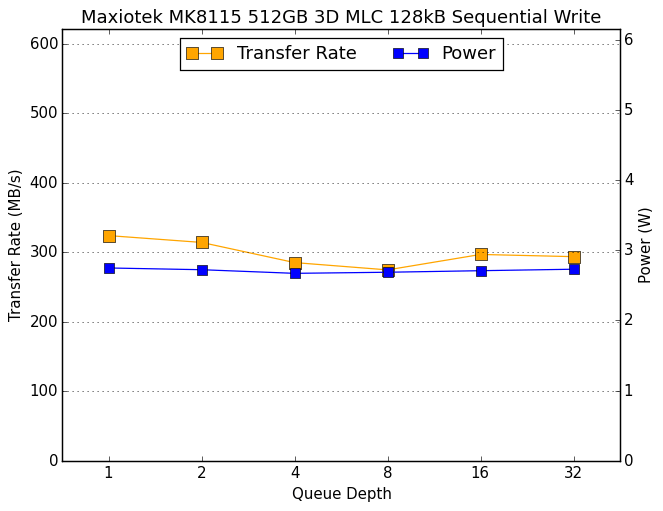
The MK8115 drive with MLC experiences a bit of trouble near the middle of the sequential write test, as write speeds drop slightly, but by the end of the test they've mostly recovered and power consumption has been constant across queue depths.
Originally published at https://www.anandtech.com/show/11339/previewing-maxiotek-mk8115-dramless-ssd-controller (Wayback Machine).