
Previewing Maxiotek's MK8115 SSD Controller: Can DRAM-less Drives Make The Cut?
Random Read Performance
The random read test requests 4kB blocks and tests queue depths ranging from 1 to 32. The queue depth is doubled every three minutes, for a total test duration of 18 minutes. The test spans the entire drive, which is filled before the test starts. The primary score we report is an average of performances at queue depths 1, 2 and 4, as client usage typically consists mostly of low queue depth operations.
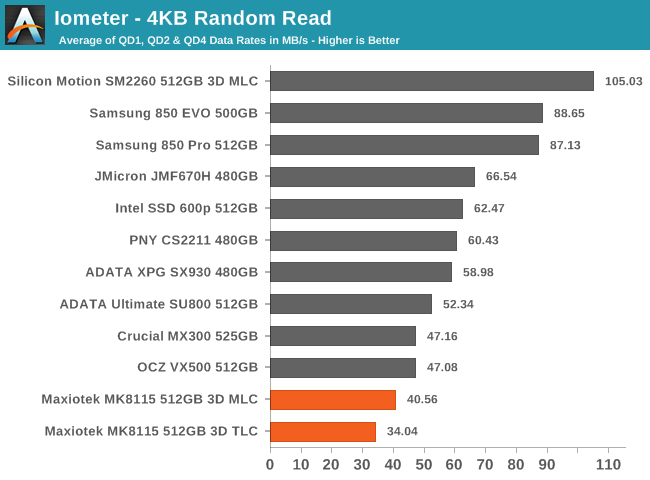
As can be expected, the DRAM-less MK8115 drives come in last in the random read speed test, with the MLC drive 13% slower than the OCZ VX500 and MX300 while the MK8115 TLC drive is closer to 28% slower. Samsung's 850 EVO and PRO are both more than twice as fast as the MK8115 drives.
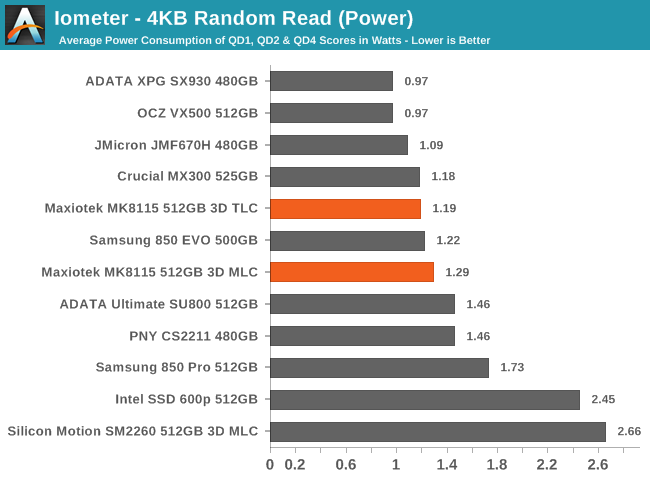
Power consumption during the random read test is reasonable for both MK8115 drives, but the low performance means neither is particularly efficient.
 |
|||||||||
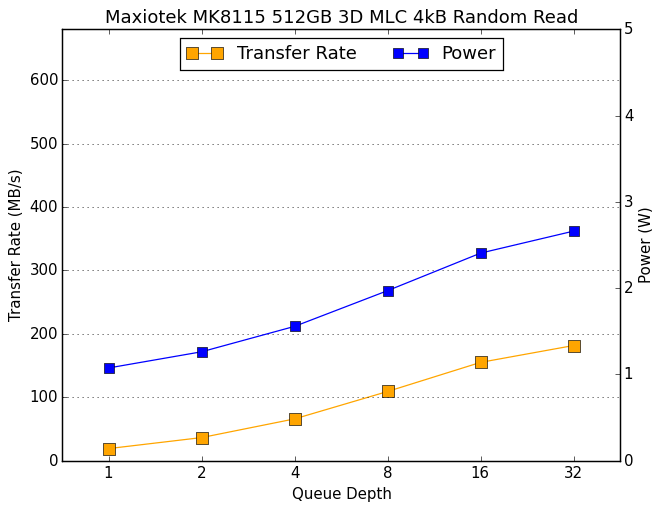
As queue depths increase both MK8115 samples show moderate increases in performance, tapering off slightly between QD16 and QD32. The MK8115 isn't drawing the most power among SATA SSDs at every single queue depth, but it's close.
Random Write Performance
The random write test writes 4kB blocks and tests queue depths ranging from 1 to 32. The queue depth is doubled every three minutes, for a total test duration of 18 minutes. The test is limited to a 16GB portion of the drive, and the drive is empty save for the 16GB test file. The primary score we report is an average of performances at queue depths 1, 2 and 4, as client usage typically consists mostly of low queue depth operations.
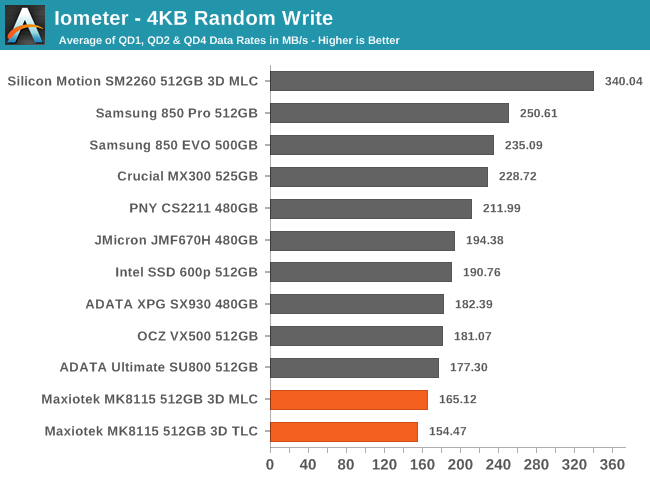
Random write speeds of the MK8115 samples are the slowest out of all the drives in this comparison, but the margin is much smaller than for random reads and nowhere near as large as the disparity in steady-state performance. The difference in performance between the MK8115 samples is smaller than it was for random reads.
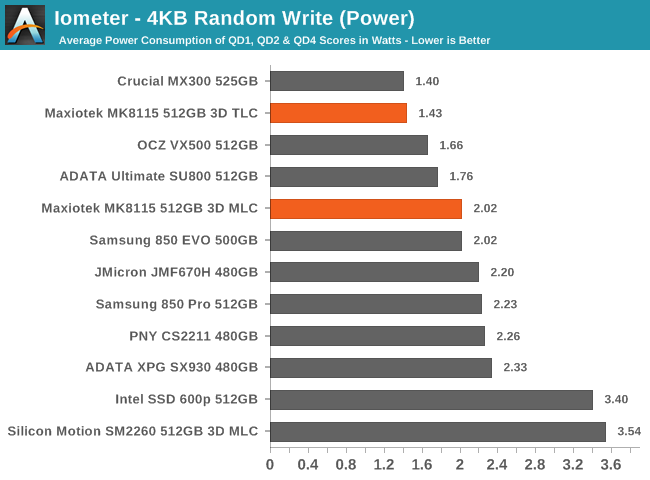
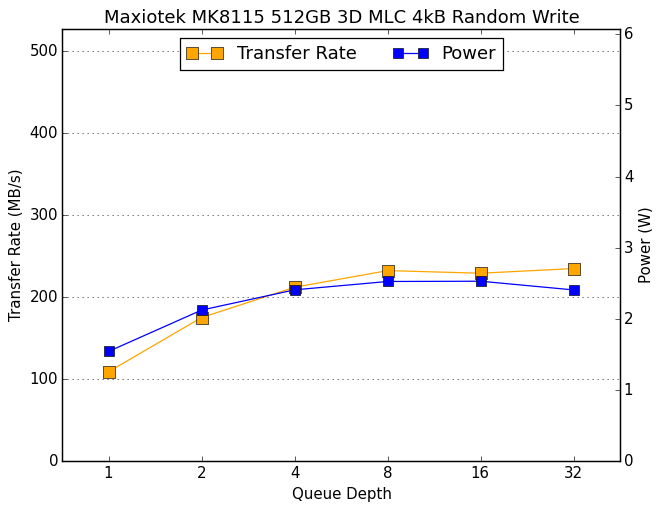
The MK8115 drive with MLC levels off after QD8. The TLC counterpart was on track to deliver slightly higher performance at significantly lower power consumption, until the TLC drive filled up and the background garbage collection killed performance and drove up power consumption.
 |
|||||||||
The two MK8115 samples behave rather differently during this random write test. The TLC drive starts out slower at QD1 but performance scales better as queue depth climbs. The TLC drive is also substantially more power efficient, with power consumption growing more slowly than throughput. However, by the end of the test the SLC cache has filled, causing performance to drop below the QD1 throughput and power jumps up to be on par with the MLC drive.
Originally published at https://www.anandtech.com/show/11339/previewing-maxiotek-mk8115-dramless-ssd-controller (Wayback Machine).