
Previewing Maxiotek's MK8115 SSD Controller: Can DRAM-less Drives Make The Cut?
Mixed Random Read/Write Performance
The mixed random I/O benchmark starts with a pure read test and gradually increases the proportion of writes, finishing with pure writes. The queue depth is 3 for the entire test and each subtest lasts for 3 minutes, for a total test duration of 18 minutes. As with the pure random write test, this test is restricted to a 16GB span of the drive, which is empty save for the 16GB test file.
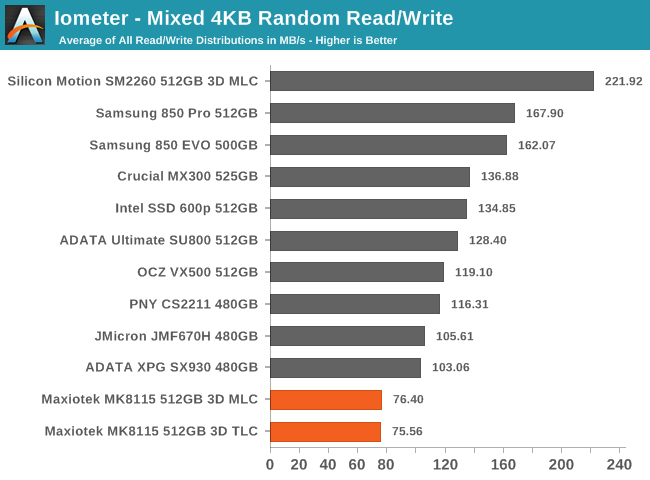
The MK8115 struggled with both random reads and random writes, so it's no surprise to see them turn in the lowest performance scores for the mixed random workload test. The MLC drive is only ahead of the TLC drive by a hair, and the next slowest drive is faster by a third.
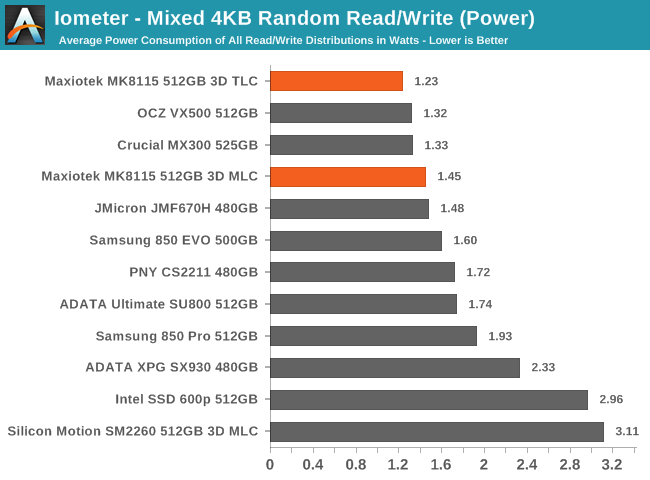
The MK8115 with TLC ends up using less power to deliver almost exactly the same performance, so the TLC drive scores a minor win for efficiency. They're both still beat by a wide range of mainstream SSDs.
 |
|||||||||
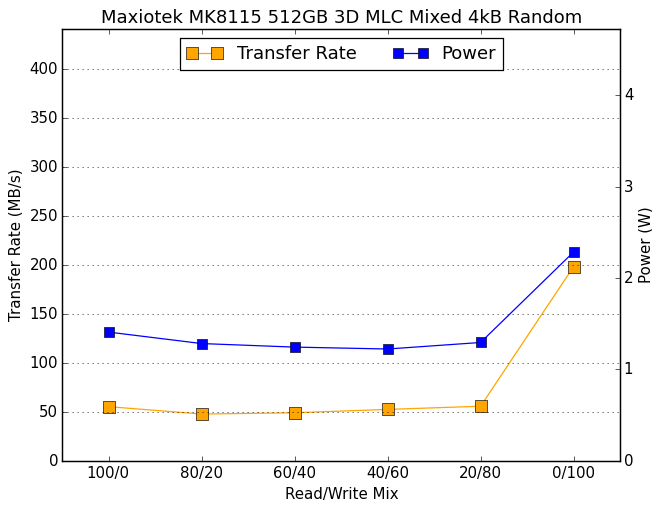
Both MK8115 drives show a normal spike in performance at the end of the test when the workload shifts to pure writes. During the rest of the test, performance is mostly constant instead of the more usual pattern of growing steadily with the proportion of writes in the workload. The TLC drive is substantially faster than the MLC drive in the initial all-reads phase of the test, but it is slightly slower through the middle of the test and that gives it the slower overall average.
Mixed Sequential Read/Write Performance
The mixed sequential access test covers the entire span of the drive and uses a queue depth of one. It starts with a pure read test and gradually increases the proportion of writes, finishing with pure writes. Each subtest lasts for 3 minutes, for a total test duration of 18 minutes. The drive is filled before the test starts.
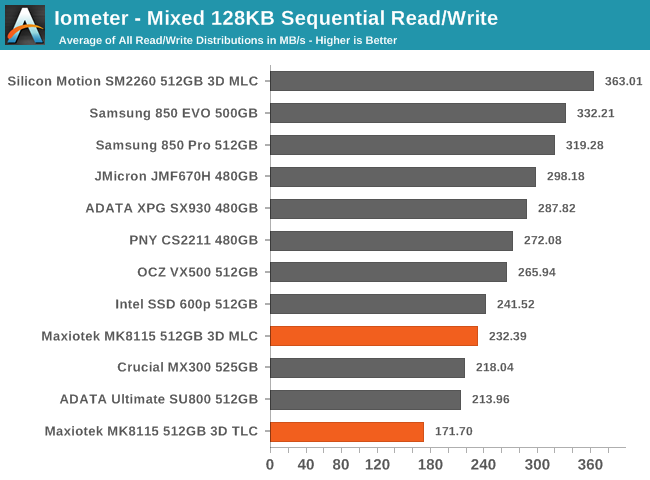
The MK8115 drive with MLC has much higher average performance on the mixed sequential workload test than its TLC counterpart, which is quite clearly the slowest drive. The MLC manages to outperform two TLC drives, but doesn't come close to matching the next slowest MLC drive on this test.
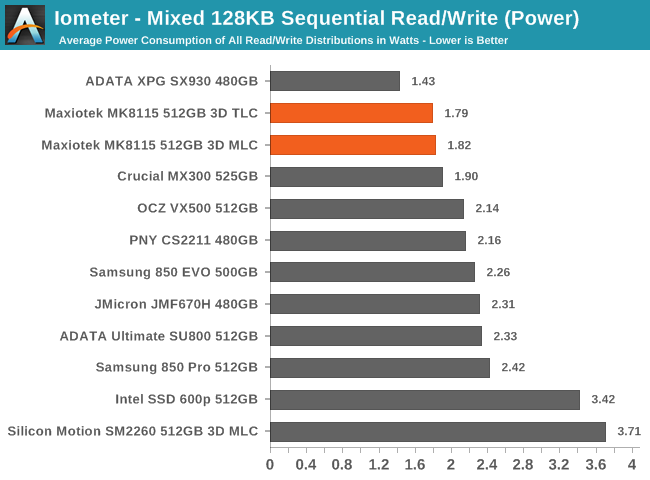
Both MK8115 drives draw about the same amount of power during the mixed sequential workload test. The MLC drive requires slightly more power but is substantially more efficient due to its higher performance, and it actually beats the Crucial MX300 for efficiency here.
 |
|||||||||
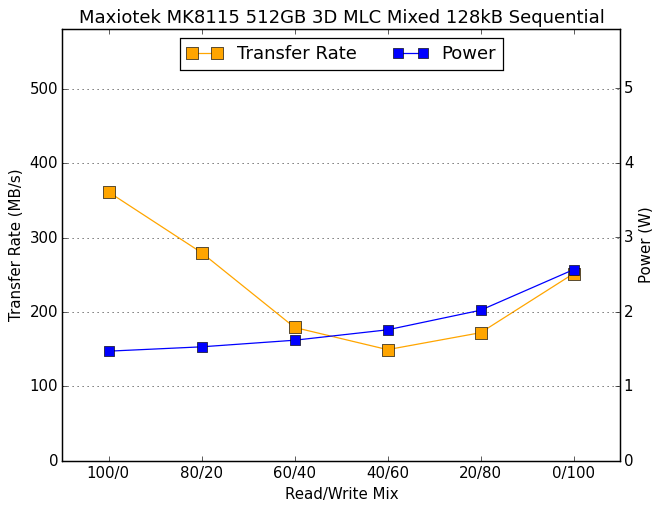
The MLC drive's performance curve across the mixed sequential test is the U shape that is normal for mainstream SSDs, though the minimum performance of around 150MB/s is a bit on the low side. The TLC drive by contrast slows down steadily as more writes are added, and doesn't recover any performance near the end of the test.
Originally published at https://www.anandtech.com/show/11339/previewing-maxiotek-mk8115-dramless-ssd-controller (Wayback Machine).