
Assessing IBM's POWER8, Part 2: Server Applications on OpenPOWER
Database Performance: MySQL 5.7.0
Thanks to the excellent repository of Percona, we were able to vastly improve our MySQL benchmarking with Sysbench. You cannot compare these results to the results published prior to the Cavium Thunder-X review: we made quite a few changes in the way we benchmark. We first upgraded the standard MySQL installation to the better performing Percona Server 5.7.
Secondly, we used Sysbench 0.5 (instead of 0.4) and we implemented the (lua) scripts that allow us to use multiple tables (8 in our case) instead of the default one. This makes the Sysbench benchmark much more realistic as running with one table creates a very artificial bottleneck.
For our testing we used the read-only OLTP benchmark, which is slightly less realistic, but still much more interesting than most other Sysbench tests. This allows us to measure CPU performance without creating an I/O bottleneck.
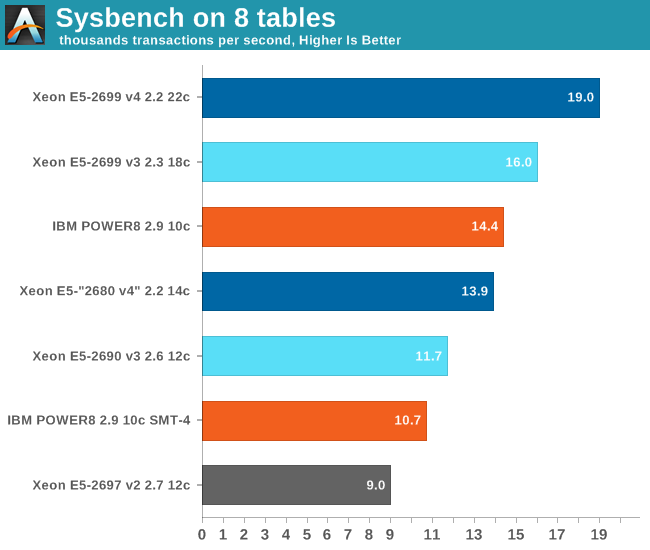
It is important to note that IBM has invested a lot of time in Postgres and MariaDB optimization. So our choice for MySQL is definitely not the most favorable. However, this is database we know best, and it will take some time before we fully master Postgres benchmarking. We already started with MariaDB testing, but the results were very similar. The reason is that we are probably missing some key optimizations.
Still, the IBM POWER8 does very well here, outperforming our simulated Xeon E5-2680 v4 by a small margin and thus keeping up with more expensive Xeons. Next we measure the 95th percentile response time, a response time which is statistically relevant for the users.
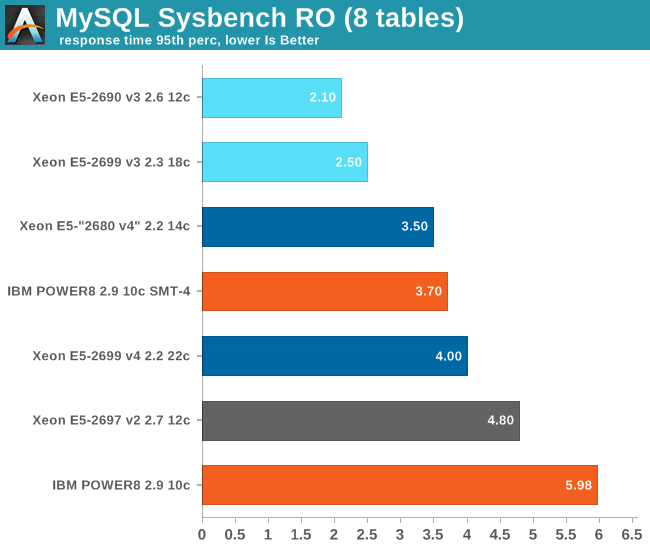
You do pay a price for the fact that 8 threads are running on one core. SMT-8 optimizes throughput at the cost of the response time of individual threads. Response times are quite a bit higher on the POWER8 than they are on the Intel Xeons.
Update: the response times are quite a bit better with SMT-4, but at the cost of a 26% lower throughput than SMT-8.
Only POWER specific optimization that makes better use of SMT-8 can remedy this.
Originally published at https://www.anandtech.com/show/10539/assessing-ibms-power8-part-2-server-applications (Wayback Machine).