
Assessing IBM's POWER8, Part 2: Server Applications on OpenPOWER
Spark Benchmarking
Spark is wonderful framework, but you need some decent input data and some good coding skills to really test it. Speeding up Big Data applications is the top priority project at the lab I work for (Sizing Servers Lab of the University College of West-Flanders), so I was able to turn to the coding skills of Wannes De Smet to produce a benchmark that uses many of the Spark features and is based upon real world usage.

The test is described in the graph above. We first start with 300 GB of compressed data gathered from the CommonCrawl. These compressed files are a large amount of web archives. We decompress the data on the fly to avoid a long wait that is mostly storage related. We then extract the meaningful text data out of the archives by using the Java library "BoilerPipe". Using the Stanford CoreNLP Natural Language Processing Toolkit, we extract entities ("words that mean something") out of the text, and then count which URLs have the highest occurrence of these entities. The Alternating Least Square algorithm is then used to recommend which URLs are the most interesting for a certain subject.
We tested with Apache Spark 1.5 in standalone mode (non-clustered) as it took us a long time to make sure that the results were repetitive. For now, we keep version 1.5 to be able to compare with earlier results.
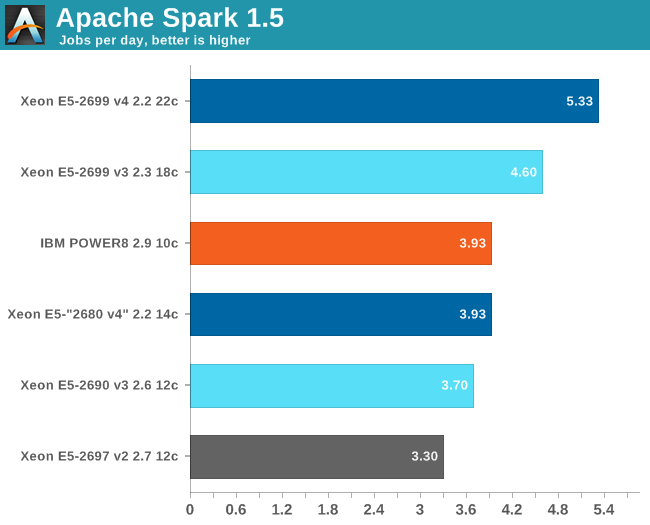
The POWER8 surprises here with excellent performance: it is able to keep with a 14 core Xeon E5 "Broadwell EP" and beats the midrange Xeon E5-2690 v3 by healthy margin. Remember, this is a midrange POWER8: there are SKUs that reach 3.4-3.8 GHz.
Originally published at https://www.anandtech.com/show/10539/assessing-ibms-power8-part-2-server-applications (Wayback Machine).