
Assessing IBM's POWER8, Part 2: Server Applications on OpenPOWER
Java Performance
The SPECjbb 2015 benchmark has "a usage model based on a world-wide supermarket company with an IT infrastructure that handles a mix of point-of-sale requests, online purchases, and data-mining operations." It uses the latest Java 7 features and makes use of XML, compressed communication, and messaging with security.
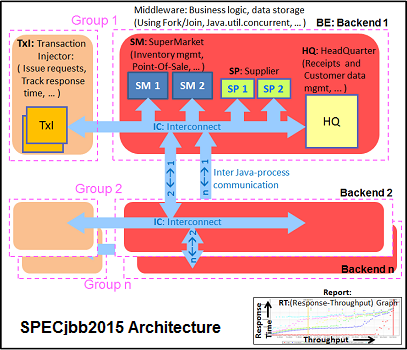
We tested with four groups of transaction injectors and backends. The reason why we use the "Multi JVM" test is that it is more realistic: multiple VMs on a server is a very common practice.
The Java version was OpenJDK 1.8.0_91. We applied relatively basic tuning to mimic real-world use, while aiming to fit everything inside a server with 128 GB of RAM:
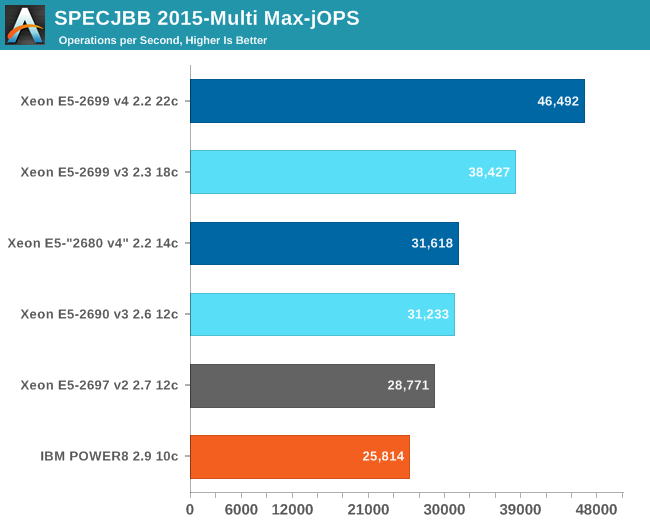
The graph below shows the maximum throughput numbers for our MultiJVM SPECJbb test.
The Critical-jOPS metric is a throughput metric under response time constraint.
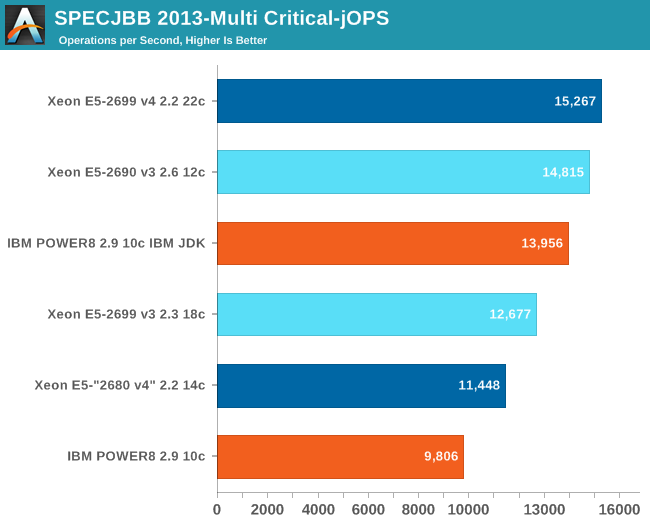
After checking the other benchmarks and IBM's published benchmarks at spec.org we suspected that there was something suboptimal for the POWER8 server. A Java expert at IBM responded:
Currently OpenJDK 8 performance on power lags behind the IBM JDK for this benchmark, and is not reflective of the hardware. The gap is being closed by driving changes into OpenJDK 9 that will be back ported to OpenJDK 8.
So this is one of those cases where the "standard" open source ecosystem is not optimal. So we tried out IBM's 64 bit SDK version LE 8.0-3.11. Out of the box, throughput got even worse. Only when we used more complicated tuning and more memory...
...did performance get better. We also had to use static huge pages (16 MB each) instead of transparent huge pages. We gave the Intel Xeons also 32 GB per VM and eight 32 GB DIMMs, but we did not use the IBM JDK as it caused a performance decrease.
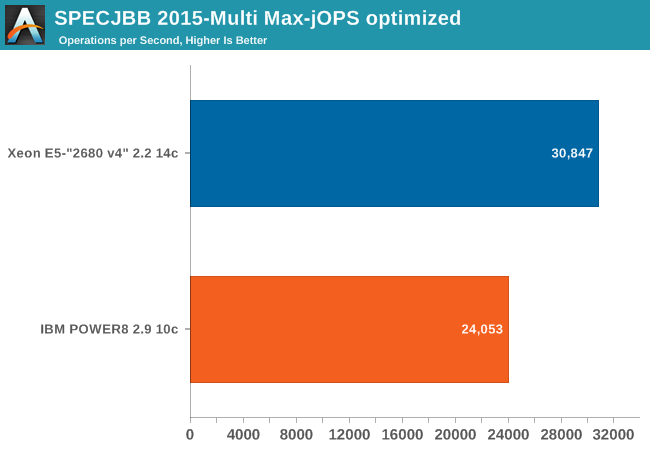
Both the Xeon and the IBM POWER8 max throughput got worse. In the case of Intel we can easily explain this: its 32 GB of DDR4-2133 memory offers less bandwidth and higher latency. In case of IBM, we can only say we lack knowledge of the IBM JDK.
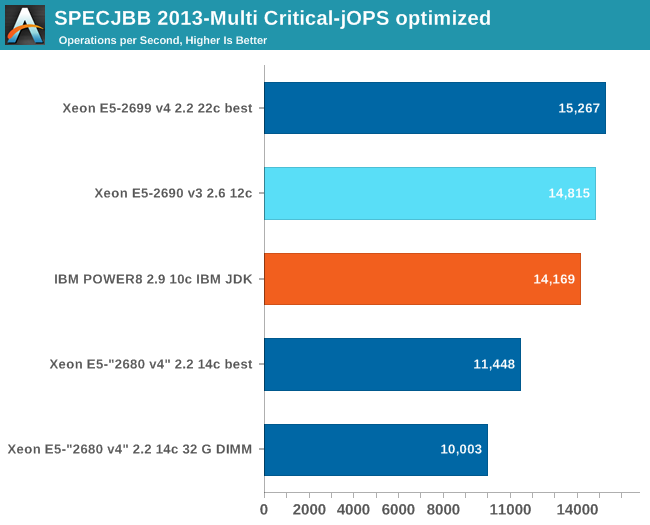
Again, the Xeon E5-2680 v4 loses performance due to the fact that we had to use more but slower memory.
This is not an apples to apples comparison as we would like it, but it gives a good indication that the IBM POWER8 might actually able to beat even more expensive Xeon E5s than our (simulated) Xeon E5-2680v4 with optimized software. A Xeon E5-2690 v4 ($2090) would be beaten by a decent margin and even the 2695v4 ($2400) might be in reach.
Originally published at https://www.anandtech.com/show/10539/assessing-ibms-power8-part-2-server-applications (Wayback Machine).