
Asustor AS6204T Braswell NAS Review
Miscellaneous Aspects and Final Words
In order to keep testing consistent across all 4-bay units, we performed all our expansion / rebuild testing as well as power consumption evaluation with the unit configured in RAID-5. The disks used for benchmarking (Western Digital WD4000FYYZ) were also used in this section. The table below presents the average power consumption of the unit as well as time taken for various RAID-related activities. In the general state with the hard disk powered on, but not actively reading or writing data, the power consumption was around 47 W, though it dropped to around 14 W with the disks in sleep mode.
| Asustor AS6204T RAID Expansion and Rebuild / Power Consumption | ||
| Activity | Duration (HH:MM:SS) | Avg. Power (W) |
| Single Disk Init | - | 19.94 W |
| JBOD to RAID-1 Migration | 08:08:00 | 31.27 W |
| RAID-1 (2D) to RAID-5 (3D) Migration | 17:31:00 | 43.65 W |
| RAID-5 (3D) to RAID-5 (4D) Expansion | 18:50:00 | 54.53 W |
| RAID-5 (4D) Rebuild | 08:23:00 | 55.25 W |
The graphs below show the power consumption and rebuild duration when repairing a RAID-5 volume for the various 4-bay NAS units that have been evaluated before.
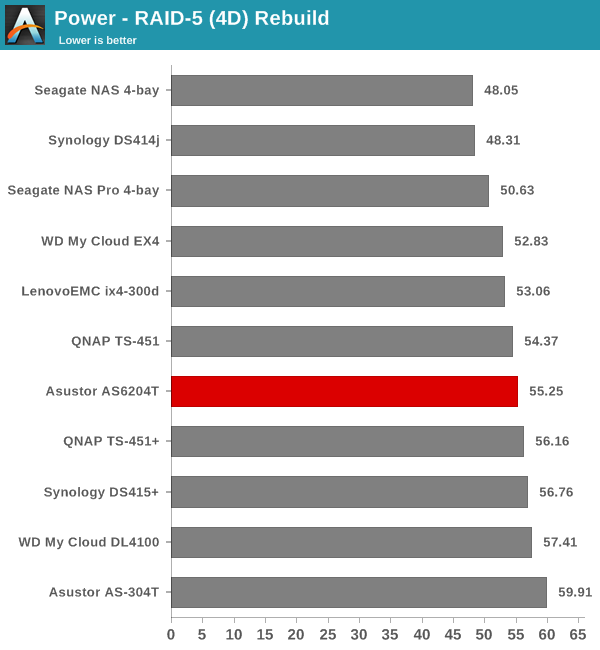
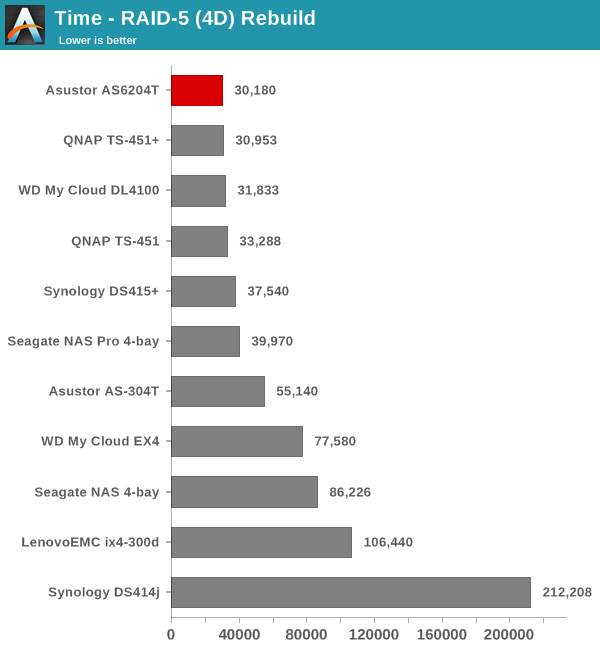
The Asustor AS6204T is not the most power-efficient NAS around. The ARM-based 4-bay NAS units perform better in that respect. However, Asustor continues to have the shortest rebuild duration for a RAID-5 volume among all the 4-bay NAS units that we have tested before.
Concluding Remarks
Asustor became the first vendor to bring a Braswell-based NAS to the market with the AS6xxx series. The capabilities of the unit make it ideal for power users, SOHOs and SMBs. Since the AS6204T is based on the latest Braswell platform and uses the quad-core Celeron N3150, there is a slight pricing premium over the other 4-bay NAS units based on Intel platforms. With a street price of $670, it is approximately in the same ballpark as the recently reviewed QNAP TS-451+.
Asustor's ADM OS (v2.5 was used in our review) has been receiving numerous fixes and feature additions over the last year. One of the things that I like about Asustor is their prompt attention to feedback and bug reports, as well as speedy resolution of reported issues. Asustor knows that they have a lot of catching up to do in terms of OS features and performance. However, it is good from a consumer viewpoint that they are taking all efforts to bridge that gap as soon as possible.
Coming to the performance aspects, we find that CIFS read performance is very good, while write performance could definitely do with some improvements. NFS support, on the other hand, leaves a lot to be desired (both in terms of performance as well as supported features such as server side locks). The good aspect is that a beta release with a few fixes is already in our hands. The fixes will be migrating to a stable release shortly.

The AS6204T also comes with a HDMI 1.4b port and bundled media playing apps. The NAS can also be used as a media player for 4K videos with support for multi-channel audio over SPDIF as well as HDMI. The presence of AES-NI enables powerful encryption capabilities at a reasonable price point. The unit ships with 4GB of RAM, but users can upgrade easily to 8GB (the unit has two SO-DIMM slots). This could be important if a lot of apps end up running on the NAS simultaneously. Unlike competitors who provide a 2-year warranty for this class of products, Asustor advertises a 3-year warranty for the AS6204T.
Coming to the business end of the review, Asustor's top-end Braswell NAS is power efficient, extensible and performs in an acceptable manner. There is obviously scope for improvement on the software side - both in terms of performance as well as feature set. However, having observed the evolution of ADM over the last couple of years and the commitment shown by Asustor, I can say that they are on the right track.
Originally published at https://www.anandtech.com/show/9753/asustor-as6204t-braswell-nas-review (Wayback Machine).