
Samsung SM951-NVMe (256GB) PCIe SSD Review
Random Read Performance
For full details of how we conduct our Iometer tests, please refer to this article.
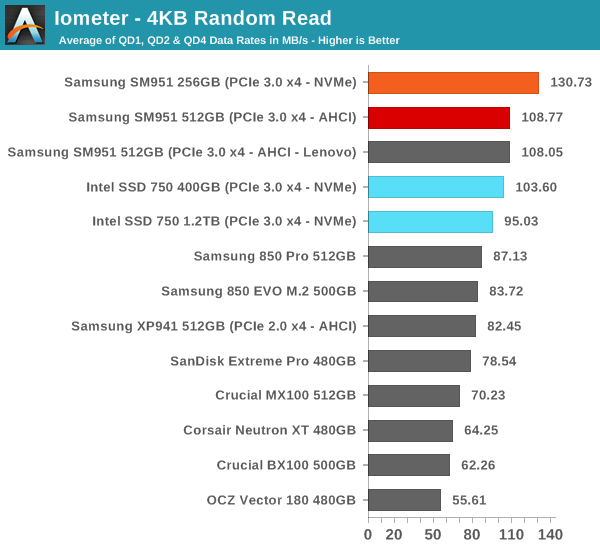
This is the graph I've been dying to see ever since I first heard about NVMe. Random read performance at low queue depths was mostly bottlenecked by AHCI latency because at QD1 the controller can only read from one NAND die (it's asked to read one 4KB chunk of data at a time), meaning that a tremendous share of the latency was caused by the command overhead. As the NVMe command set is much simpler and the whole IO stack is lighter, it opens the doors for improved low queue depth performance, which is exactly what we are seeing with the SM951 NVMe.
 |
|||||||||
| Default | |||||||||
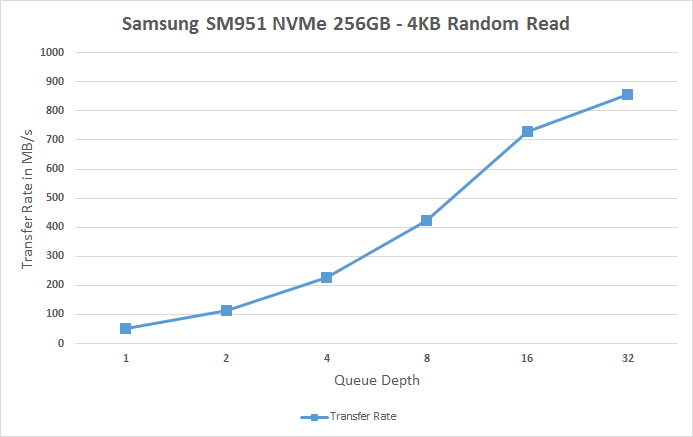
At QD1 the SM951 NVMe offers about 50MB/s, whereas the best AHCI drives I've seen hover around 30-35MB/s, resulting in about 50% gains. Performance at QD2 and QD4 is also better than what other drives offer and in general the SM951 NVMe has excellent random read performance including the high QDs as well.
Random Write Performance
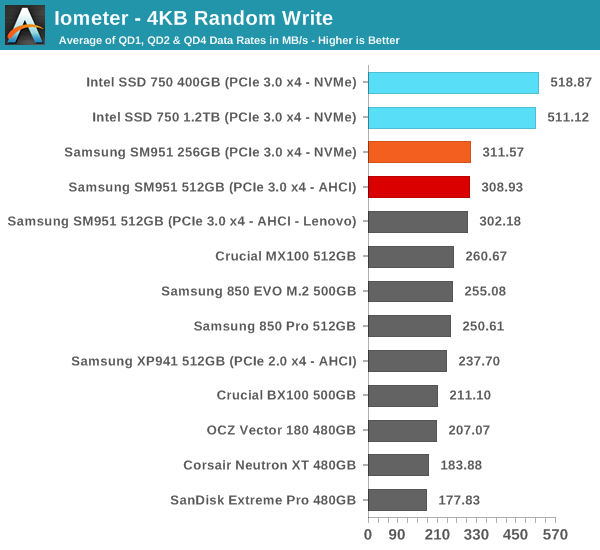
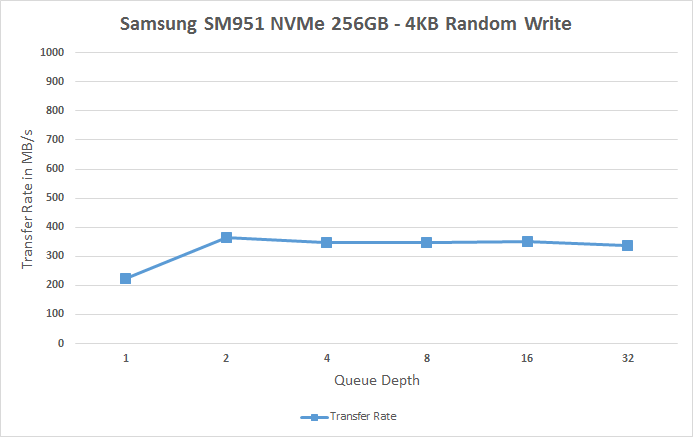
NVMe doesn't present similar gains to random write performance, though. This is an area where Intel clearly has an advantage, but given that the SSD 750 carries an 18-channel controller that is hardly a surprise. Moreover, because the SSD 750 features full power loss protection Intel can cache more user data in the DRAM buffer without the risk of data loss, which can further improve random write performance as IOs can be combined more efficiently. Intel's custom driver may also help with random write performance because the native Microsoft driver has some write performance issues due to Force Unit Access (basically FUA won't consider write to be complete until it has been written to its final medium i.e. NAND, whereas Intel's driver can consider write to be complete when it reaches the DRAM buffer).
 |
|||||||||
| Default | |||||||||
Originally published at https://www.anandtech.com/show/9396/samsung-sm951-nvme-256gb-pcie-ssd-review (Wayback Machine).