
GIGABYTE BRIX GB-BXi7-4500 Review: Intel Core i7 in a UCFF PC
Networking & Storage Performance
We have recently started devoting a separate section to analyze the storage and networking credentials of the units under review. On the storage side, one option would be repetition of our strenuous SSD review tests on the drive(s) in the PC. Fortunately, to avoid that overkill, PCMark 8 has a storage bench where certain common workloads such as loading games and document processing are replayed on the target drive. Results are presented in two forms, one being a benchmark number and the other, a bandwidth figure. We ran the PCMark 8 storage bench on selected PCs and the results are presented below.
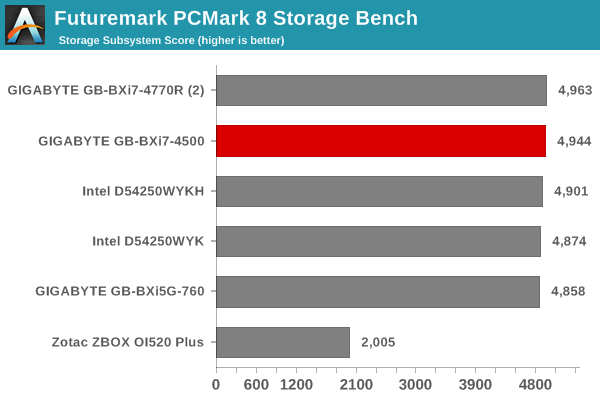
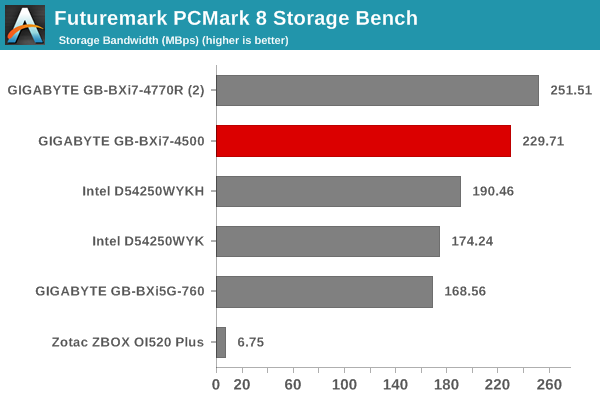
The Plextor PX-128M6M turns out to be the best-performing mSATA SSD that we have evaluated for UCFF systems. Even though the storage sub-system scores are quite close to each other for all the SSD-equipped machines, the storage bandwidth numbers show a clear lead for the PX-128M6M over the other mSATA SSDs. In terms of both parameters, only the Samsung SSD 840 EVO (2.5" version) scores a lead over the PX-128M6M. However, the current performance issues with reading of old data from the Samsung EVO drives may make users hesitate in purchasing a mSATA version of the same. In any case, the Plextor PX-128M6M currently retails for around $90 compared to the $105 for the Samsung 840 EVO 120 GB mSATA drive.
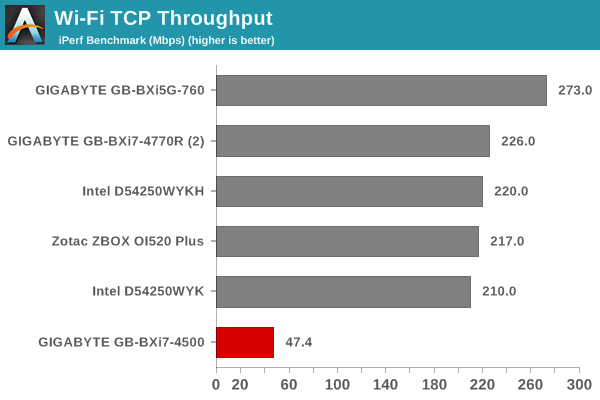
On the networking side, we restricted ourselves to the evaluation of the WLAN component. Our standard test router is the Netgear R7000 Nighthawk configured with both 2.4 GHz and 5 GHz networks. The router is placed approximately 20 ft. away, separated by a drywall (as in a typical US building). A wired client (Zotac ID89-Plus) is connected to the R7000 and serves as one endpoint for iPerf evaluation. The PC under test is made to connect to either the 5 GHz (preferred) or 2.4 GHz SSID and iPerf tests are conducted for both TCP and UDP transfers. It is ensured that the PC under test is the only wireless client for the Netgear R7000. We evaluate total throughput for up to 32 simultaneous TCP connections using iPerf and present the highest number in the graph below.
In the UDP case, we try to transfer data at the highest rate possible for which we get less than 1% packet loss.
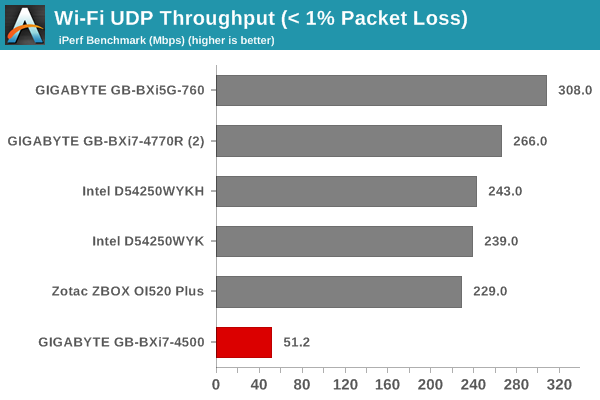
In both tests, we are let down by the presence of a 1x1 802.11n mPCIe card. It connects only to the 2.4 GHz band and simply can't stand up to the other competitors which are 802.11ac-capable units. The GB-BXi7-4500U is still being sold with the Realtek RTL8723AE mPCIe card. Hopefully, future revisions will move to the RTL8821AE (1x1 802.11ac) that is being used in the BRIX Pro and BRIX Gaming units.
Originally published at https://www.anandtech.com/show/8594/gigabyte-brix-gbbxi74500-review-intel-core-i7-in-a-ucff-pc (Wayback Machine).