
AMD Radeon R9 285 Review: Feat. Sapphire R9 285 Dual-X OC
Metro: Last Light
As always, kicking off our look at performance is 4A Games’ latest entry in their Metro series of subterranean shooters, Metro: Last Light. The original Metro: 2033 was a graphically punishing game for its time and Metro: Last Light is in its own right too. On the other hand it scales well with resolution and quality settings, so it’s still playable on lower end hardware.
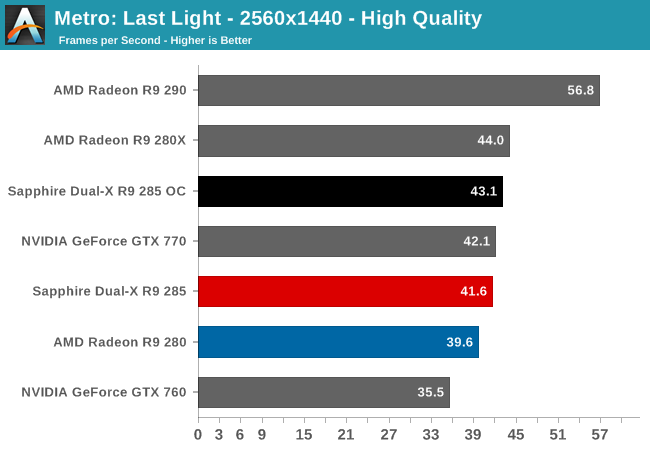
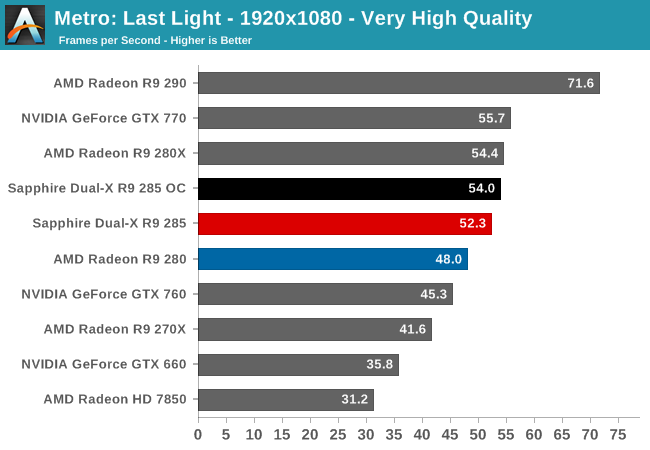
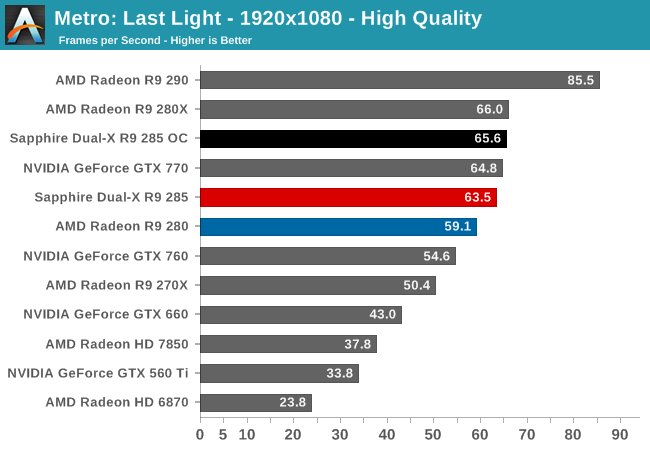
Metro, though perhaps a bit optimistic, does a decent job of setting the tone for this review. Right off the bat we can see that the R9 285 and R9 280 are performing closely to each other, with the newer R9 285 leading by 5-9%. On the whole this is greater than the average, but it’s otherwise a solid example of where the R9 285 fits into AMD’s world. In terms of design it is a lateral, but the same is also true from the resulting performance. It is not meant to – nor generally will it – perform differently from the R9 280 it replaces. R9 285 is in a nutshell an R9 280 with more features.
What this also means though is that AMD generally has the $250 price segment to themselves. In the case of Metro they have little trouble outperforming the GTX 760, and at times come close to the more expensive GTX 770. This is why Metro is a bit optimistic, since on the whole R9 285 isn’t quite enough to catch up to GTX 770.
Originally published at https://www.anandtech.com/show/8460/amd-radeon-r9-285-review (Wayback Machine).