
AMD Radeon R9 285 Review: Feat. Sapphire R9 285 Dual-X OC
Thief
Our newest addition to our benchmark suite is Eidos Monreal’s stealth action game, Thief. Set amidst a Victorian-era fantasy environment, Thief is an Unreal Engine 3 based title which makes use of a number of supplementary Direct3D 11 effects, including tessellation and advanced lighting. Adding further quality to the game on its highest settings is support for SSAA, which can eliminate most forms of aliasing while bringing even the most powerful video cards to their knees.
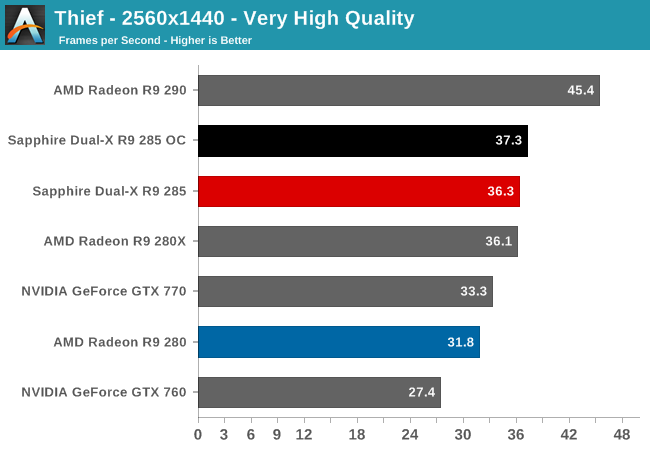
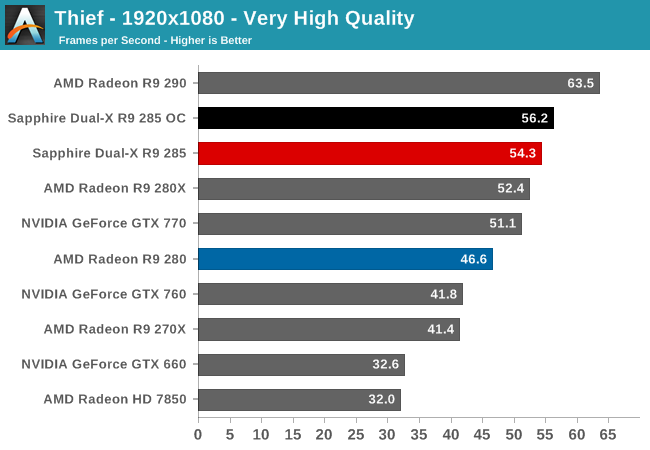
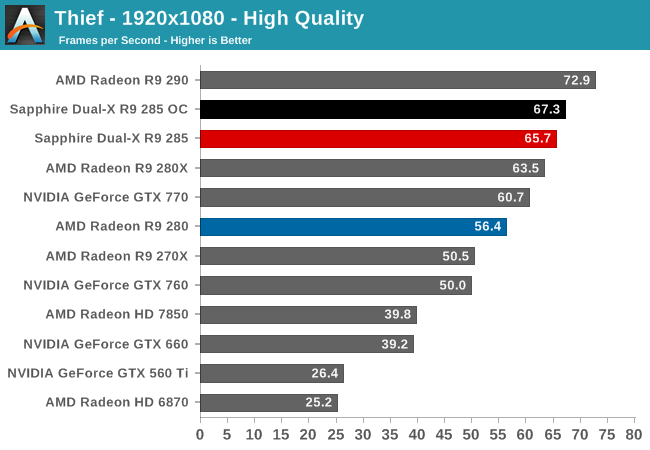
With Mantle’s current performance regressions on R9 285, Thief is best played using the Direct3D renderer. In this case we have another situation where the R9 285 is doing unexpectedly well against the R9 280 and even R9 280X, edging out the latter in all three benchmarks. Thief does make use of SSAA at High and Very High qualities, so we may be seeing another case of color compression working its magic since the oversampling should improve image compressibility. Meanwhile for Sapphire’s factory overclock, the extra bandwidth savings offers some additional legroom to pull ahead of the stock card. This gives Sapphire’s overclock a roughly 4% performance advantage.
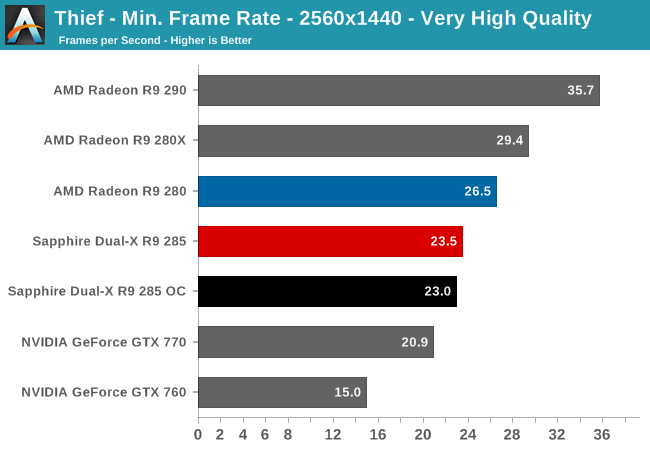
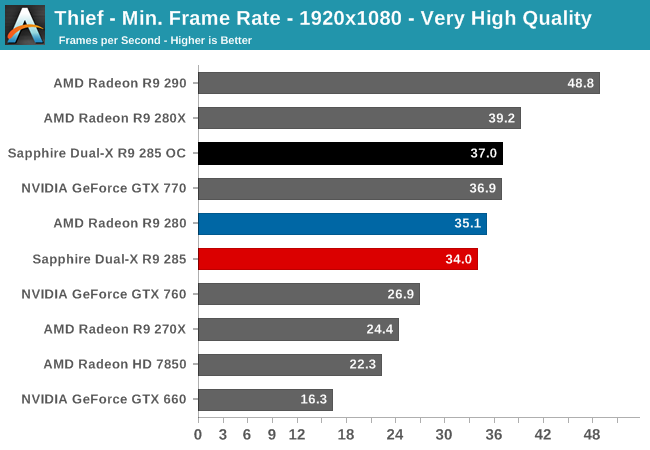
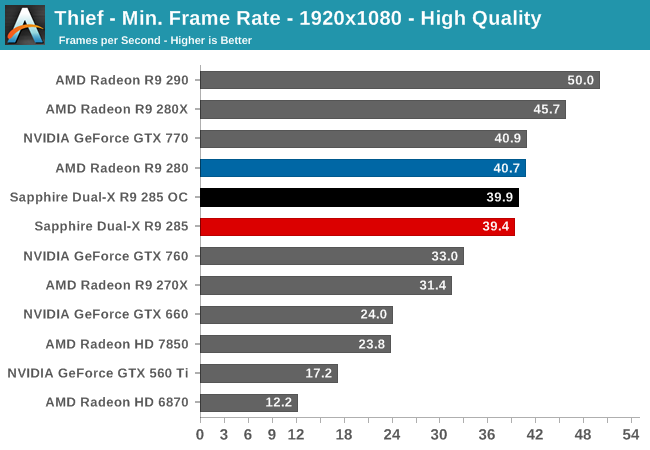
However looking at minimum framerates, Thief is also another good example to question whether 2GB is really enough VRAM. Strong average framerates give way to inferior minimums, especially at 2560. This is one of the reasons we believe that the R9 285 is not a good match for 2560 in the long term.
Originally published at https://www.anandtech.com/show/8460/amd-radeon-r9-285-review (Wayback Machine).