
VisionX 420D Review: ASRock's mini-PC Lineup Continues to Impress
VisionX 420D as a HTPC
The VisionX 420D has a much better acoustic profile compared to the BRIX Pro and even the ZBOX EI750 (thanks to the larger chassis, which, in turn, allows for a better thermal solution). Subjectively speaking, I found it to be ideal for a gaming HTPC, but is is definitely no substitute for the Haswell Core i5 NUC or a passive HTPC. The Radeon R9 270MX should be capable enough for madVR, but does it choke when we try to bring complicated scaling algorithms into play? We aim to find that out in this section. Prior to tackling that, we have two HTPC aspects to explore.
Refresh Rate Accuracy
AMD and NVIDIA have historically been able to provide fine-grained control over display refresh rates. The default rates are also quite accurate. The R9 270MX in the VisionX 420D is no exception.

The gallery below presents some of the other refresh rates that we tested out. The first statistic in madVR's OSD indicates the display refresh rate.


Network Streaming Efficiency
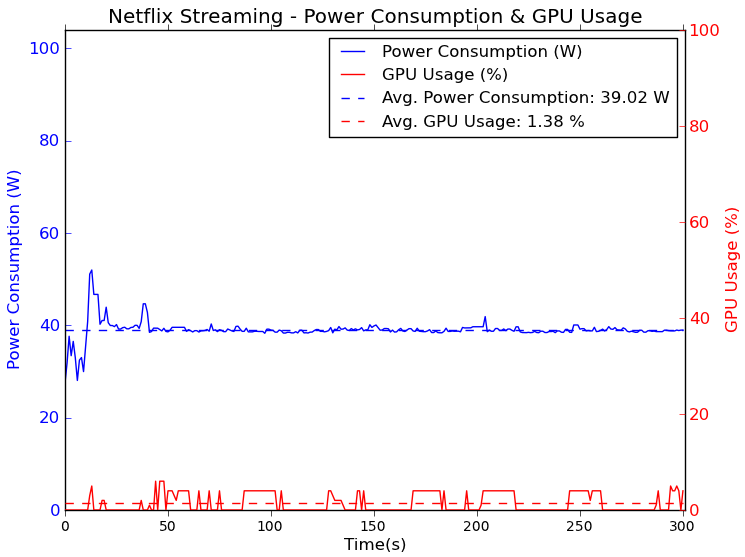
Evaluation of OTT playback efficiency was done by playing back our standard YouTube test stream and five minutes from our standard Netflix test title. Using HTML5, the YouTube stream plays back a 720p encoding, while Adobe Flash delivers a 1080p stream. The power consumption at the wall as well as the GPU usage while playing them on Mozilla Firefox are provided in the graphs below. Note that the utilization statistics don't directly correspond to similar numbers delivered by the Intel and NVIDIA GPUs.
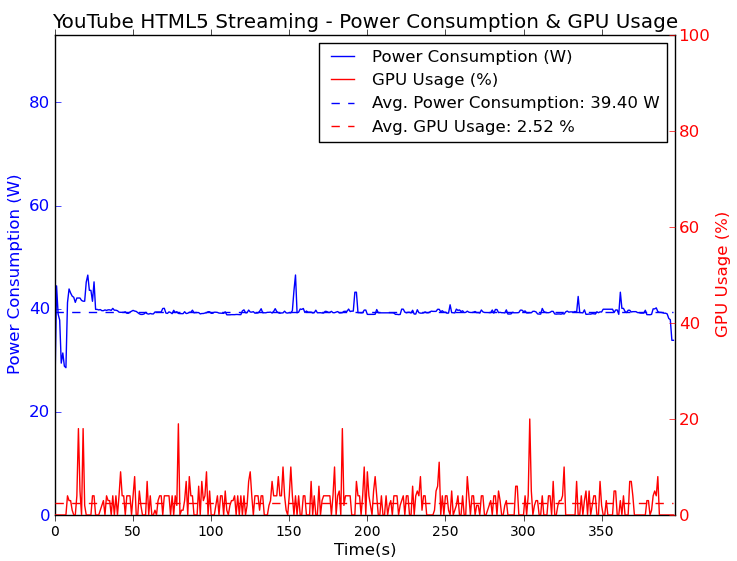

Unlike our earlier comparisons of Flash vs. HTML5 in Firefox, we find that the average power consumption numbers are approximately the same this time around. This was the first time that Firefox 31.0 was being used for this evaluation, and it looks like there have been some improvements to HTML5 video playback.
Netflix streaming evaluation was done using the Windows 8.1 Netflix app. Manual stream selection is available (Ctrl-Alt-Shift-S) and debug information / statistics can also be viewed (Ctrl-Alt-Shift-D). Statistics collected for the YouTube streaming experiment were also collected here.
Decoding and Rendering Benchmarks
In order to evaluate local file playback, we concentrate on EVR-CP and madVR. We already know that EVR works quite well even with the Intel IGP for our test streams. Under madVR, we used the default settings initially. We also put together a 'madVR stress configuration' with the upscaling algorithms set to Jinc 3-tap with anti-ringing activated and the downscaling algorithm set to Lanczos 3-tap, again with anti-ringing activated. The decoder used is from the LAV filters integrated in MPC-HC v1.7.6.
| ASRock VisionX 420D - Decoding & Rendering Performance | ||||||||
| Stream | EVR-CP | madVR - Default | madVR - Stress | |||||
| GPU Load (%) | Power (W) | GPU Load (%) | Power (W) | GPU Load (%) | Power (W) | |||
| 480i60 MPEG2 | 8.40 | 39.57 | 28.04 | 44.85 | 69.24 | 57.71 | ||
| 576i50 H264 | 10.07 | 39.75 | 31.08 | 45.48 | 74.78 | 59.31 | ||
| 720p60 H264 | 8.70 | 40.47 | 26.25 | 47.52 | 87.07 | 64.86 | ||
| 1080i60 MPEG2 | 21.01 | 41.50 | 29.40 | 48.23 | 59.41 | 56.00 | ||
| 1080i60 H264 | 21.21 | 42.18 | 30.69 | 48.66 | 60.34 | 56.94 | ||
| 1080i60 VC1 | 11.97 | 42.14 | 29.70 | 48.83 | 60.24 | 56.35 | ||
| 1080p60 H264 | 11.36 | 41.50 | 31.34 | 49.09 | 69.01 | 59.34 | ||
| 1080p24 H264 | 6.32 | 39.29 | 8.21 | 43.05 | 34.17 | 47.02 | ||
| 4Kp30 H264 | 17.88 | 49.41 | 71.34 | 80.12 | 81.62 | 82.77 | ||
The PC has no trouble, as expected, with EVR-CP for any of our test streams. Just like the Iris Pro-equipped PCs, madVR works well with the default settings. Problems start to appear only for 60 fps progressive streams as well as 4K streams when advanced madVR scaling algorithms are chosen. A point to note about 4K: The R9 270MX doesn't support 4K decode in hardware, though the HDMI port does drive 4K displays at native resolution. Earlier AMD driver versions used to BSOD when 4K playback was attempted using DXVA. In recent releases, the driver has simply not exposed that functionality (making LAV Video Decoder fall back to avcodec irrespective of the chosen codec for playback). The other aspect that we found in our testing was that madVR dropped lot of frames under the default settings (auto fullscreen exclusive mode). Disabling this mode (i.e, playback in windowed mode even in fullscreen) enabled playback of the clips without any issues.
Originally published at https://www.anandtech.com/show/8406/visionx-420d-review-asrock-continues-to-impress (Wayback Machine).