
VIA KT266A Initial Roundup - October 2001
- Posted in
- Motherboards
MSI K7T266 Pro2-RU: USB 2.0 is here
|
MSI K7T266 Pro2-RU |
|
|
CPU
Interface
|
Socket-462
|
|
Chipset
|
VIA
KT266A
|
|
Form
Factor
|
ATX
|
|
Bus
Speeds
|
100
- 131MHz (in 1MHz increments) |
|
Core
Voltages Supported
|
Auto
Detect |
|
DIMM
Voltages Supported
|
2.5V
- 2.7V (in 0.1V increments)
|
|
Memory
Slots
|
3
184-pin DIMM Slots
|
|
Expansion
Slots
|
1
AGP Slot |
|
On-board
Audio
|
Avance
Logic ALC201A
|
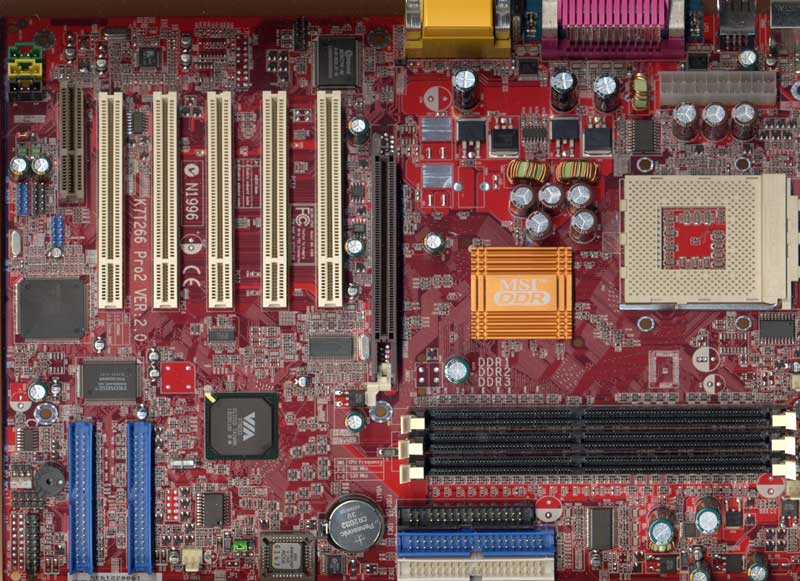
MSI was one of the first to release a KT266 based motherboard, and they were also one of the first to regret doing so. This time around the KT266A based K7T266 Pro2-RU is a much better product than the original KT266 solution MSI released months ago. The red PCB makes it stand out amongst the competition but the basic feature set doesn't have as great of a contrast. The board only features 5 PCI slots vs. EPoX's 6, but you'll be hard pressed to fill all of them much less one more. Unlike the 8KHA+ this board does feature an ACR slot which will most likely go unused by most.
The three DIMM slots are pretty much standard and the board worked fine with all banks populated with 256MB DDR266 DIMMs.
The most unique feature of the K7T266 Pro2-RU is the on-board USB 2.0 controller that is made by NEC. The K7T266 Pro2-RU has enough on-board headers for a total of 8 USB ports, all of which can be taken advantage of since MSI bundles the appropriate external ports with the motherboard. Of those 8 USB ports, 4 of them are driven by the NEC USB 2.0 controller and can thus be used as regular USB 1.0 ports or they can be used with newer USB 2.0 peripherals thus enabling much higher transfer rates. USB 2.0 peripherals are still scarce so it's up to you as to whether or not this is a true selling point. USB 2.0 support will eventually be integrated into South Bridges so this is more of an intermediate solution. The board also features a Promise IDE RAID controller.
Although the K7T266 Pro2-RU had no problems with the GeForce3 Ti 500, we ended up having more usability complaints about this board than the EPoX. The complaints all stemmed from MSI's decision to use an AMI BIOS setup with the board. The setup has no pop up menus for quickly selecting from a large list of options. For example, when picking a clock multiplier or FSB frequency you have to scroll through all of the values before getting to the one you want. In contrast, the newer Award BIOSes you can hit the enter key to bring up a popup displaying all of the possible options, sometimes allowing you to input a value manually. The BIOS also lacks the option of disabling Halt on Keyboard errors which was a problem for us since the BIOS kept on reporting a "Keyboard Connected Incorrectly" error most likely because of our KVM switch box. An interesting point to note is that there was a multiprocessor version option in the BIOS which indicates that MSI hasn't really custom tailored this BIOS for the K7T266 Pro2-RU.
The board is a bit more expensive than the EPoX 8KHA+; you can expect to find it for around $120 - $130.
Originally published at https://www.anandtech.com/show/839 (Wayback Machine).