
VIA KT266A Initial Roundup - October 2001
- Posted in
- Motherboards
EPoX EP-8KHA+: Pure Speed
|
EPoX EP-8KHA+ |
|
|
CPU
Interface
|
Socket-462
|
|
Chipset
|
VIA
KT266A
|
|
Form
Factor
|
ATX
|
|
Bus
Speeds
|
100 - 199MHz (in 1MHz increments) |
|
Core
Voltages Supported
|
Auto
Detect |
|
DIMM
Voltages Supported
|
2.5V
- 3.2V (in 0.1V increments)
|
|
Memory
Slots
|
3
184-pin DIMM Slots
|
|
Expansion
Slots
|
1
AGP Slot |
|
On-board
Audio
|
Avance
Logic ALC201A
|
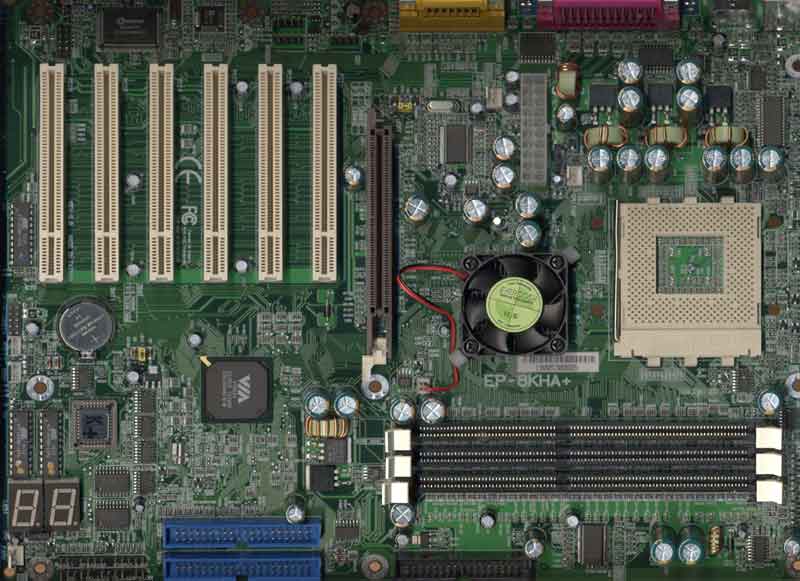
The 8KHA+ is the first retail KT266A motherboard we had a look at and we liked it so much that we used it in our review of the AMD Athlon XP. The board is very high performing and was the only one out of the three to actually match the performance of the KT266A reference board we looked at almost two months ago. The performance comes at no loss to any features as the board has six PCI slots and three DIMM slots. You won't find any CNR slots on this board which is a welcome change from the unusable CNR slots we've become accustomed to seeing on motherboards.
The 8KHA+ has a very well laid out Award BIOS setup in which all multiplier and FSB controls can be adjusted. Like the other two boards, the 8KHA+ can not only adjust the voltage supplied to the CPU but also the voltage supplied to the memory banks which can be useful in overclocking your memory well beyond their rated spec. The default setting for the 'VDIMM' voltage is already boosted by 4% from the factory, for all of our tests we ran it at the rated 2.5V setting instead of the boosted 2.6V default to be fair. We noticed no decrease in stability because of it.
We had two complaints with the 8KHA+. The first was that for whatever reason, Windows 2000 would not get passed the non-GUI portion of its install with a GeForce3 Ti 500 installed. We hypothesized that this could be a problem of delivering sufficient power to the AGP slot for the higher clocked Ti 500 however once Windows 2000 was properly installed, the Ti 500 worked just fine. We tried multiple cards to no avail. The system would simply hang after the Starting Windows 2000 text prompt appeared after the first reboot in the installation process. The install worked perfectly fine with all other cards including the GeForce3, GeForce3 Ti 200 and the ATI Radeon 8500.
The second complaint regarding the 8KHA+ is that it only ships with one two-port USB header leaving two of the 6 USB ports that the chipset supports unused. This is only an issue for those of you with many USB peripherals, which isn't too uncommon these days.
Other than the one issue with the GeForce3 Ti 500 under the Windows 2000 install, we encountered no stability or compatibility issues with the 8KHA+. The 8KHA+ is priced around $105 - $125.
Originally published at https://www.anandtech.com/show/839 (Wayback Machine).