
Intel 850 Motherboard Roundup: September 2001
- Posted in
- Motherboards
ECS P4ITA

|
ECS P4ITA |
|
|
CPU
Interface
|
Socket-423
|
|
Chipset
|
Intel
850/ICH2
|
|
Form
Factor
|
ATX
2.03
|
|
Bus
Speeds
|
100MHz
Auto Detect
|
|
Voltages
Supported
|
Auto
Detect
|
|
Memory
Slots
|
4
184-pin RIMM Slots
|
|
Expansion
Slots
|
1
AGP Slot |
|
On-board
Audio
|
Avance
Logic ALC200
|
|
BIOS
|
AMI
Hiflex BIOS Setup Utility 1.30
|
When we mentioned to ECS that we would be having an i850 motherboard roundup soon, they were eager to send us an early sample of their P4ITA for evaluation. The board arrived as expected and after testing the board we were impressed by the performance and stability of the board.
The engineering sample we received featured the AMI Hiflex BIOS Setup Utility version 1.30, something we don’t see too often. This BIOS had no memory tweaking options, but the performance of the board was quite good anyway, topping the charts in almost all of our tests.
Similarly, the board is very stable throughout our tests, especially for an engineering sample. Like the ASUS P4T, the P4ITA features an AGP Pro slot for professional graphics cards. Furthermore, ECS uses the same HSF mounting on the P4ITA as ABIT did on the TH7, making it easier for you to lock your HSF unit in place without using a flat head screwdriver.
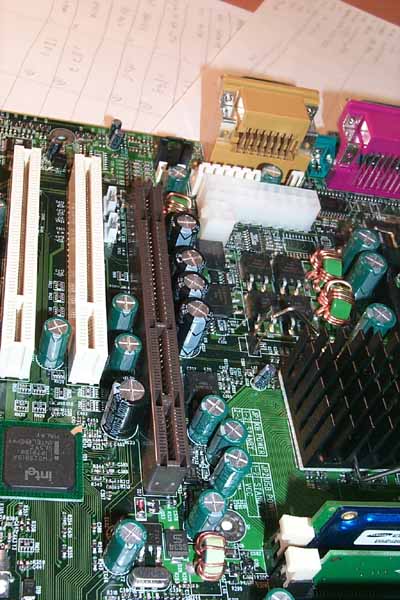
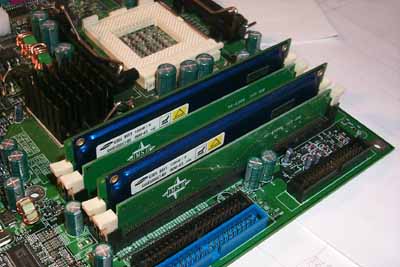
Somewhat surprisingly, the P4ITA has the exact same memory bank setup as the ASUS P4T, so make sure you install the RIMMs and the CRIMMs alternatively, otherwise your system will not boot at all.
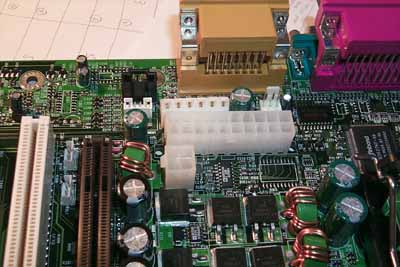
One very nice thing we noticed on the P4ITA is the location of the power connectors. In order to achieve optimal operating conditions, you will have to install a total of three connectors on an i850 motherboard: the traditional ATX power connector, an AUX power connector, and the new 12V 2x2 power connector. ECS was able to put all the connectors together at the back of the board, allowing you to keep all the cables together and organized.
Our engineering sample board did not feature any FSB options, although ECS assures us that most shipping boards will actually come with an Award (rather than AMI) BIOS that will include the overclocking features that are mentioned in the manual. Those speeds will apparently include 103,105,110,115,120,125, and 133. Unfortunately, since our board did not include the appropriate BIOS support, we were unable to test them, although if other boards in this roundup are any indication, they should work relatively.
What we can say for sure is that the board offers great performance and rock solid stability.
Originally published at https://www.anandtech.com/show/827 (Wayback Machine).