
Seagate NAS 4-Bay with Marvell ARMADA 370 Review
Miscellaneous Aspects and Concluding Remarks
It is expected that most users would configure the Seagate NAS 4-bay in RAID-5 for optimal balance of redundancy and capacity. Hence, we performed all our expansion / rebuild testing as well as power consumption evaluation with the unit configured in RAID-5. The disks used for benchmarking (Western Digital WD4000FYYZ) were also used in this section. The table below presents the average power consumption of the unit as well as time taken for various RAID-related activities.
| Seagate NAS 4-bay RAID Expansion and Rebuild / Power Consumption | ||
| Activity | Duration | Avg. Power |
| Single Disk Init (4TB in JBOD) | - | 17.16 W |
| 4 TB JBOD (1D) to 4 TB RAID-1 (2D) | 12h 00m 46s | 28.47 W |
| 4 TB RAID-1 (2D) to 8 TB RAID-5 (3D) | 36h 43m 29s | 38.36 W |
| 8 TB RAID-5 (3D) to 12 TB RAID-5 (4D) | 46h 56m 07s | 48.19 W |
| 12 TB RAID-5 Rebuild (4D) | 23h 57m 06s | 48.05 W |
One of the interesting aspects that I have noted in NAS OS is that the time taken for rebuild of an array is approximately half the time taken for a similar expansion step. Usually, the 3-disk to 4-disk RAID-5 expansion approximately takes the same amount of time as replacing one of four disks in a RAID-5 array, but Seagate seems to be having some tricks up its sleeve to shorten the rebuild time.
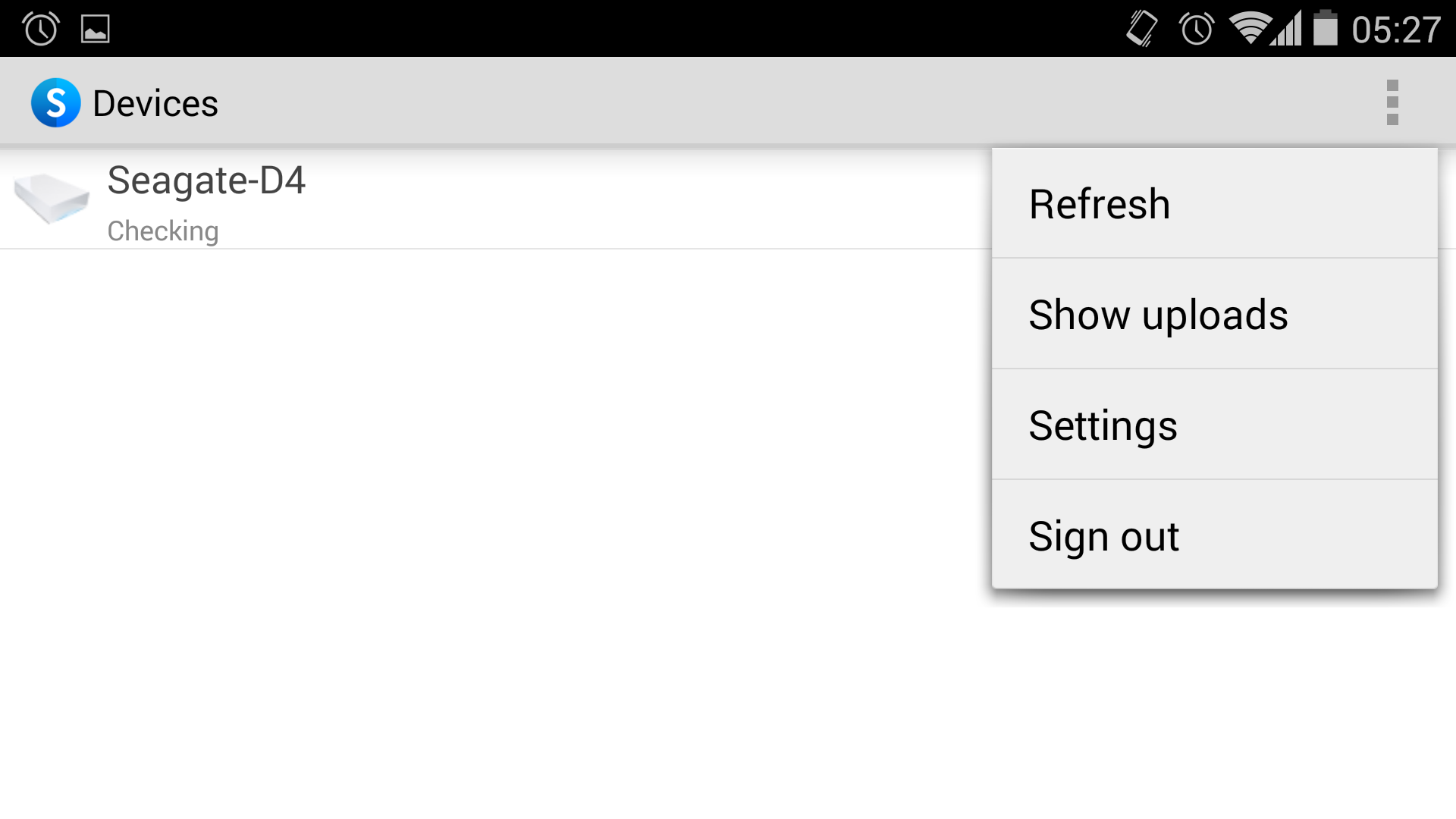
Seagate also provides the Sdrive desktop program as well as iOS / Android app for access to the NAS on-the-go. Upon installing Sdrive, the user is required to create an account first. These accounts can then be associated with particular user IDs on a Seagate NAS / NAS Pro. Seagate operates a relay server in case the user is out of the NAS's local network. In our experience, the Android app and program worked flawlessly. Scope for improvement include adding more features within the app (similar to Thecus's T-On-the-Go), but, given the target market, I don't believe it is that important. The program and app already have the core features necessary in a business environment.
Coming to the business end of the review, credit must be given to Seagate for recovering well from the disaster that was the 2013 Business Storage NAS lineup. The shift to the LaCie-developed NAS OS has brought in the much-needed stability to the platform. When we first looked at NAS OS in the LaCie 5big NAS Pro early last year, we were quite happy, but felt it was a work in progress (no third-party apps or SSH access, for instance). All our concerns are getting addressed one-by-one. There are still quite a few business-oriented features that the firmware could provide (snapshot support, for instance). Hopefully, they will make an appearance in future firmware releases. That said, the current firmware version is quite usable. On the software side, Seagate seems to be doing the right things.
From a hardware perspective, we can see that the choice of ARMADA 370 is dictated by the requirement to hit certain price points. It would have been nicer to have one of the more powerful dual-core variants (such as the ARMADA XP - MV78230 - used in the LenovoEMC ix4-300d), as this could have resulted in better performance and also provided a more robust platform for running multiple applications simultaneously. The price point reached by the ix4-300d ($270) is actually lower than the NAS 4-bay (suggested retail price of $300, but $360 on Amazon). Even if the absence of hot-swap in the ix4-300d is considered, it looks like Seagate could have gone in for a better SoC at the same price point.
Despite the shortcomings outlined, we believe Seagate will taste better success with this product compared to last year's lineup - the renewed focus on the SMB market and stable firmware will prove beneficial. From a SMB perspective, Seagate's handling of all the aspects of the NAS - the drives, the chassis and the hardware/software design - in-house will provide them with the confidence to adopt these solutions.
Originally published at https://www.anandtech.com/show/8264/seagate-armada-370-nas-4bay-review (Wayback Machine).