
Advatronix Cirrus 1200: a Storage Server Under Your Desk
Top Performance
Thanks to the fact that you have six 2.5" disk bays, it is possible to store all your database data on a RAID-1(0) of SSDs and use the remaining bays for SSD caching. This way you get the best of both worlds: very low latency for your transactional database and SSD caching for the rest of your applications. You lose a bit of flexibility as you must be sure that your databases do not fill up your SSD setup, but in most cases the storage space of current affordable enterprise SSDs is more than sufficient.
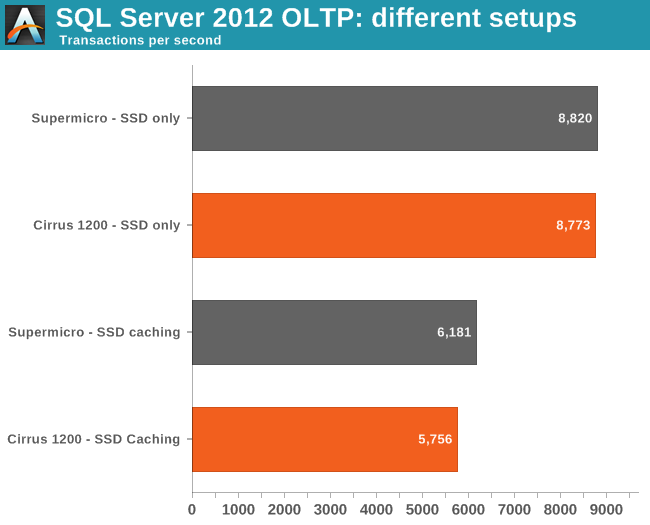
Storing the data directly on SSDs is still quite a bit faster than SSD-caching even if your database is smaller than your SSD caches. Performance increases by more than 40% at the same response time. That is a significant increase for those with intensive database applications. For those on a budget, it is clear that SSD caching is still a great option. You only need two SSDs in RAID-1 and performance is 3-4X higher than without SSD caching.
It is important to note again that placing the SSD cache in RAID-1 is absolutely necessary. The Adaptec controller in theory allows you to enable write caching with one SSD, but in reality SSD write caching is only possible with your SSDs in RAID-1. And SSD read only caching does very little for a transaction based workload.
To sum it up, the six 2.5 disk bays allow you to achieve very high database performance and you are still able to boost performance by using SSD-caching for your applicatons that need additional terrabytes of data storage.
Originally published at https://www.anandtech.com/show/7968/advatronix-cirrus-1200-a-storage-server-under-your-desk (Wayback Machine).