
Advatronix Cirrus 1200: a Storage Server Under Your Desk
RAM Shortage
It is common knowledge that SQL server is designed to make the best use of available physical memory. It will automatically cache data in the buffer pool and will use as much memory as the OS allows it to use. Advatronix's choice of the Xeon E3 comes with a serious disadvantage. Intel marketing decided that for product differentiation reasons, the Xeon E3 is limited to 8GB DIMMs and two DIMMs per channel (2 DPC). As a result any Xeon E3 system is limited to 32GB. That is serious limitation, even for a server in mid size or small business. But is 32GB "good enough"?
We tested the Cirrus 1200 with 16GB and 32GB. To determine if our workload could benefit from more than 32GB, we used the Supermicro server. Using the Microsoft Storage spaces functionality to create an SSD cached storage tier, we installed 64GB to see how much of a difference it makes. The buffer pool allocates more memory as we make more connections. We test up to 1024 connections requesting at 100 ms. Our transactional load can use more memory, as SQL server is using up to 42GB of RAM when we tested.
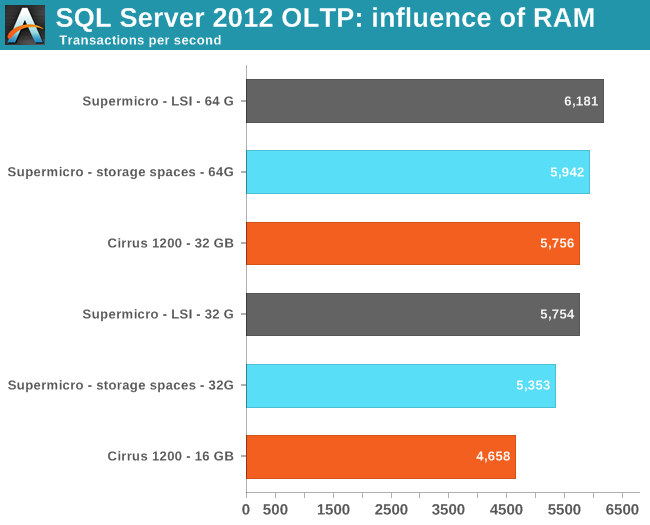
Interestingly, there is very little performance difference between the software (Storage spaces) and the hardware based solutions (LSI, Cirrus 1200/Adaptec).
The average tower server with 64GB will deliver slightly better top performance (3-7.5%) than the Cirrus 1200, which is limited to 32GB. That is of course only important if you want the best database performance that is possible in this low end server market. The good news for the Cirrus 1200 is that SQL server is able to perform well with 16GB (75% of the 64GB performance), so you can probably reach about 80 to 90% performance if you need to run a file server alongside your database server.
Originally published at https://www.anandtech.com/show/7968/advatronix-cirrus-1200-a-storage-server-under-your-desk (Wayback Machine).