
Micron M500DC (480GB & 800GB) Review
The Features
Micron calls its enterprise feature set eXtended Performance and Enchanced Reliability Technology or just XPERT. It's a combination of hardware and software-level features that help to extend endurance and ensure data integrity at any time. Some elements of XPERT are present in client drives as well while some are limited to Micron's enterprise SSDs.
ARM/OR
ARM/OR, short for Advanced Read Management/Optimized Read, is Micron's adaptive DSP technology (i.e. aDSP). The idea behind ARM/OR and aDSP in general is to monitor the NAND voltages in real time and make changes if necessary.
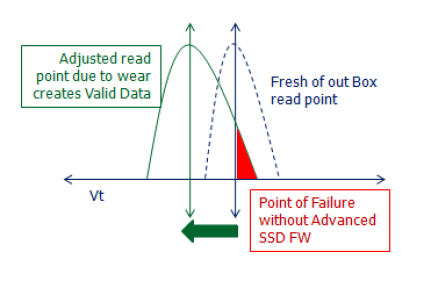
As NAND wears out, electrons get trapped inside the silicon oxide and floating gate. This changes the voltage required to read/program the cell (as the graph above shows) and eventually the cell would reach a point where it cannot be read/programmed using the original voltage. With ARM/OR the controller can adapt to the changes in read/program voltages and can continue to operate even after significant wear.
RAIN
We've talked about RAIN (Redundant Array of Independent NAND) before as it is a feature Micron utilizes in all of its SSDs but I'll go through it briefly here. Essentially RAIN is a RAID 5 like structure that uses parity to protect against data loss. In the case of the M500DC, the stripe ratio is 11:1 for the 120GB, 240GB and 480GB models and 15:1 for the 800GB one, meaning that one page/block is reserved for parity for every 11 or 15 pages/blocks. The parity can then be used to recover data in case there is a block failure or the data gets corrupted.
DataSAFE
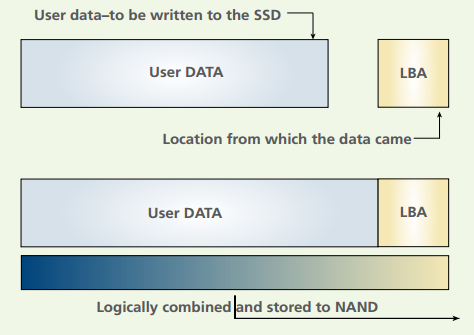
DataSAFE ensures that all data, read or written, is intact. When writing data, Micron not only writes the data from the host to the NAND but also the metadata associated with the data (i.e. its logical block address/LBA). When the host then requests the data to be read from the drive, the LBA of the data is first compared against the value in the L2P table (logical to physical -- Micron's name for the NAND mapping table) before sending the data to the host. This ensures that the data that is being read from the NAND is in fact the same data that the host requested. If the LBA values of the NAND and L2P table are different, then the drive will have to rely on ECC or RAIN to recover the correct data.
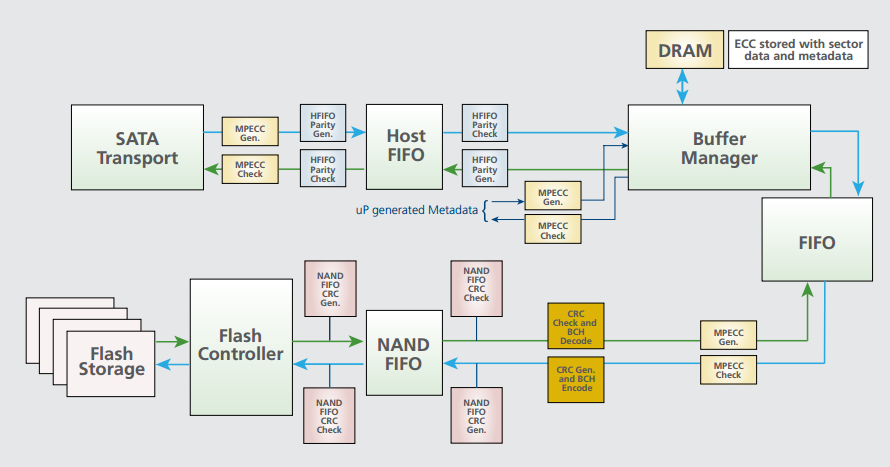
In addition to LBA embedding and read checking, DataSAFE does data path protection from the SATA transport all the way to the NAND controller. While client drives only generate CRC and BCH error correction codes to detect errors, the enterprise drives add an additional memory correction ECC (MPECC) layer. MPECC is a 12-byte error-correcting code that follows the user data during its whole path. The difference between the client and enterprise solutions is that the client drives rely on the host to make the actual error correcting, whereas the MPECC layer can correct a single-bit error within the data path (i.e. before the data even hits the host).
Power Loss Protection
While both Micron's client and enterprise SSDs feature power loss protection, there is a difference between them. The enterprise drives features more rigid tantalum capacitors that provide a higher capacitance compared to the standard capacitors used in the client drives. The higher capacitance ensures that absolutely no data is lost during a power loss, whereas there is still a small risk of data loss in client drives. I believe the difference is that the capacitors in client drives only provide enough capacitance to flush the NAND mapping table (or L2P table as Micron calls it) to the NAND, while the enterprise solution guarantees that in addition to the NAND mapping table, all write requests in process will also be completed.
Originally published at https://www.anandtech.com/show/7947/micron-m500-dc-480gb-800gb-review (Wayback Machine).