
IDE RAID Comparison
- Posted in
- Storage
Performance: RAID 1
We will investigate the performance of the various cards in a RAID 1 configuration in the same way that we investigated the performance of the cards in a RAID 0 array.
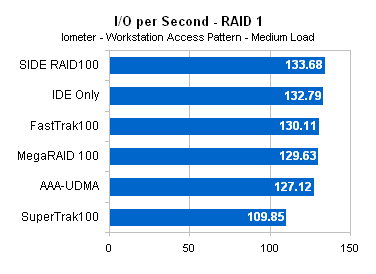
With the exception of the SuperTrak100, all the cards performed relatively similar in the I/O per second test. The SIDE RAID100 was the only card able to outperform the IDE drive, doing so by less than 1%.
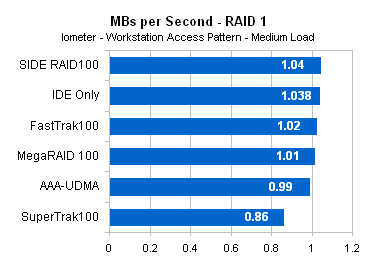
The results are the same for the MBs per second rate. Most of the cards are able to run a RAID 1 array at speeds very similar to that of a single IDE drive.
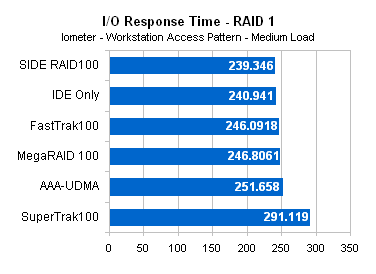
The I/O response times are very similar throughout all the cards, yet the SuperTrak100 falls to the bottom of the chart again for some unknown reason.
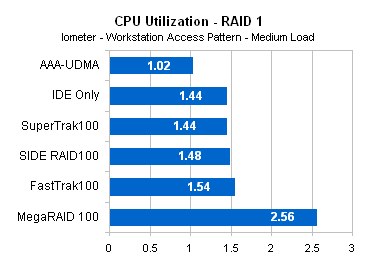
The situation changes a bit when we investigate how much CPU the cards are using. Again we find that the MegaRAID and its AMI MG80649 uses the most CPU time by far. The card with the lowest tax on the CPU in RAID 1 is the Adaptec hardware RAID card.
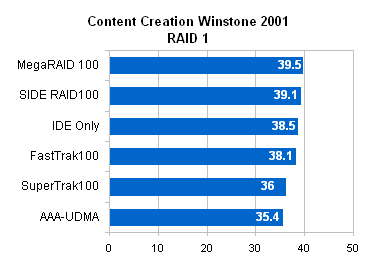
Perhaps the best demonstration of which RAID cards perform best when mirroring is the Content Creation Winstone 2001 test. Here we can see that the MegaRAID 100 and its AMI 80649 chip and the SIDE RAID100 and its Highpoint HPT370A chip provide the best RAID 1 speeds. The SIDE RAID100 performed 2% faster than a single IDE drive and the MegaRAID 100 performed slightly higher.
The purpose of RAID 1 configurations should not be speed but rather data security. Since the drives are mirrored, data is easily recoverable if a drive fails. The 2% performance increase that we saw with some of the cards does not hurt the decision to go RAID 1 either.
Originally published at https://www.anandtech.com/show/788 (Wayback Machine).