
Sony VAIO Pro 13: Exceptionally Portable
Sony VAIO Pro 13: Excellent Battery Life
If the performance in applications wasn't particularly impressive, where Sony positively shines is in their battery life. We have our standard Light, Medium, and Heavy battery life tests, and even the Light test is reasonably demanding (loading four web pages every 60 seconds). We also run the LCD at 200 nits (87% on the VAIO Pro 13), so turning down the brightness will only improve these results.
This is also one of the tests where we can make cross-OS comparisons to Apple's MacBook Air 13. We've seen in the past that OS X gets substantially better battery life with MacBooks than Windows, but we're at least able to run the same workloads so the tests are more or less “fair”. Anand ran the MBA13 under both Windows 8 and OS X, and we've included both results in the charts below. For the VAIO Pro 13, we likewise have results using just the integrated 37Wh battery as well as with the extra sheet battery.
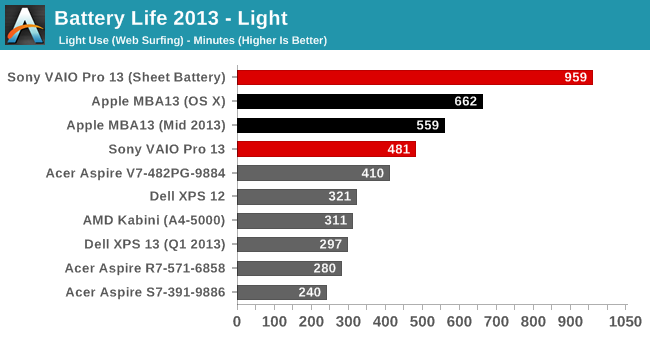
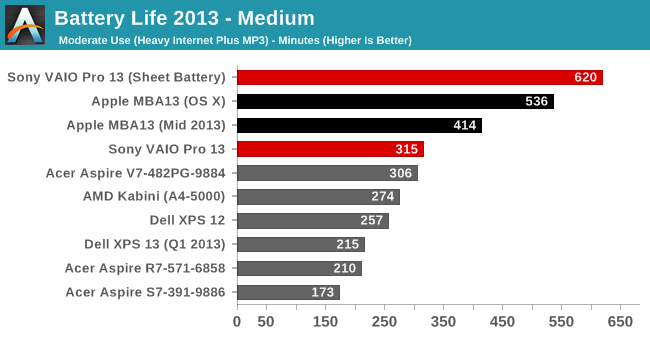
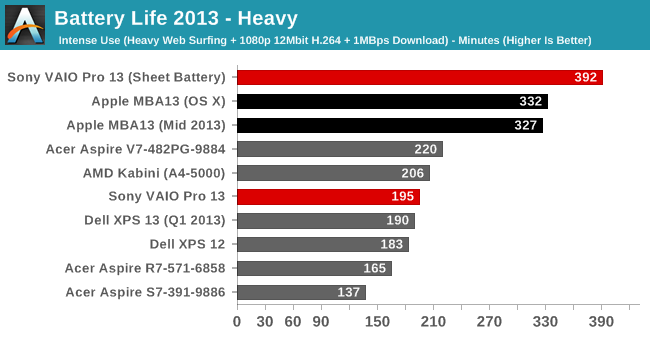
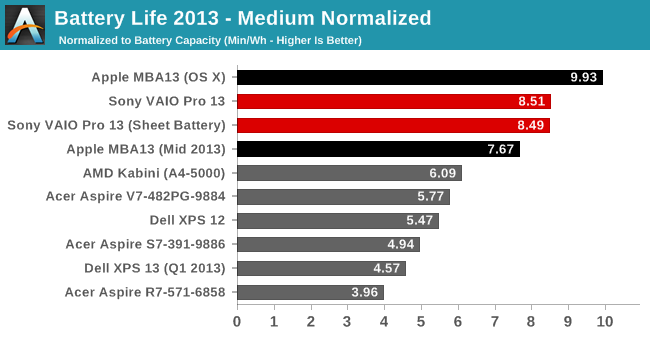
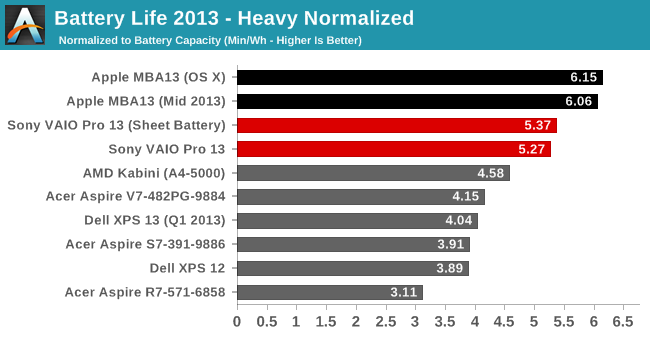
In terms of pure battery life numbers, with the extra battery the Sony VAIO Pro 13 comes in at the top of our charts, but even without the doubling of capacity it does well. In raw battery life, it trails the Haswell-equipped MacBook Air 13 (particularly when the latter is running OS X), and in the Heavy test it also falls behind the Acer V7 and the AMD Kabini prototype. That's only part of the story, however, as the integrated battery is pretty small compared to many of the other laptops in our charts.
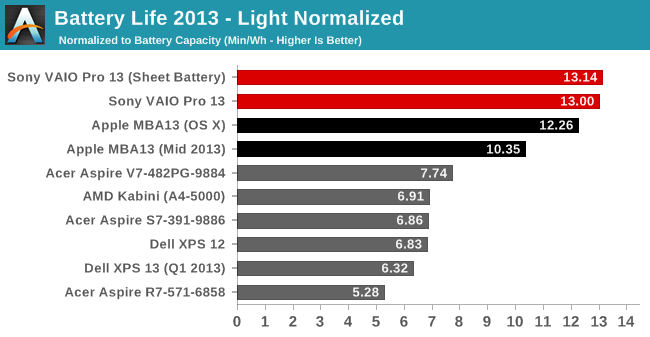
Look at the normalized battery life and the VAIO Pro 13 is quite a ways ahead of any other (Windows) contender in the Light and Medium loads. Apple still does better in heavy loads, indicating that Apple is either more aggressive in getting down to lower power C-states, and in OS X Apple also posts an impressive result in our Medium workload. The Heavy load tends to not allow the CPU to relax much (It averages out to around a 20-30% CPU load throughout the test), so it's not too surprising that the MBA13 results are a lot closer to their Win8 results in that particular test.
Adding the sheet battery basically doubles battery life, which puts Sony way ahead of any other laptop we've tested in recent years (though it doesn't change the normalized results). It was almost painful to test battery life, simply because it took so long for the battery to go dead. With the Light dual-battery testing, I started the test, went to bed, came back the next morning and the combined battery charge was still around 50%. If you need even more battery life, you could purchase additional external batteries and swap them quite easily with no downtime, and since Sony has the laptop drain the sheet battery first, you don't need to worry about the integrated battery unexpectedly running out of power.
However you want to look at it, the Sony VAIO Pro 13 delivers on the battery life front. This is how every Haswell laptop should behave, at a minimum. Sadly, we have plenty of examples where this level of power optimization is clearly not in effect, but I'll save that discussion for an upcoming review (cough, Clevo, cough).
Originally published at https://www.anandtech.com/show/7417/sony-vaio-pro-13-exceptionally-portable (Wayback Machine).