
The Neophyte's Custom Liquid Cooling Guide: How To, Why To, What To Expect
- Posted in
- Cases/Cooling/PSUs
- Systems
- G.Skill
- Corsair
- Gigabyte
- Haswell
- Water Cooling
- Plextor
- NVIDIA
- Overclocking
- Swiftech
With solid air cooling performance tested, it's time to make the jump to liquid cooling. It's very easy to be intimidated by the hardware involved, but let's break down what Swiftech graciously provided (and they provided quite a bit) and understand what these individual parts represent.
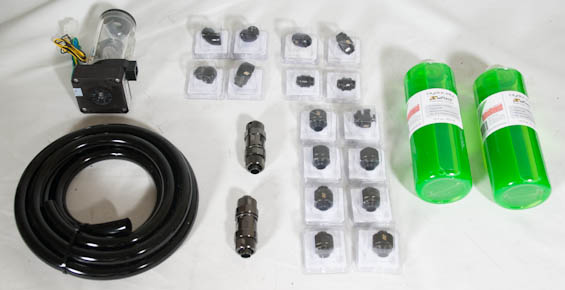
The top left of the photo above is Swiftech's combination MCP35X pump and reservoir, pre-assembled. The MCP35X pump is powered by a 4-pin molex connector, but can run at a variable speed controlled through an additional PWM header. Below it is six feet of very thick black TruFlex PVC tubing. The two large chrome parts to the right of it are no-spill, quick-release couplings designed to be in the middle of the tubing to allow you to disconnect parts of the loop as needed; these use what are called compression fittings. Speaking of which, the bulk of the parts in the surrounding plastic cubes are compression fittings, with 45-degree and 90-degree adapters floating around, along with multi-GPU connectors. Finally, the two bottles are Swiftech's HydrX PM (pre-mixed) coolant.
We're talking about watercooling, so what's in the coolant? Water is actually absolutely excellent at absorbing and carrying heat and has a tremendous heat capacity (think about how long it takes a pot of water to boil); the HydrX PM is actually 90% distilled water (which contains no impurities) and a mixture of chemicals to prevent algae and corrosion. This is very similar to how coolant/anti-freeze works in your car; water carries heat very well, but is also corrosive, so chemicals are introduced into the mixture to counteract that effect.
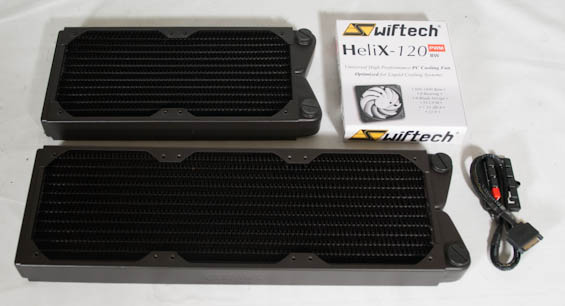
Next are the radiators. The radiators are made out of copper with brass tubing, and Swiftech carries two different types: one with a normal fin density designed for low speed fans (these), and one with a higher fin density designed for high speed fans. Higher fin density means improved surface area which in turn means superior heat dissipation, but more powerful fans are required to really push air through a denser radiator. For this build, there's one 360mm radiator and one 240mm radiator. Next to them is one of the five Helix-120 PWM-controlled fans intended to be used with the radiators, and the odd-looking dongle is actually a SATA-powered PWM-splitter.
Originally published at https://www.anandtech.com/show/7363/the-neophytes-custom-liquid-cooling-guide-how-to-why-to-what-to-expect (Wayback Machine).