
The Impact of Disruptive Technologies on the Professional Storage Market
NetApp: Automatic Tiering and More Flash Goodness
Most vendors did not do much better than NetApp as they used an advocated automatic tiering, meaning that hot data was moved from the slow magnetic disks to the flash disk. Although it sounds nice, the reality was that it did not solve some performance bottlenecks. As the process was not real-time, you could be hitting the disks a lot for a piece of data before the data was finally moved towards the flash tier. Also migrating data around is not very energy friendly as it wastes a lot of processing and storage bandwidth.
To sum it up: NetApp's Flash Cache did better than the "automatic flash tier" of other vendors, but the flash cache performance/dollar ratio was not exactly something to write home about.
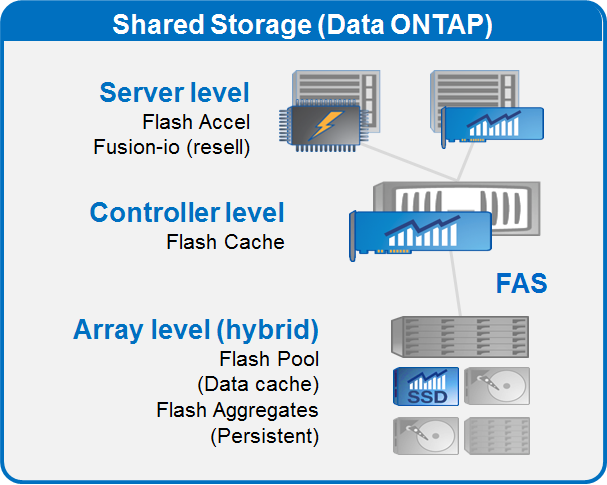
Last year, NetApp went a step further. The storage arrays could be expanded with a “flash pool”, a storage pool consisting of a RAID group of SSDs (100, 200, or 800GB) that caches the random reads and writes of the volumes inside a magnetic hard disk pool. All writes are first written to the NVRAM and then flushed to the disks. However, an overwrite of random write is written to the flash pool. This greatly improves performance when you update the same data over and over again in a small time period because the update is only propagated to the disks when the data is not changed for some time. Sequential writes and reads are still sent to the disks, which is an intelligent way to make the most of your SSDs. Also, the flash pool is an LRU (Least Recently Used) cache.
It is ironic to notice that NetApp quotes customers who reported 100s of ms for critical requests in case studies. While the case studies did make the flash based SAN shine, they also show how a few years ago, SAN arrays were expensive and not delivering. Luckily, those customers now report that flash pools reduced the response time to 5 ms. It is good that the newest NetApp technology has accelerated this, but it is also a clear example that even high-end SANs failed to deliver good performance to customers just a year ago.
But flash pool and flash cache do not give the performance benefits that server side flash cache delivered with Fusion-IO. So something really interesting happened: NetApp announced Flash Accel, making sure its SANs could work together with server side flash caches. Even more interesting is that NetApp is not charging anything for this software, probably to make sure that the current NetApp customers do not get lured away by other server side storage solutions.
Existing customers can simply download the ESXi 5.0/Windows 2008 agent. Each VM needs to get an agent and an ESXi host, so Flash Accel works at the moment with only a limited number of configurations. However, it's quite disruptive to witness a typical SAN vendor promoting server side caching. Just a year ago, most SAN vendors were downplaying this trend.
Originally published at https://www.anandtech.com/show/7170/impact-disruptive-technologies-professional-storage-market (Wayback Machine).