
AMD's A10-5750M Review, Part 2: The MSI GX60 Gaming Notebook
Conclusion: The Value of Balance
On paper, the AMD-powered MSI GX60 had to seem like a good idea, and I'm not even convinced it actually isn't one. Using a less expensive CPU to force the price tag down and going whole hog on the GPU isn't that uncommon among custom built desktop PCs, so as long as the gaming performance is there in a notebook, it's certainly worth a shot. The A10-5750M is nowhere near as powerful as an Ivy Bridge quad core, let alone a Haswell, but if it doesn't need to be, that's not an issue. Of course, it does need to be, but we'll get to that.
I feel like I've reviewed this chassis a hundred times by now, but at least shrinking it down to a 15.6" gives me both a better perspective and feels different. Knowing what I know now about how MSI seems to be designing and building their gaming notebooks, I can't under any circumstances recommend their 17.3" notebooks. The only reasons to buy one are if you somehow find a better deal than on its 15.6" equivalent, or if you just really want that larger display. You're not getting more pixels or better thermals, you're just getting two more pounds of bulk. But the hardware is almost identical.
There's the sweet and the sour. The chassis is bulky but at least reasonably tough, and the SteelSeries licensed keyboard really is very comfortable to type on if you can get used to MSI's goofy layout. They're able to cram a healthy amount of power and cooling potential into a 15.6" chassis as well, and you still get two 2.5" bays.
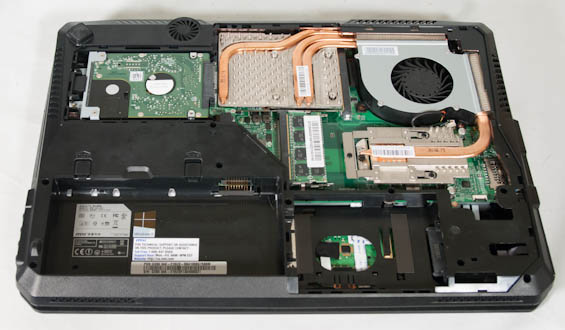
The AMD model of the GX60 is cute in concept, but in practice has problems. The single biggest reason not to buy it is that for the same price, MSI will sell you a Haswell-based system with an NVIDIA GeForce GTX 765M. While that GPU is most definitely slower than the AMD Radeon HD 7970M, the brakes the A10-5750M APU puts on the 7970M keep it from hitting its true performance potential, and as a result I suspect the more well-rounded GE60 will ultimately make a lot of end users much happier. While $1,199 is a fantastic deal for an AMD Radeon HD 7970M, you're not really getting one. Looks fantastic in marketing material, though, no doubt.
What the GX60 really needs to be is a $999-or-less gaming notebook. That potentially means cutting the 7970M, but we need a more balanced combination of CPU and GPU anyhow. The 7970M is far too powerful for the A10, but a Radeon HD 7870M/8870M would be a more appropriate companion. Ideally AMD would release a mobile Bonaire GPU, which would be perfect for the A10-5750M. At that point the value proposition kicks in hard. GPU performance won't hit those outside highs, but under most circumstances neither part should hold the other back too much, and the end user doesn't wind up wasting money on more GPU than they could ever hope to use.
As for the A10, it's not a bad chip, but Intel has been driving prices down hard in the mobile space and AMD doesn't have much latitude to work in. I can see an all-AMD gaming notebook potentially working if Kaveri lives up to expectations. In the meantime, the GX60 is a cute idea in theory, but the inescapable fact is that as I said before, you're not really getting an AMD Radeon HD 7970M for $1,199. The GPU is there, but it's leashed. There are better alternatives.
Originally published at https://www.anandtech.com/show/7111/amds-a105750m-review-part-2-the-msi-gx60-gaming-notebook (Wayback Machine).