
NZXT H630 Silent Case Review
- Posted in
- Cases/Cooling/PSUs
- NZXT
- ATX
In and Around the NZXT H630
The exterior of the NZXT H630 is a wonderfully simple, beautiful thing. They asked me if I wanted a black model or the two-toned white and black version; I think the white and black is beautiful, but at the end of the day, black goes with everything. Where I suspect users may take some issue with the H630 is in its use of a predominately plastic shell, but the plastic actually makes sense for the design from at least a practical perspective. Keep in mind that the chassis itself is built of sturdy steel (essential for producing a vibration-free and silent enclosure). My mistake, the outer shell is also steel.


As I mentioned in the introduction, NZXT eschews using a door for the H630; instead there are just two 5.25" bays on the front of the case, with the NZXT logo at the bottom and a dim white activity LED at the top right. The unusual contour at the top of the front fascia blends with the contour on the top of the case itself, creating a beautiful accent. Unfortunately, I feel like NZXT didn't quite capitalize on the opportunity to add a little bit of discreet ventilation here. On top of the case is the power button and a recessed reset button, and the ring around the power button glows a soft white when the system is powered on.
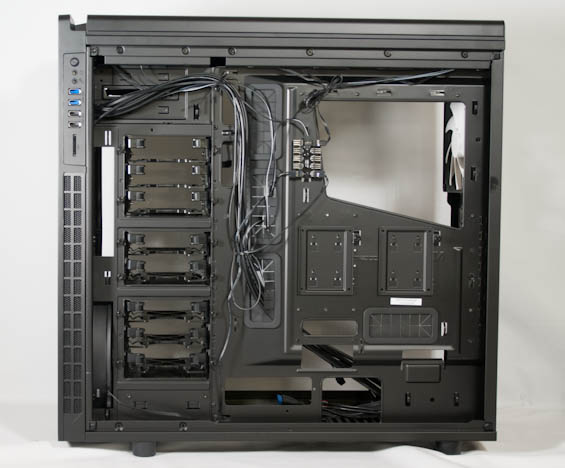
If you take a tour around the case you're going to see a lot of flat surfaces, but the way the case is vented is slightly unusual. The right side of the case sports the switch to toggle the I/O lighting along with the audio jacks, USB ports, and the integrated SD card reader. Beneath this cluster is a patch of fairly inconspicuous ventilation, but that ventilation is not mirrored on the opposite side. That's a tough judgment call to make; I understand why the opposite side isn't vented, but I do think it would've been a reasonable sacrifice to make for potentially superior airflow. Around the top rim of the H630 is more similarly discreet ventilation. Note that like the chimney on the Nanoxia Deep Silence 1, this ventilation does not correspond to headroom for fans or radiators.
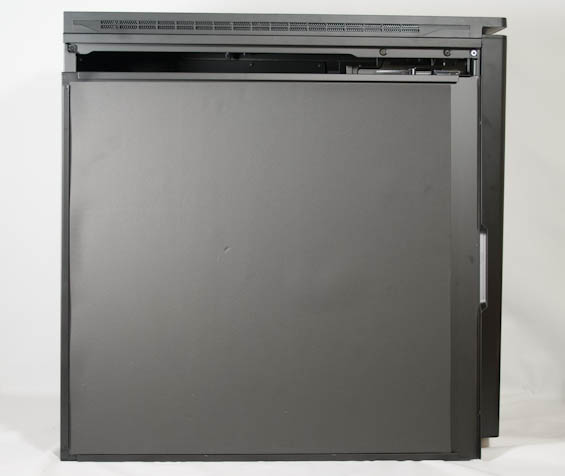
The two side panels are held in place by thumbscrews, and mercy of mercies, they're hinged. The top and front panels are also designed to pop off, but on my pre-production review unit, the front panel is borderline impossible to remove. This is a recognized flaw in the review batch of cases and it's my understanding that it will be corrected in retail. I personally find the choice of dampening material particularly interesting; NZXT opted for 7mm thick sheets of closed cell foam on the insides of the side panels along with the interior of the top panel.
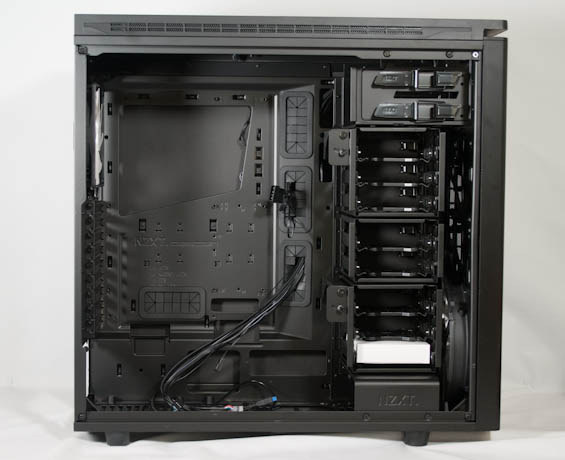
When you do reach the H630's interior, it's pretty traditional NZXT. There's a slight incline surrounding the motherboard tray to aid in cable routing, but I was disappointed to see the modular drive cage design doesn't inherit the brilliance of the Phantom 630's 1-2-3 stacking. Instead there's a 3-2-3 combination. Note that there are also two 2.5" trays docked behind the motherboard tray; this area gets toasty, but it's totally reasonable for SSDs and is a great way to free up space in the interior proper.
While I'm fond of the H630's design overall, and I believe the plastic shell was actually a smart design choice given the case is still 30 pounds, the interior isn't quite as progressive as the Phantom 630's was. I get the sense that NZXT definitely still has room for improvement here. Externally, though, I think it's absolutely stunning and breathes new life into the "black monolith" case aesthetic. That, and while I've never been a big fan of the "stormtrooper" look of NZXT's Phantom cases, the H630 is stunningly and wonderfully tasteful and sleek.
Originally published at https://www.anandtech.com/show/6951/nzxt-h630-silent-case-review (Wayback Machine).