
Calxeda's ARM server tested
Finding a Good Fit
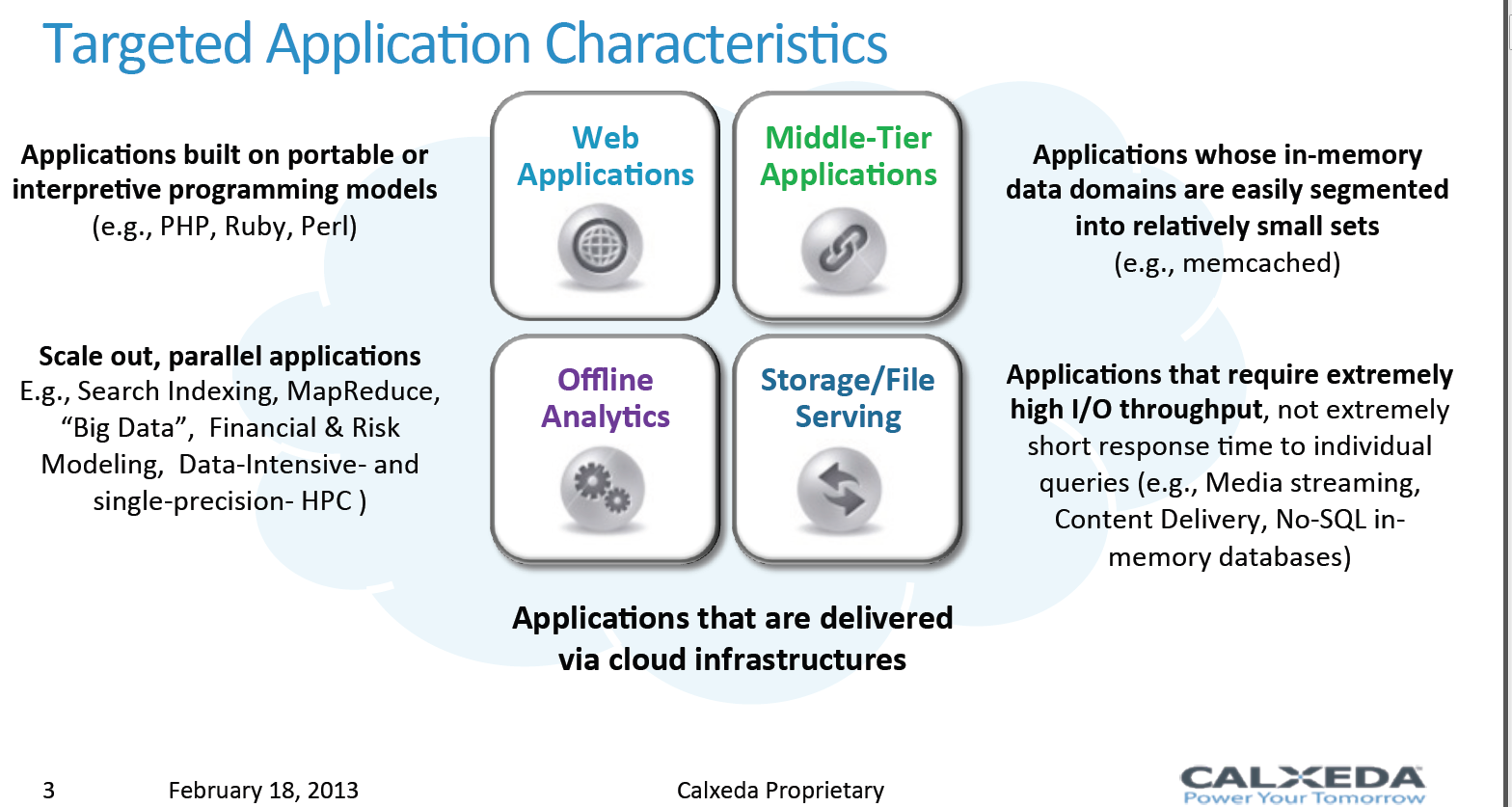
The previous benchmarks have shown that the first Calxeda server is not for the general IT market. As the slide below shows, Calxeda targets four kinds of workloads:
- Web applications
- Middle-tier applications
- Offline analytics
- Storage and file serving
For applications such as Memcache, the ECX-1000 1.4GHz lacks bandwidth and memory capacity. Once a Cortex-A15 based server is available, this can change quickly as performance will improve significantly and the amount of memory per CPU can be quadrupled to 16GB.
We did not test it yet, but our own experience tells us that the majority of the "scale out" applications are out of reach. Especially in the financial and risk modeling world, top performance and ultra low response times are prioritized.
Calxeda based Boston servers are already making inroads as storage servers. There is little doubt that a low power processing unit makes a lot of sense in a storage server.
That leaves the question whether or not Calxeda's latest server can make it in the web server and Content Delivery world. Calxeda claims 5W per server node, and no more than 250W for the complete server chassis with 24 server nodes. That's pretty cool, but currently there is another solution. Two octal-core Xeon E5 deliver no less 32 threads running on top of 16 very potent cores. Add a virtualization layer and you get tens of servers. The only limitation is typically the amount of RAM.
So assume you are a hosting provider. Which server do you use as your building block? You've got two choices:
The standard one, the Intel Xeon E5 server. The advantages are excellent performance whenever you need it, whether your application scales well with more threads or not. The Xeon can address up to 384GB of affordable RAM (16GB DIMMs). If that's not enough, 768GB is possible with more expensive LR-DIMMs.
Those are impressive specs, but what if most of your customers just want to host medium sized web sites, sites that are rich on content but rather low on processing requirements? Can the Boston Viridis server attract such users with a much lower power consumption? How far can you go with slicing and dicing the Xeon's monstruous performance into small virtual pieces? We decided to find out.
Originally published at https://www.anandtech.com/show/6757/calxedas-arm-server-tested (Wayback Machine).