
Calxeda's ARM server tested
Building and Compiling
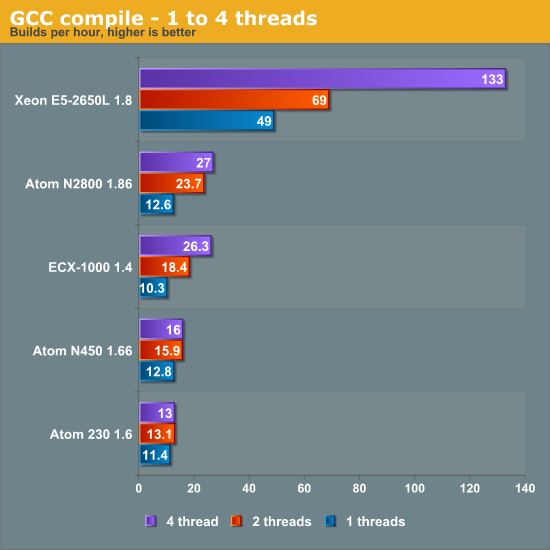
We compiled the 7z source by performing a make -jx (with x being the number of threads). Compiling is branch intensive (22%) workload that does mostly loads and stores (about 40%).
Looking at the single-thread performance, the ARM Cortex-A9 and Atom are in the same ballpark. This is the kind of workload where the Sandy Bridge core of the Xeon really shines. You need about eight Cortex-A9 cores to beat one Xeon (without HT). And it must be said: compiling inside a virtual machine on top of the Xeon E5 is a very pleasant experience compared to the long wait times on the Atom and ECX.
Lessons so Far
A quad-core Cortex-A9 performs well in server workloads that are mostly memory latency sensitive. A quad-core Cortex-A9 ECX-1000 at 1.4GHz has no trouble competing with Atoms at slightly higher clockspeeds (1.6GHz). There is only one exception: bandwidth intensive workloads.
Both Atom and ARM based servers have the disadvantage of being rather slow in typical "management" tasks such as compiling, installing, and updating new software. Compiling a rather simple piece of software in a VM with only two Xeon vCPUs (running on one 1 core + HTT) took only 37 seconds. A single-core Atom server needed 275 seconds, while the quad-core ARM ECX-1000 needed 137 seconds.
But the Boston Viridis is much more than just a chassis with 24 server nodes. It has a high performance switching fabric. So it's time to see what this server can do in a real server environment.
Originally published at https://www.anandtech.com/show/6757/calxedas-arm-server-tested (Wayback Machine).