
iBuyPower Revolt System Review: Closing the Boutique and Opening the Store
- Posted in
- Systems
- Mini ITX
- iBuyPower
- Mini-Tower
Conclusion: An Important Release, But With Caveats
The iBuyPower Revolt is almost difficult to evaluate due to what it essentially represents, so we need to split our evaluation in two directions: what the Revolt signifies for the future of iBuyPower, and how the Revolt competes with the current bumper crop of smaller gaming desktops seemingly destined for the living room.
Addressing the former, the Revolt represents the first step in iBuyPower establishing itself not as another boutique, but as a full on vendor competing with the big boys. Obviously the major signal here is iBuyPower's claim that the motherboard is their own kit. In evaluating and analyzing the Revolt, there's...some truth to that claim. The board has iBuyPower's own silkscreen, and you can't buy one exactly like it. What it is, though, is a custom revision of ASRock's Z77E-ITX. The UEFI is laid out identically to ASRock's own UEFI but with an iBuyPower "theme" to it, and the board itself is just the Z77E-ITX without Virtu or display outputs. The ASRock branding on the chipset heatsink is also gone; the heatsink itself is replaced with a generic one. So while my first instinct is to go "gotcha!", the reality is a lot more mundane, because this isn't actually that much different than anything the big boys use. The Revolt continues to be valid as a demonstration of iBuyPower as a potential major player, especially as their presence in retail continues to grow.
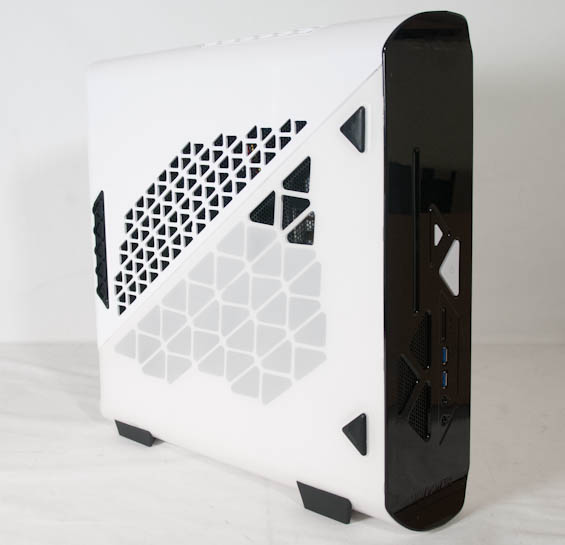
As for the Revolt's competitive fitness, it's really going to come down to price. iBuyPower does have a history of almost attacking prices in the time-honored tradition of Billy Mays and Mr. Popeil, with the difference being that this product is a sound one. If iBuyPower can hit $1,199 with this review configuration, they're pretty bulletproof. Their $899 model is embarrassingly skint on RAM and wastes the i5-3570K at its core with a stock cooler, but otherwise it's pretty fantastic and definitely competitive. Amusingly, if you want the most bang for your buck, going with their $649 model and then bumping the GPU to a GTX 660, the RAM to 8GB, and the PSU up to 350W results in an $819 price tag, and that's something Alienware just can't offer. If iBuyPower could offer that configuration at $799 or even $749, forget it, competition's over.
With that said, the two models on NewEgg right now are really underwhelming. The $999 model is unimpressive compared to what you can do on iBuyPower's site, and the $639 model's GeForce GT 630 (featuring a comically large 4GB of DDR3 video memory) is an embarrassment that actually undermines iBuyPower's credibility. I don't like seeing companies using sticker amounts like 4GB on crappy video cards to sucker in rubes who don't know any better, and I think it hurts iBuyPower in the long run to resort to a gimmick like that to sell units instead of just letting the product stand on its own.
So ultimately while I'm not over the moon with iBuyPower's stock configurations and think they could produce much more compelling options, and the uncertainty of our unit's price tag paints a bit of a dark cloud over the review, the Revolt is nonetheless a pretty stellar product. Anything that democratizes gaming hardware is a good thing, and iBuyPower is continuing to make gaming PCs more and more accessible. I want to see the Revolt on store shelves because it obsoletes more half-baked attempts like HP's Phoenix as well as making people who came for the Alienware X51 do a double take.
It's not going to be available until the beginning of March, but if you want to game for a good price, the Revolt is tough to beat. Just don't buy it stock.
Originally published at https://www.anandtech.com/show/6752/ibuypower-revolt-system-review-closing-the-boutique-and-opening-the-store (Wayback Machine).