
iBuyPower Revolt System Review: Closing the Boutique and Opening the Store
- Posted in
- Systems
- Mini ITX
- iBuyPower
- Mini-Tower
Build Quality
You'll either love or hate the way the iBuyPower Revolt looks, but at least it's incredibly distinctive. While the Alienware X51's design securely fits into their lineup, iBuyPower is essentially fashioning a particular look with the Revolt. It's a functional design, though, and a step up from the somewhat chaotic one that DigitalStorm uses on their Bolt. Opening the Revolt involves removing two screws and then sliding off the side panel; when you do so you're greeted with this:
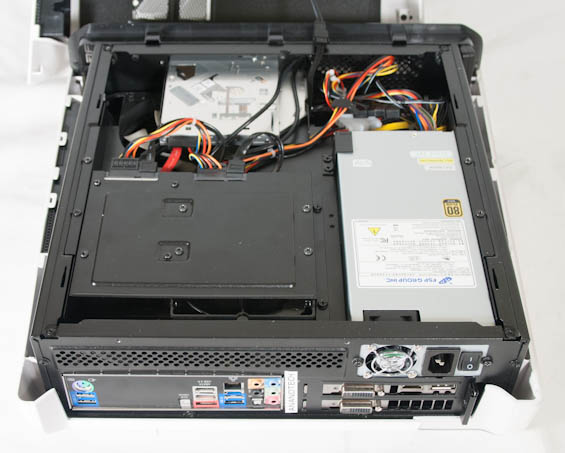
Everything is held into place with Phillips head screws, but the stacking order is pretty clean. The radiator for the CPU sits under the optical drive; the power supply sits above the right-angled PCIe x16 slot. I'm loathe to see how a stock CPU cooler would fare in this enclosure, though, which was clearly designed with the radiator in mind. All of the side ventilation on the case is very specifically positioned to keep the components cool.
What's worth mentioning, though, is that the Revolt is definitely bigger than the Alienware X51 and more similar in size to DigitalStorm's Bolt. This can't really be helped; the X51 moved the power supply out of the chassis and uses an external PSU, which in turn places a hard limit on the GPU at 150W and precludes overclocking the CPU.
Noise and Heat
The best way I can describe the noise character of the iBuyPower Revolt is this: Xbox 360. The aesthetic of the Revolt does remind me of the first generation white Xbox 360s, and the system sounds basically identical to the 360 under heavy load. That means it's audible, but not aggravatingly so. What the Revolt doesn't have in common with the poorly engineered first generation 360 is this:
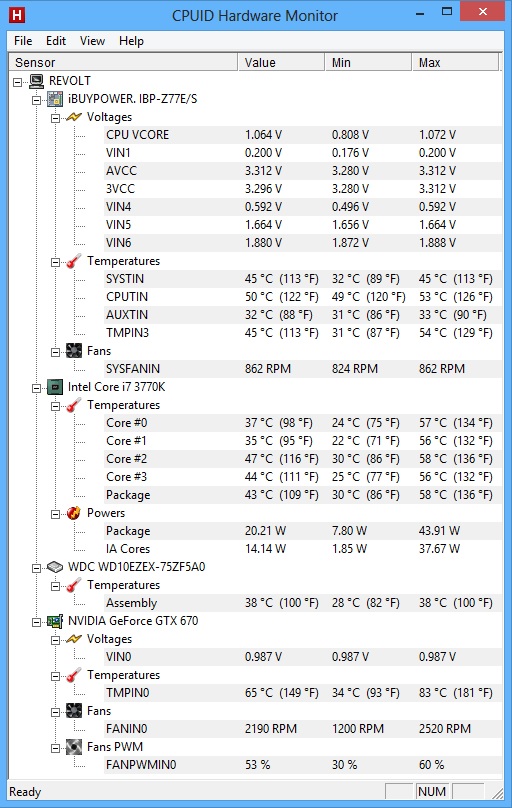
While the 360 was busy cooking its chips off, the Revolt was able to keep fairly cool. CPU thermals are appreciably low (though admittedly running at stock clocks), although the GTX 670 does run just a hair on the warm side. That's worth bringing up because Kepler's boost clocks are actually thermally controlled. It shouldn't be a huge issue, but I wouldn't expect to get a whole lot of extra oomph out of the 670 in the Revolt.
Power Consumption
The combination of Ivy Bridge and Kepler in the iBuyPower Revolt should yield precious few surprises, and sure enough that's exactly what you'll get. In addition to looking and sounding like Microsoft's first generation game console, the Revolt draws about as much power under load.
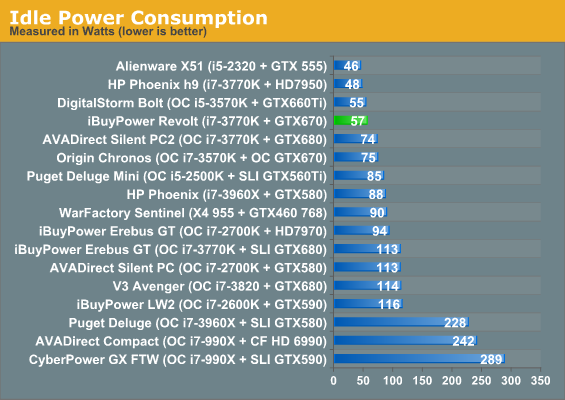
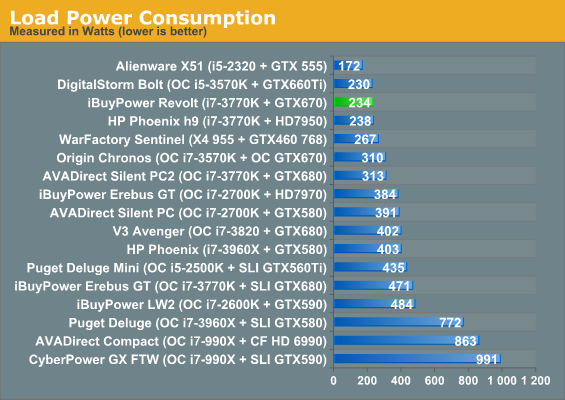
It's hard for thermals to be spectacularly poor when the system is among the most frugal with power that I've ever tested. Like I said, Ivy Bridge and Kepler are a pretty unbeatable combination, and that's proven again here.
Originally published at https://www.anandtech.com/show/6752/ibuypower-revolt-system-review-closing-the-boutique-and-opening-the-store (Wayback Machine).