
The Full Intel SSD 525 Review: 30GB, 60GB, 120GB, 180GB & 240GB Tested
TRIM Functionality
SandForce has always exhibited strange behavior when it came to TRIM. Even Intel's custom firmware in the SSD 520 wasn't able to fix SandForce's TRIM problem. The issue happens when the SSD is completely filled with incompressible data (both user LBAs and spare area). Any performance degradation after that point won't be restored with a TRIM pass and instead will require a secure erase to return to new. None of the Intel SF SSDs have been able to fix this issue and the 525 is no exception. I ran a slightly modified version of our usual test here. I filled the drive with incompressible data, ran our consistency workload (also with incompressible data) then measured performance using a 128KB (incompressible) pass in IOmeter. I then TRIMed the entire drive and re-ran the IOmeter test.
| Intel SSD 525 Resiliency - IOMeter 128KB Incompressible Sequential Write | |||||
| Clean | After Torture (30 mins) | After TRIM | |||
| Intel SSD 525 240GB | 293.5 MB/s | 59.8 MB/s | 153.3 MB/s | ||
And the issues persists. This is really a big problem with SandForce drives if you're going to store lots of incompressible data (such as MP3s, H.264 videos and other highly compressed formats) because sequential speeds may suffer even more in the long run. As an OS drive the SSD 525 will do just fine since it won't be full of incompressible data, but I would recommend buying something non-SandForce if the main use will be storage of incompressible data.
Power Consumption
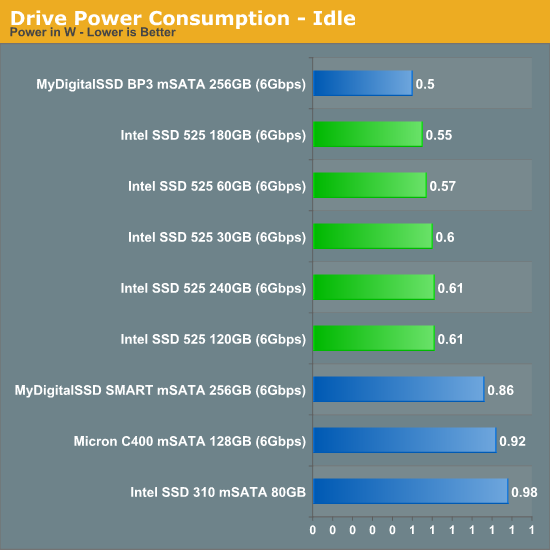
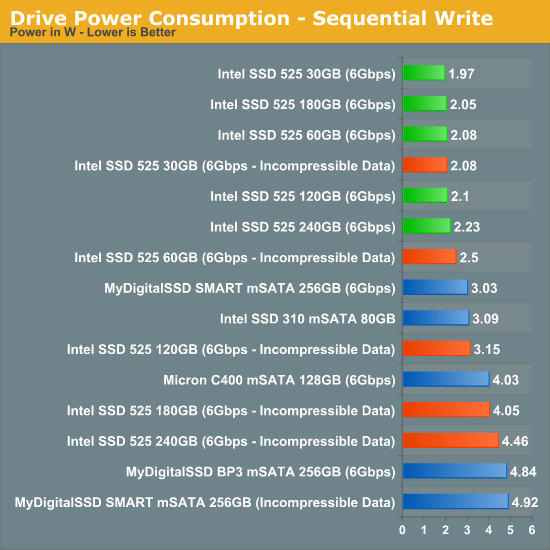
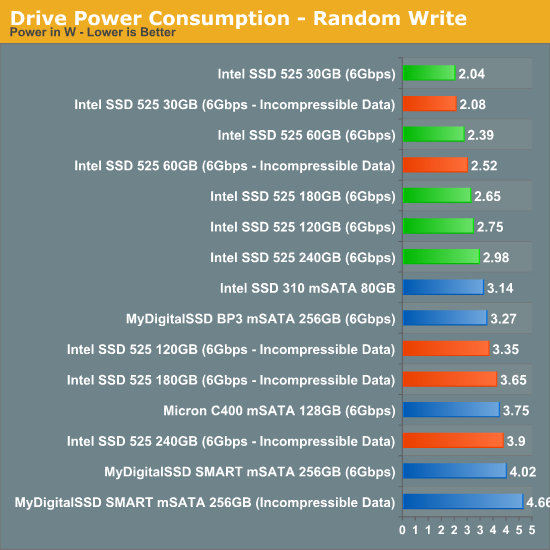
In our original 525 review I noticed lower idle power consumption compared to the Intel SSD 520, however higher active power consumption. It turns out that both active and idle power consumption should be lower than the 520. As is the case with all of our SSD reviews, we measure power consumption on the 5V rail going into the drive as most drives don't use 3.3V or 12V power. In the case of the 525, it will draw power on the 3.3V rail by default but when used in our mSATA to SATA adapter it is only fed power on the 5V rail. Measuring power at the mSATA to SATA adapter rather than at the mSATA board itself is likely the cause for this discrepancy. Update: We've measured 525 power consumption using the 3.3V rail supplied directly to the drive.
The numbers below are taken from drives using the same mSATA adapter, although actual power consumption in a system with a native mSATA connector should be lower for the 525 at least. Note that the 180GB 525 only has three NAND packages, which seems to positively influence power consumption in the easily compressible data access tests. Under incompressible data load the extra NAND die outweigh the power savings of only having three NAND packages.
Power consumption remains a strength of the 525, although I'd be curious to see how an mSATA Samsung 840 Pro would do here.
Originally published at https://www.anandtech.com/show/6725/the-full-intel-ssd-525-review-30gb-60gb-120gb-180gb-240gb-tested (Wayback Machine).