
NZXT Phantom 630 Case Review: The Relentless Pursuit of Perfection
Conclusion: The Enthusiast Chassis of Choice?
I think it's important to note that NZXT's flagship Phantom 820 was only released about three months ago. I'm not quite sure how NZXT was able to hit the kind of turnaround time they did with the Phantom 630, but this new release effectively obsoletes the older, more expensive model. That's no mean feat when you're talking about the successor of a case that won our Bronze Editor's Choice award, but what makes the Phantom 630 so impressive is the fact that it's able to meet or surprass the 820 in every meaningful way while costing $70 less.
The Phantom 630 is in this editor's opinion a better looking, better designed enclosure capable of providing top shelf thermal performance with very reasonable acoustics. This is the kind of case I'm talking about when I talk about the stratification of the enclosure market: below $100 you're going to see a balancing act of noise and thermals that tends to favor thermals, between $100 and $150 you're going to see better noise performance but the same balancing act, and when you go north of $150 you can and should expect a case that's both quiet and efficient. At $179, the 630 offers superior cooling performance with better-than-average acoustics. If noise is your utmost concern you're never going to really beat the Nanoxia Deep Silence 1, but the Phantom 630 is incredibly compelling otherwise.
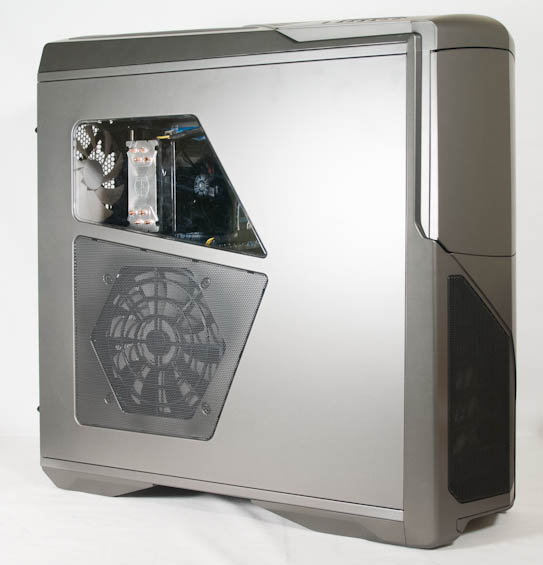
So why isn't the 630 Silver or Gold Editor's Choice material if it's directly better than a Bronze winner while costing less? For starters, $179 still isn't exactly a "value" price tag, even if you really do get what you pay for. Editor's Choice is about getting more than what you paid for; for example, an MSRP of $149 on the Phantom 630 might be unrealistic, but it would also be bulletproof (so keep your eye out for a good sale). The price is a nitpick; where the 630 loses points is in its continued use of those awful drive trays, and the strangely too-small routing hole for the AUX 12V line. The windowed side panel looks better than its predecessor and obviously contributes to the case's killer performance, but it's still a little ostentatious.
 I pick nits with the 630 because it's my job and because NZXT has built tremendous momentum as of late. My ideal refinement of this enclosure would be a reduction in the number of 5.25" bays from four to three or even two, allowing for increased and even more direct front intake, along with completely closed side panels. A little acoustic padding wouldn't be out of place, either. Add a mounting post to the motherboard tray, fix the AUX 12V routing hole, get sturdier drive trays, and find some way to make picking up the case without accidentally popping out the bottom fan filter easier.
If you like or at least don't mind the way the it looks, and you're in the market for an enthusiast class case with substantial liquid cooling potential, I'm really not sure you're going to be able to beat the NZXT Phantom 630. SilverStone's FT02 might still be better for air cooling (at least for air cooling the CPU), and the Thermaltake Level 10 GT and CoolerMaster Cosmos II might both be bigger and fancier, but the Phantom 630 is more feature rich, easier to move and assemble, and ultimately more forward thinking. Other companies should be keeping a close eye on what NZXT is doing. Absolutely recommended.
Originally published at https://www.anandtech.com/show/6681/nzxt-phantom-630-case-review-the-relentless-pursuit-of-perfection (Wayback Machine).