
Transcend SSD320 & SSD720 (256GB) Review
Random Read/Write Speed
The four corners of SSD performance are as follows: random read, random write, sequential read and sequential write speed. Random accesses are generally small in size, while sequential accesses tend to be larger and thus we have the four Iometer tests we use in all of our reviews.
Our first test writes 4KB in a completely random pattern over an 8GB space of the drive to simulate the sort of random access that you'd see on an OS drive (even this is more stressful than a normal desktop user would see). I perform three concurrent IOs and run the test for 3 minutes. The results reported are in average MB/s over the entire time. We use both standard pseudo randomly generated data for each write as well as fully random data to show you both the maximum and minimum performance offered by SandForce based drives in these tests. The average performance of SF drives will likely be somewhere in between the two values for each drive you see in the graphs. For an understanding of why this matters, read our original SandForce article.
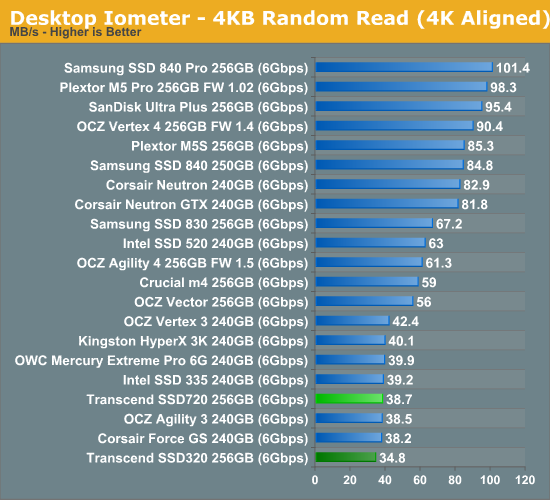
Random read performance is typical SandForce. The SSD320 comes in slightly slower, but the difference is a mere 3.9MB/s compared to SSD720.
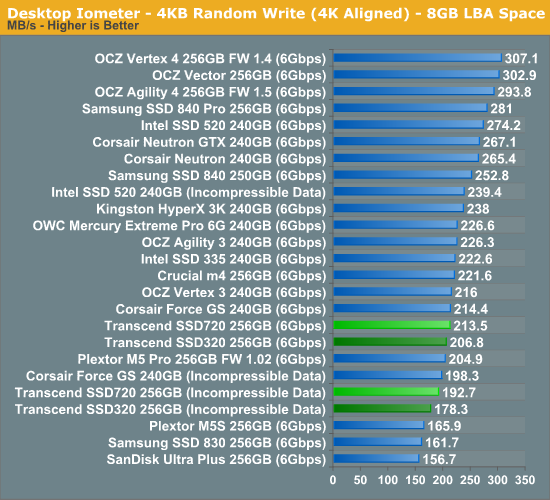
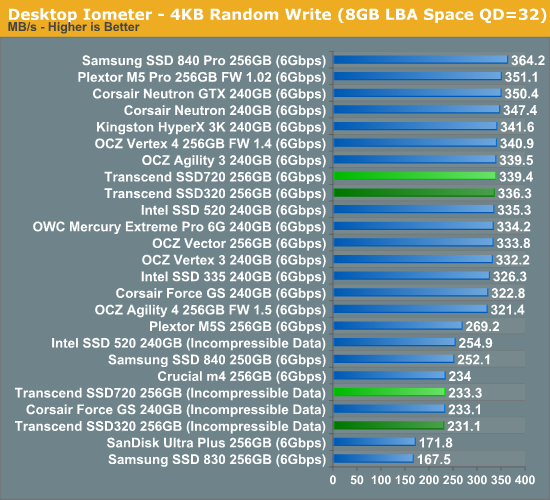
Same story with random write speed; the SSD720 performs hand in hand with Corsair's Force GS (except in QD32 test with compressible data, but Corsair had some issues with that particular aspect), though this is hardly a surprise given that they use identical NAND and the same stock firmware from SandForce. Due to SandForce's real-time compression, the slower NAND in SSD320 only shows up when the data is fed with incompressible data -- with compressible data the SF-2281 writes so little to the NAND that something else becomes a bottleneck even with asynchronous NAND.
Sequential Read/Write Speed
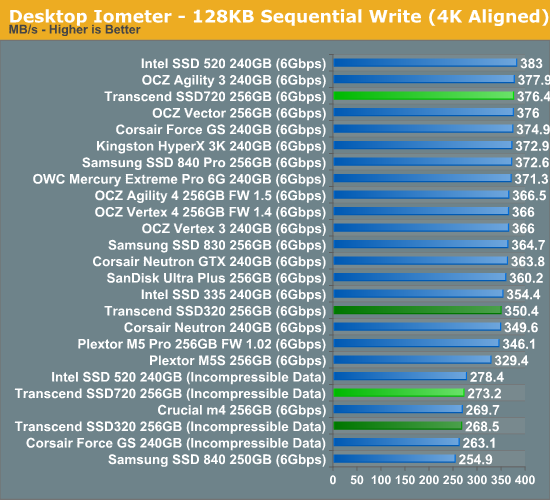
To measure sequential performance I ran a 1 minute long 128KB sequential test over the entire span of the drive at a queue depth of 1. The results reported are in average MB/s over the entire test length.
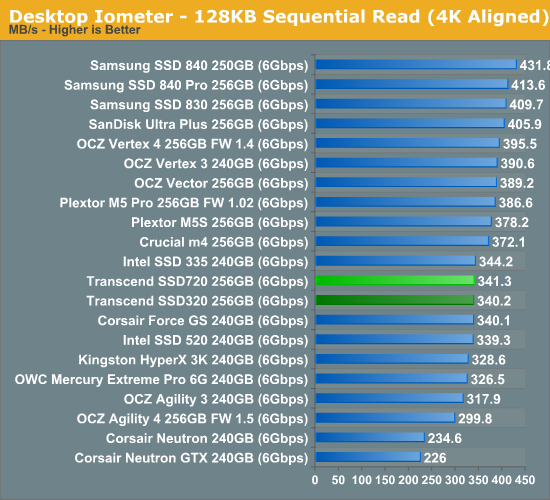
Moving to sequential tests, the SSD720 offers marginally faster write performance than the SSD720.
AS-SSD Incompressible Sequential Performance
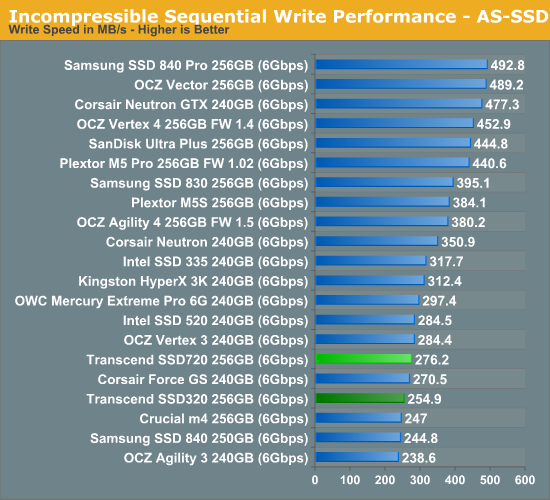
The AS-SSD sequential benchmark uses incompressible data for all of its transfers. The result is a pretty big reduction in sequential write speed on SandForce based controllers.
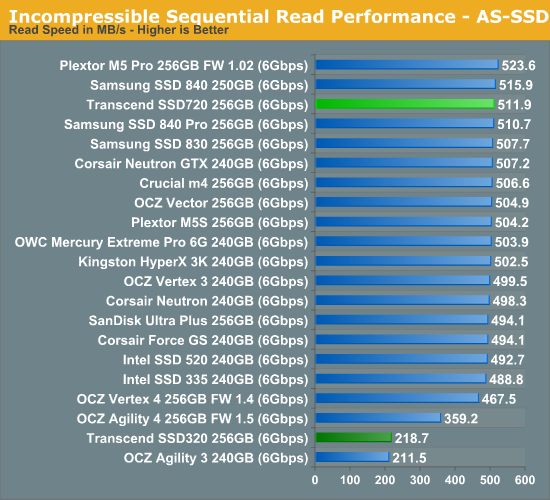
Asynchronous NAND has an enormous impact on incompressible sequential read speed as you can see above. The SSD320 and OCZ's Agility 3, another async NAND based SandForce SSD, perform poorly in this test. It's not a bug or error in our testing as I checked the product specs for the SSD320 and they specified that the maximum read speed for AS-SSD is 220MB/s. When using slower NAND, the performance will be handicapped in scenarios where the NAND is the bottleneck. In this case, the controller and SATA 6Gbps bus are capable of faster throughput but the NAND can't keep up. I believe SandForce's compression adds some overhead as well because the data has to be decompressed -- the Agility 4 with no compression is faster even though it's using async NAND as well.
Originally published at https://www.anandtech.com/show/6597/transcend-ssd320-ssd720-256gb-review (Wayback Machine).