
Lenovo ThinkStation D30 Workstation Review: 16 Cores and 32 Threads Under Your Desk
Build Quality
Speaking candidly, Lenovo's internal design for the ThinkStation D30 may be at least somewhat competitive with HP's Z820's interior, but it's worlds behind Dell's Precision T7600. The design philosophy Dell rolled out with the T3600, T5600, and T7600 is probably the most thoughtful and detailed one I've seen in the workstations I've tested; Lenovo's interior in the D30 is comparably very staid and even a bit archaic in some respects.
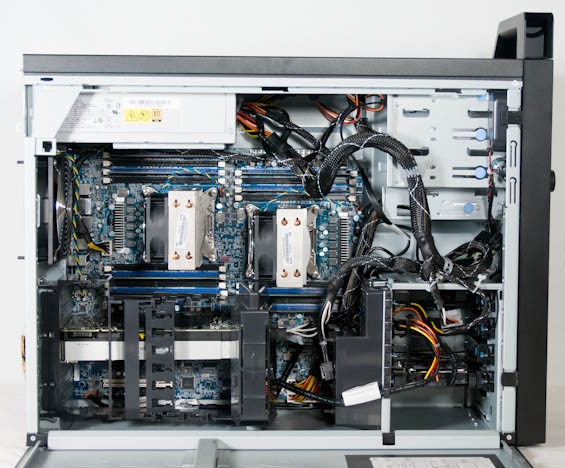
For starters, the cable management is pretty poor for a system like this. For comparison's sake, below is the interior layout of the smaller Dell T3600. This isn't the most fair comparison since the D30 is a deeper case and has to support two processors, but I think the decisions involved in the design come across well enough.
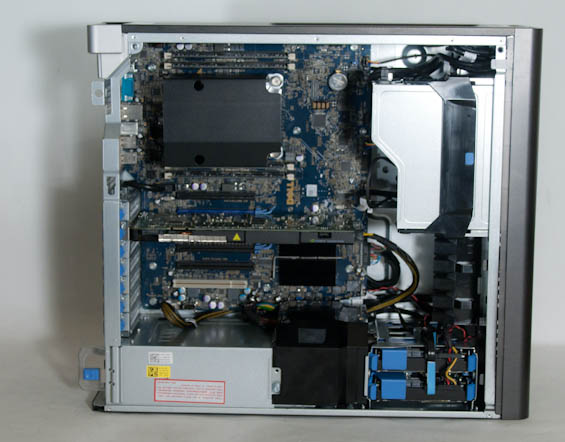
Quite frankly, Dell's design is just cleaner. A lot of this owes to the modular power supply design they're using in their modern workstations; power supplies are designed to be easily removed and replaced out of the back of the case by the end user. Meanwhile, Lenovo's design still has a mess of cables spewing out of the back of the power supply. It's just sloppy, and worse, if the PSU goes, that's going to mean a tremendous amount of downtime.
Noise, Heat, and Power Consumption
Unfortunately HWMonitor flipped its lid trying to read the operating temperatures of the D30, but monitoring the system under load with AIDA64 revealed generally reasonable thermal performance. Noise was also for the most part a non-issue as it often is with these workstations, which is really impressive when you think about it. Lenovo was able to keep the noise level below the 30dB floor of my sound meter at idle, and then under load it peaked at a noticeable but still very tolerable 34.5dB from a foot away.
As for power consumption, it goes without saying that the D30 is going to be a bit of a monster. The combined rated wattage of the CPUs and GPU is 452W on its own, and that's ignoring the eight DIMMs and 15K-RPM mechanical hard drive.
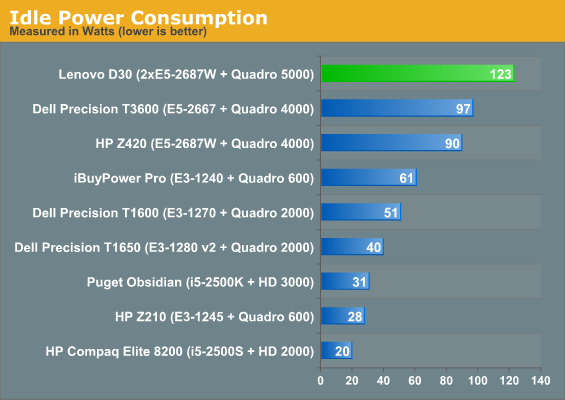
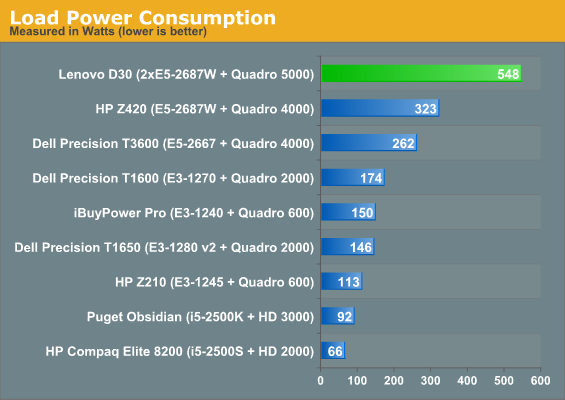
It takes a lot of juice to sit at the top of the charts, but when you're pushing for as much raw performance as you can get (as you would with a system like this one), power consumption is really going to be a secondary concern.
Originally published at https://www.anandtech.com/show/6456/lenovo-thinkstation-d30-system-review-16-cores-and-32-threads-under-your-desk (Wayback Machine).