
The Xeon Phi at work at TACC
One of the big selling points of the Xeon Phi is that you can simply run multi-threaded Xeon code on the Xeon Phi. If you want to get decent performance out of the Xeon Phi, that code should be compiled with the Intel C or fortan Compiler and the Intel MKL math libraries. In that case, Intel claims many "typical applications" get about 2 to 2.5 higher performance with the Xeon Phi. A few exceptions get more.
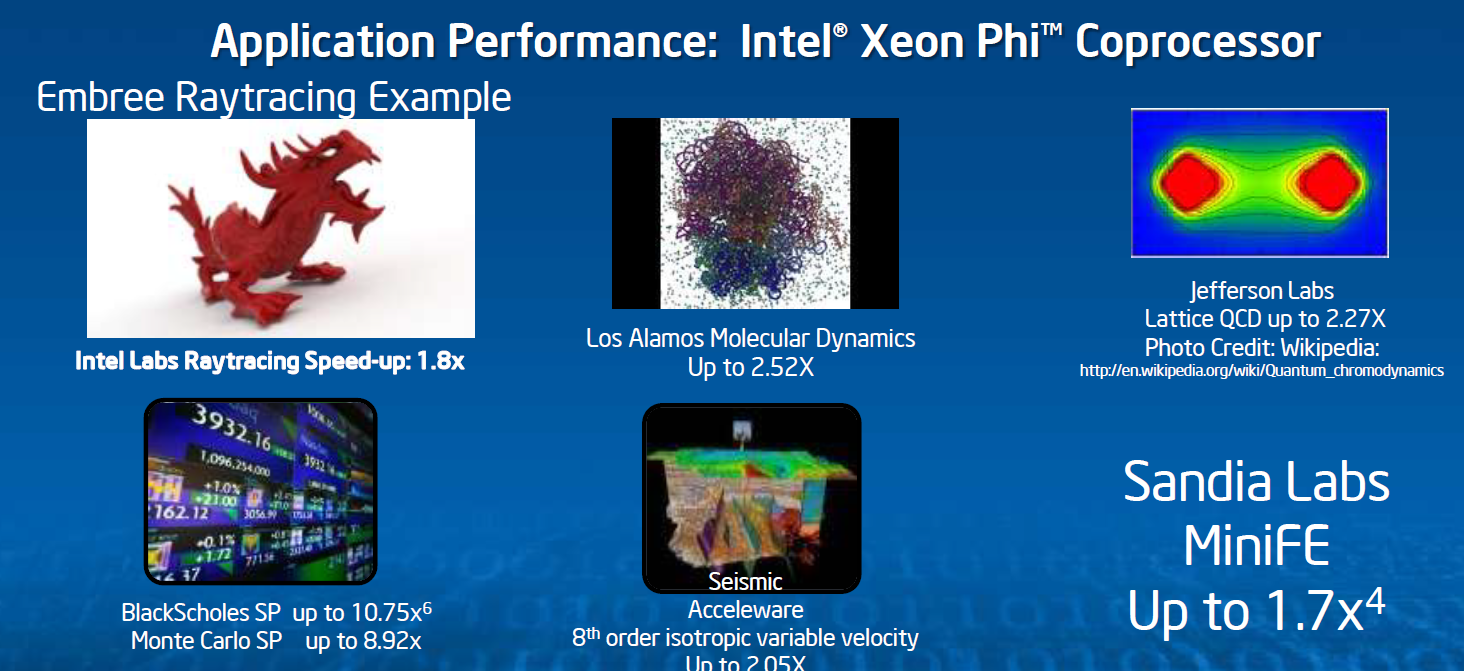
That is an impressive performance boost, but not earth shattering. These numbers are much more realistic than the typical benchmarks of 100x that are throw around by the GPU folks. Those benchmarks are typically comparing a single threaded non SIMD binaries running on a CPU to a fully threaded carefully tuned application running on a GPU.
The question remains in which applications a cheaper quad CPU solution is more effective. Before the Xeon E5 (Sandy Bridge EP) came out, AMD was quite succesful with their less expensive quad CPU platforms in the HPC world. It will be interesting to compare the performance per dollar and performance per watt of such quad CPU platforms with a CPU + Phi solution. There are certainly applications where the CPU + Phi wins hands down, but we are willing to bet that there are lots of HPC applications where it is a close call (e.g. highly threaded, but harder to vectorize code).
The point is of course that the time investment to get there is a lot lower than is the case with CUDA on NVIDIA's Tesla K20. We have heard from several companies that debugging CUDA code is still a pretty daunting experience. One good example can be found here. The maturity of the Intel compilers and high performance software is a big plus for the Xeon Phi. The numerous papers and OpenMP to CUDA frameworks/translators clearly indicate that porting OpenMP applications to CUDA is not necessarily straightforward. That in contrast with the Xeon Phi, where existing OpenMP applications run faster on the Xeon Phi without a recompile. OpenMP is simply the ecosystem where the Xeon Phi thrives. And Intel has an excellent track record when it comes to supporting OpenMP in its compilers.
The Xeon Phi might also prove to be a bit more flexible and forgiving. The Xeon Phi architecture still, at a high level, resembles a general purpose Xeon core. We're talking about 60 in-order x86 cores with wider SIMD units, a 512KB L2 feeding 4 threads per core.
GPUs on the other hand are built for more "extreme" parallelism: hundreds of stream processors, with small shared L1-caches and one relatively small L2-cache.
We'll have to hold final judgement until we get a Xeon Phi equipped system in house, but our first impressions are that the Xeon Phi looks like a more cost effective, potentially easier to use alternative to high-end GPUs for HPC.
Originally published at https://www.anandtech.com/show/6451/the-xeon-phi-at-work-at-tacc (Wayback Machine).