
G.Skill TridentX Review: 2x4GB at DDR3-2666 C11-13-13 1.65V
Conversion – Xilisoft 7
Another classic example of memory bandwidth and speed is during video conversion. Data is passed between the memory and the CPU for processing – ideally faster memory here helps as well as memory that can deal with consecutive reads. Multiple threads on the CPU will also provide an additional stress, as each will ask for different data from the system. If we combine this with the capability of using GPUs that Xilisoft Video Converter 7 allows, we can attempt to really tax the memory. Our test consists of converting 26GB of various sized videos (1080p to VGA), totalling 45+ hours of video time, to MP2 format using our test bed.
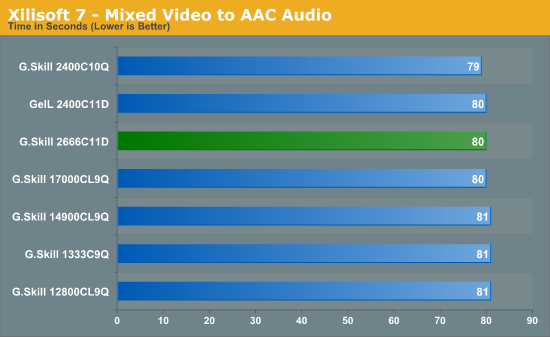
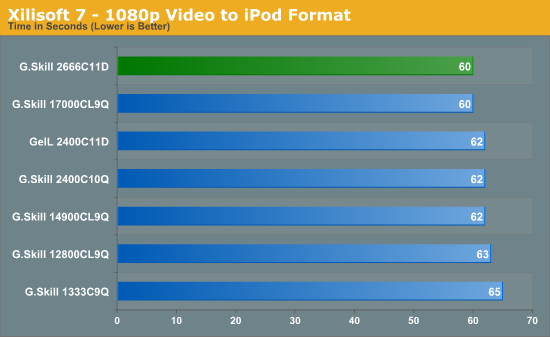
In both of our conversion tests there seems to be a hard limit at which the CPU becomes more of the limiting factor – as the CPU cannot process data quickly enough, any copy times or latency to the memory are hidden by the lack of CPU power. As a result, we do not see any speed up beyond 1600 C9/1866 C9.
Folding on GPU
Memory usage is all algorithm dependent – if the calculation has a lot of small loops that do not require additional reads memory, then memory is unimportant. If the calculation requires data from other sources in those calculations, then memory can either be stressed randomly or sequentially. Using Ryan’s Folding benchmark as a platform, we are testing how much memory affects the serial calculation part of a standard F@H work unit.
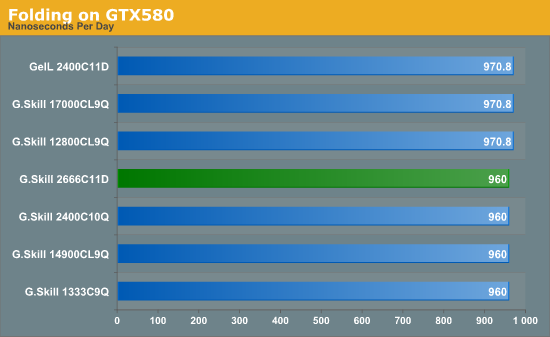
As before, the serial copying to the GPU, or CPU specific code, is not affected by memory speed when GPU Folding.
WinRAR x64 4.20
When compressing or converting files from one format to another, the file itself is often held in memory then passed through the CPU to be processed, then written back. If the file is larger than the available memory, then there is also loading time between the storage and the memory to consider. WinRAR is a variable multi-threaded benchmark, whereby the files it converts and compresses determines how much multi-threading takes place. When in multithreaded mode, the rate of cache misses can increase, leading to a less-than optimal scaling. Having fast memory can help with this.

Our WinRAR test remains the standout test in terms of what memory can improve. WinRAR deals a lot with memory accesses, so having that faster memory can help with compressing data. As we see, the 2666C11D has an advantage over the 2400C10Q by 22 seconds, or around 5%. While WinRAR may not follow exactly the proportions that the MemTweakIt software predicts, it has shown the order in which these kits should perform.
Greysky's x264 HD 5.0.1
The x264 HD test, now version 5.0.1, tests the time to encode a 1080p video file into a high quality x264 video file. This test is standard across a range of reviews from AnandTech and other websites allowing for easy comparison. The benchmark is capable of running all cores to the maximum. Results here are reported as the average across four attempts for both the first and second passes.
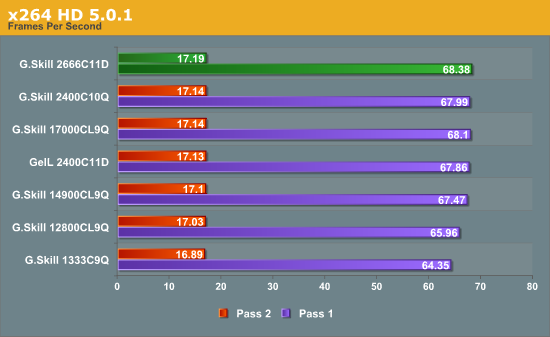
For our x264 test, the 2666 C11 does come out top, albeit by the smallest of margins. Moving from 1333 C9 we are still only getting a 6% increase in frame rates – similar scores are achieved with 2133 C9.
Originally published at https://www.anandtech.com/show/6389/gskill-tridentx-review-2x4gb-at-ddr32666-c111313-165v (Wayback Machine).