
Lian Li PC-A55 Case Review: Unfortunate Name Befits the Design
Noise and Thermal Testing, Overclocked
Lian Li's PC-A55 is the first time I've actually been nervous about thermally testing a case. The CPU cores were already pushing the mid-to-high 80s at stock settings under load; how was this whole thing going to fare when I bumped up the clocks and pumped more voltage through the CPU and graphics card? As it turns out, it wasn't going to fare well at all, and I'm thankful we live in an era where our hardware has thermal protections in place. Ten years ago, I likely would've had to replace most of the testbed after this.
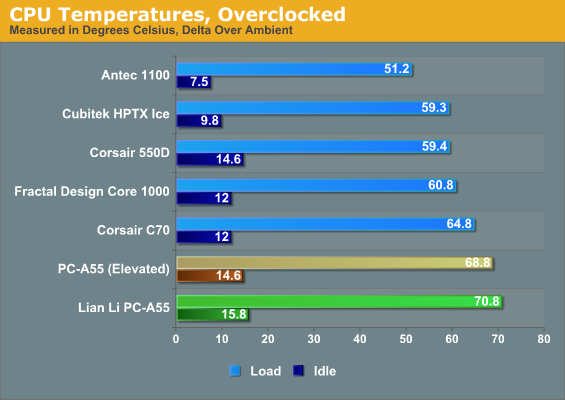
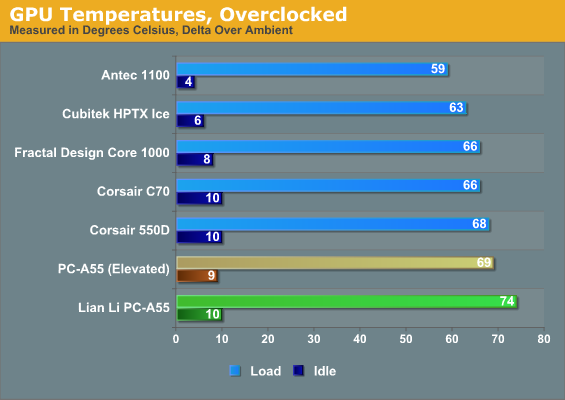
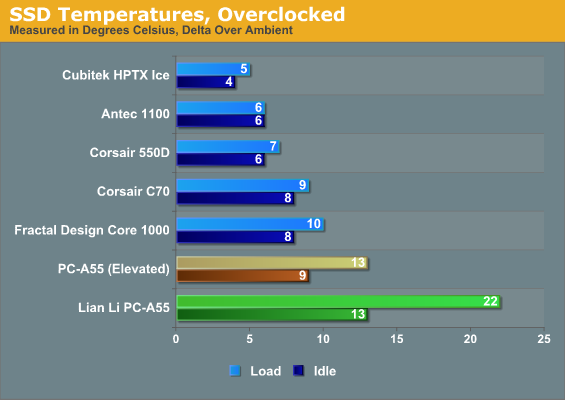
On the charts it doesn't look as bad, but keep in mind that the Intel Core i7-2700K's cores were actually hitting 95C with the case elevated, and 98C without. The GeForce GTX 560 Ti was also peaking at 95C. All of this in a room with an ambient temperature of about 24C, a temperature which isn't terribly uncomfortable or unreasonable. If the PC-A55 had a hard time dealing with a stock system, it flat out couldn't deal with any kind of overclocking. What's worse, look at how heat builds up around the SSD and imagine what would happen if a mechanical drive were used.
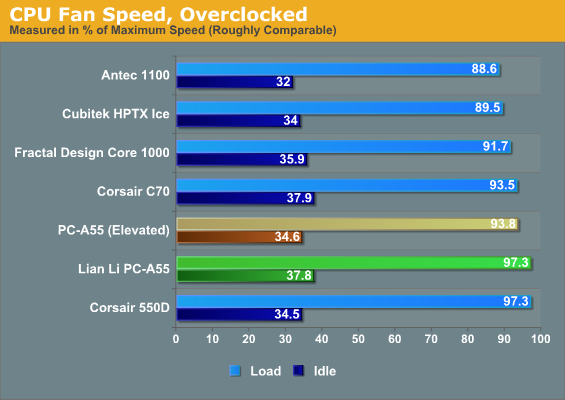
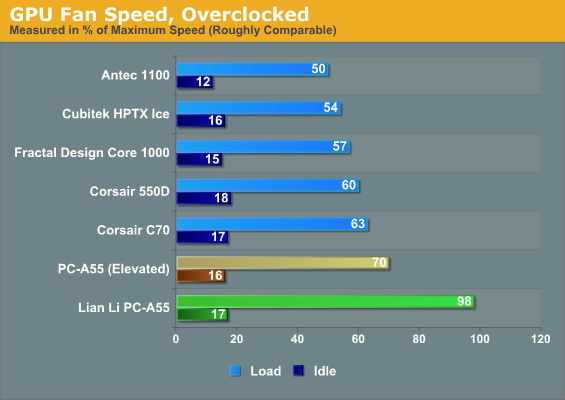
Our Cooler Master Hyper 212 Evo was being pushed as hard as it possibly could and the CPU thermals were still hitting the maximum spec. The normally efficient custom cooler on the ASUS GeForce GTX 560 Ti had just as hard a time, with the fan basically maxing out under load. Lian Li's design has virtually no thermal headroom. With the elevated testbed, the GPU does better, but even so it places last out of our set of cases.
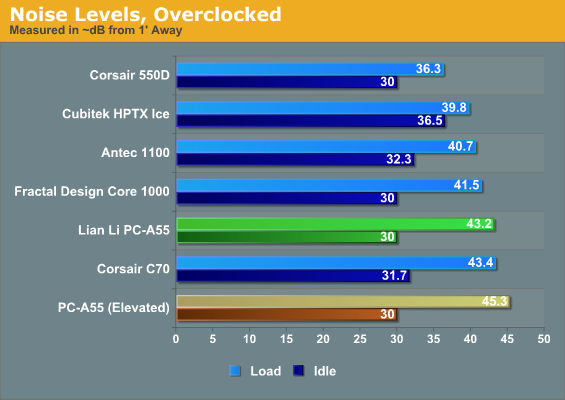
The PC-A55 basically winds up being our worst-case scenario on almost all fronts. While it remains quiet at idle, under load it's very noisy and uncomfortable to listen to, due to the fact that the fans running inside are all going at full bore. As a side note, because of the aluminum shell, the top of the case was actually almost painfully hot to the touch when tested under these conditions. Putting the case on a flat surface helped thermals a bit, but also gave noise one more place to escape, causing it to run even louder.
Originally published at https://www.anandtech.com/show/6012/lian-li-pca55-case-review-unfortunate-name-befits-design (Wayback Machine).