
Lian Li PC-A55 Case Review: Unfortunate Name Befits the Design
Noise and Thermal Testing, Stock
When testing the Lian Li PC-A55 I came upon a real conundrum. It's easy to argue our traditional assembly is less than ideal for testing this case, and the usual testing conditions unfortunately involve testing it on a thinly carpeted floor. At the same time, these are the exact same conditions that every other case was tested under, so making these allowances for the PC-A55 would potentially skew the results.
There was also the distant possibility that a second set of tests would give the PC-A55 some breathing room, so to speak. I originally made a judgment call and decided against testing on a different surface, but we eventually decided it was best to show what would happen if the case isn't on carpet. The results certainly improve, though not as much as you might want, and ultimately more data is always good to have.
With summer now here in Northern CA, my AC is working overtime to keep temperatures in check. I tested the PC-A55 under our standard conditions with an ambient temperature of approximately 24C, and again using the side panel of an Antec P280 as a flat surface on the carpet; those results are the ones labeled "elevated."
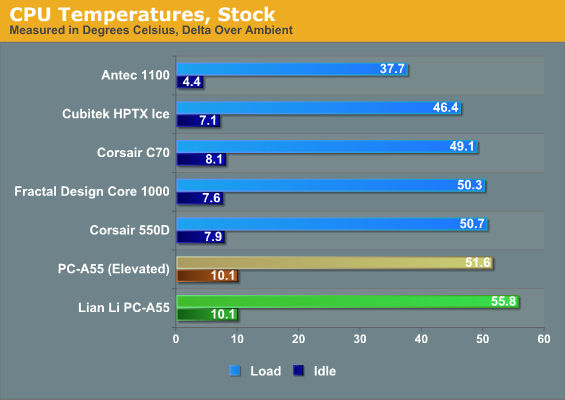
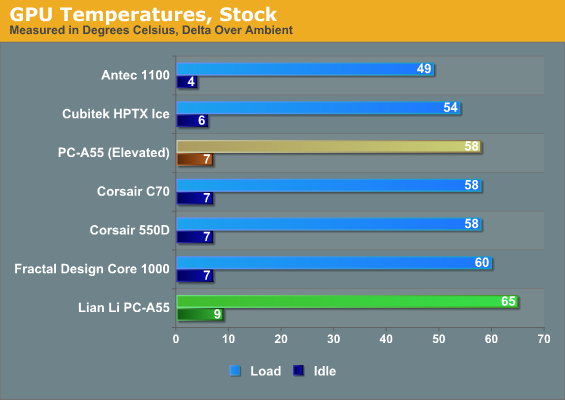
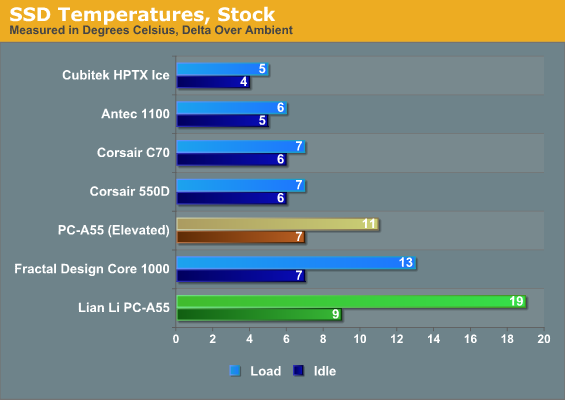
At stock, the thermal results of the PC-A55 aren't horrible, but they're still near the back of the pack—and on the carpet, the PC-A55 really lives up to its name. The SSD runs particularly hot, and that's due to the fact that there's no airflow around either of the 2.5" mounts. In an ideal situation, air is channeled up from the bottom 140mm fan, through the left side of the case, and out of the top 140mm fan. There's literally no ventilation anywhere near any of the drive bays and we're forced to rely on the aluminum building material to channel heat off of the drive.
Even that wouldn't be too bad, except that due to the way the drive mounts to the cage and the bottom of the enclosure, there's a small gap between it and the aluminum surface of the case. 43C is probably still okay for an SSD, but it's at the limit of where I'd be comfortable, and the rest of the storage bays are likely to be just as hot. Running a couple 3.5" HDDs sandwched together in this sort of enclosure is not something I would recommend.
Elevating the PC-A55 does improve temperatures substantially, but not really enough to make it competitive. The one to beat here is the Corsair Obsidian 550D, which performs comparably thermally but as you'll see in a moment it runs much quieter.
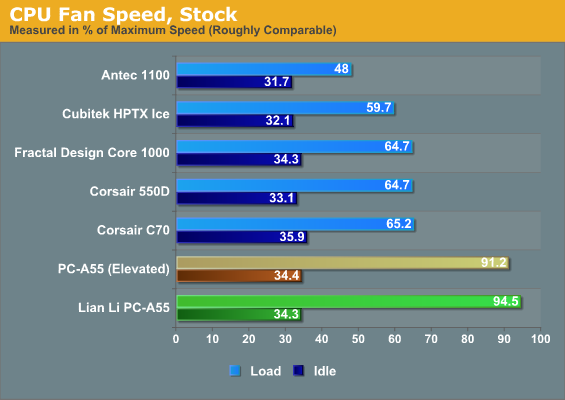
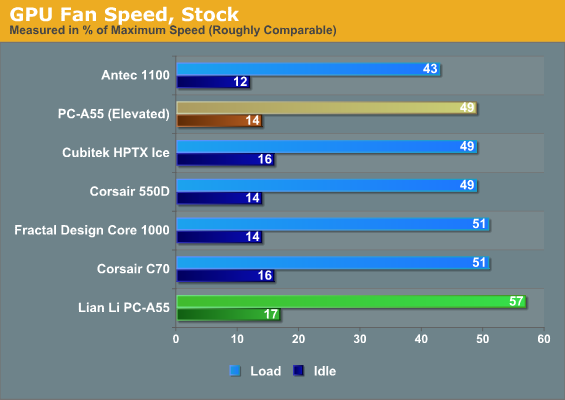
Even at stock clocks the CPU fan is already running nearly full tilt under load, while the graphics card fans are running at higher than usual settings. Putting the PC-A55 on a flat surface (or resting it on its side) and allowing cool air inside at least mitigates the video card's fan speed, but the CPU fan is still suffocating.
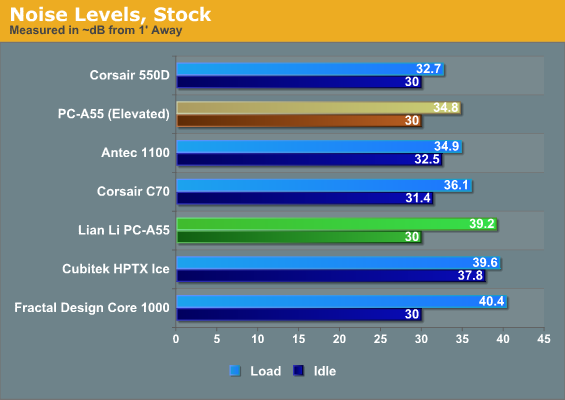
Thankfully Lian Li's case runs fairly quiet despite essentially cooking itself. Having only two fans (one of which is muffled in the bottom) allows the PC-A55 to run below the noise floor of our sound meter at idle, while load noise is bad but not horrible. Keep in mind that part of this is because there's virtually nowhere for sound to escape either, though; the only ventilation the PC-A55 really has is through the top fan.
Originally published at https://www.anandtech.com/show/6012/lian-li-pca55-case-review-unfortunate-name-befits-design (Wayback Machine).