
NEC PA271W - When Accuracy and Consistency Matter
NEC PA271W - Input Lag and Power Use
The last 27” display I tested, the HP ZR2740w, was a pleasant surprise for gaming as it had a very low lag time despite the IPS panel and high resolution, likely due to the lack of an internal scaler or LUT to add a delay. Since the NEC has a scaler, and the additional custom electronics to provide display uniformity, I wasn’t certain that the NEC would perform as well.
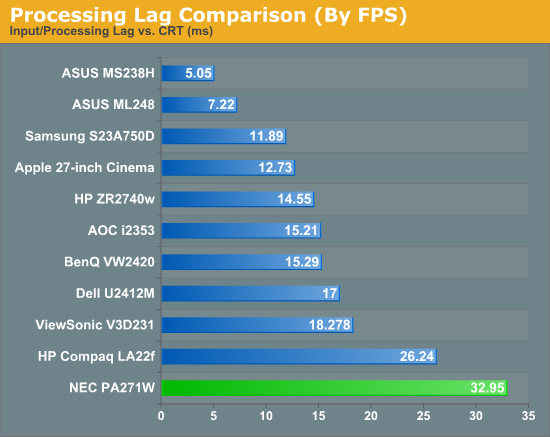
As you can see, the NEC is not going to be a display for a serious gamer, though it really isn’t targeting that market either. The input lag was 20.5 ms, and the pixel response took 24.9 ms to go from blue to yellow to blue, giving us an overall response time of 32.95 ms. The effective (subjective) lag was a little better, but with that high input lag it was still close to 25 ms, which is more than most serious gamers would be interested in. If you want a 27”, 2560x1440 resolution display for gaming the HP is still your best option.
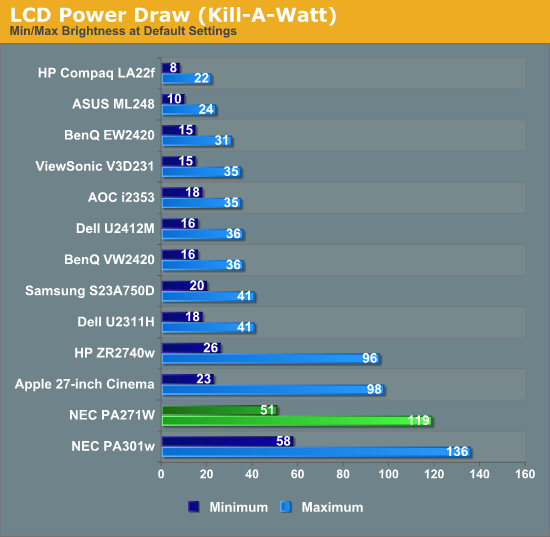
The PA271W has a built in power use monitor showing you how much power you are using with the display, so being efficient is something that it does aim to do. With the backlight set at minimum we used 51 watts, and at maximum we used 119 watts. These were both worse than the HP as well, but since the HP uses an LED lighting system we would expect it to come in behind. Since the LED lighting system provided for a smaller gamut than the NEC's CCFL system produced, and a less uniform screen, I’m certain that had something to do with NEC's decision to stay with the CCFL technology on this panel. Power use wasn’t bad, it just wasn’t exceptional, and any 27” display is going to use far more power than a 24” or smaller one.
Originally published at https://www.anandtech.com/show/5752/nec-pa271w-when-accuracy-and-consistancy-matter (Wayback Machine).