
990FX Motherboard Roundup with Thuban and Bulldozer – A Second Wind for ASUS, Gigabyte, MSI and Biostar
USB Speed
For this benchmark, we run CrystalDiskMark to determine the ideal sequential read and write speeds for the USB port using our 64GB Patriot SuperSpeed USB 3.0 drive. Then we transfer a set size of files from the SSD to the USB drive, and monitor the time taken to transfer. The files transferred are a 1.52 GB set of 2867 files across 320 folders – 95% of these files are small typical website files, and the rest (90% of the size) are the videos used in the Sorenson Squeeze test.
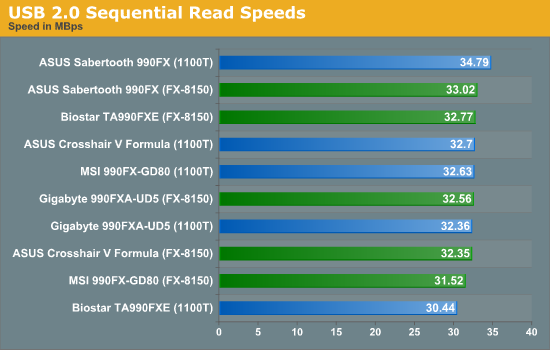
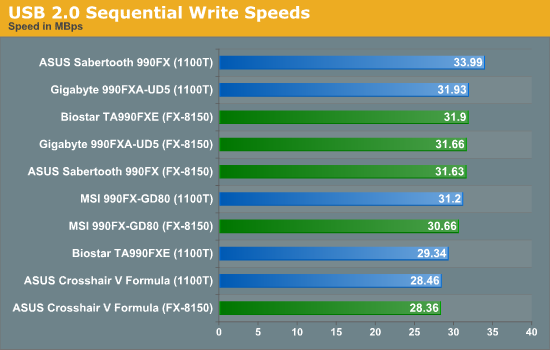
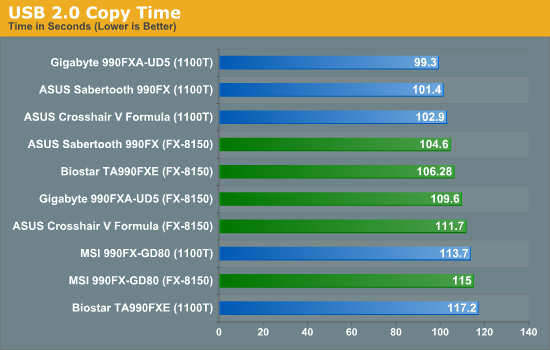
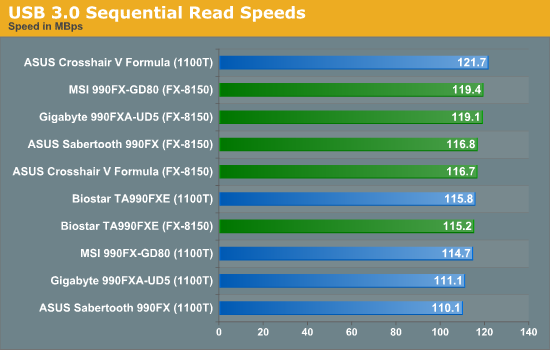
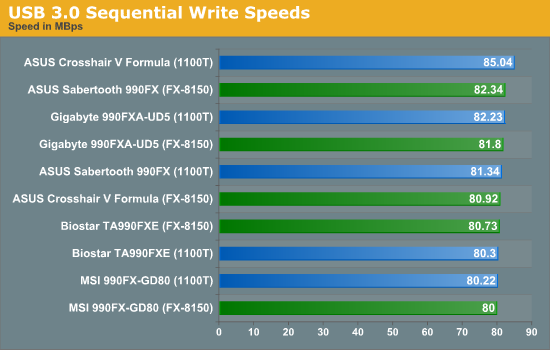
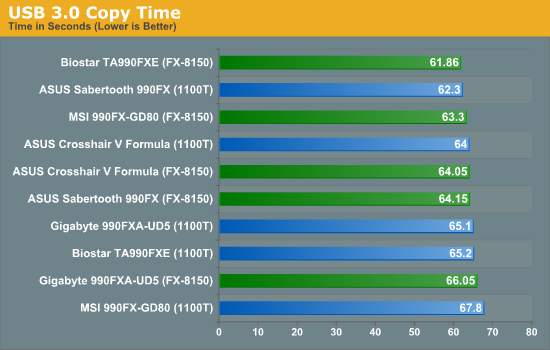
A lot of how the system deals with USB interactions is based on the hardware, including BIOS stated priorities, but also on the software and drivers supplied. This results in our spread on USB 2.0 and USB 3.0 speeds/times. On the whole the Sabertooth 990FX is a good performer, while the MSI tends to lag behind in real world testing.
SATA Testing
We also use CrystalDiskMark for SATA port testing. The operating system is installed on the SSD, and the sequential test is run at the 5 x 1000 MB level. This test probes the efficiency of the data delivery system between the chipset and the drive, or in the case of additional SATA ports provided by a third party controller, the efficiency between the controller, the chipset and the drive.
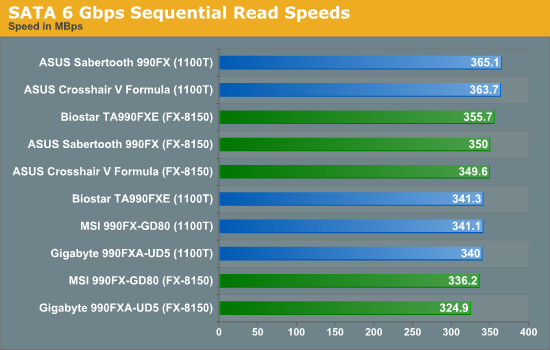
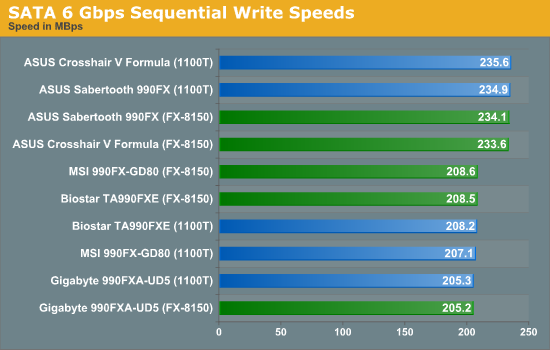
For SATA testing, again we get a processor independent spread. The interesting thing here is the SATA 6 Write results, in which the ASUS boards clearly have an advantage over the other products. This is most likely due to more agressive BIOS settings at default.
DPC Latency
Deferred Procedure Call latency is a way in which Windows handles interrupt servicing. In order to wait for a processor to acknowledge the request, the system will queue all interrupt requests by priority. Critical interrupts will be handled as soon as possible, whereas lesser priority requests, such as audio, will be further down the line. So if the audio device requires data, it will have to wait until the request is processed before the buffer is filled. If the device drivers of higher priority components in a system are poorly implemented, this can cause delays in request scheduling and process time, resulting in an empty audio buffer – this leads to characteristic audible pauses, pops and clicks. Having a bigger buffer and correctly implemented system drivers obviously helps in this regard. The DPC latency checker measures how much time is processing DPCs from driver invocation – the lower the value will result in better audio transfer at smaller buffer sizes. Results are measured in microseconds and taken as the peak latency while cycling through a series of short HD videos - less than 500 microseconds usually gets the green light, but the lower the better.
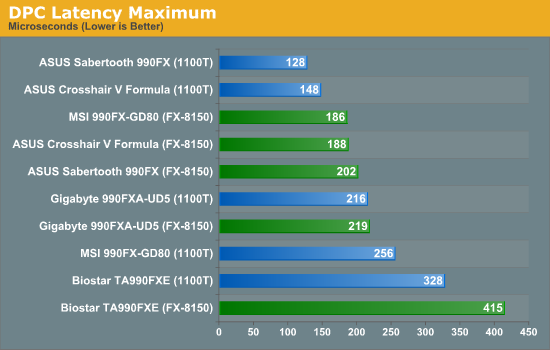
DPC Latency always shows the biggest differences between our motherboards. It is hampered by the fact that it can be disturbed by software. In particular, ASUS' AI Suite and Gigabyte's EasyTune software, when installed, initialise themselves on startup and continuously monitor the motherboard sensors (by pinging them every 3-5 seconds). This request for data has a higher priority, and thus when we do our DPC checks, those boards when the software is enabled shoot up to 3000 microseconds or more. For these tests, we disable the software (as it shows uncharacteristic spikes) to take a reading while playing HD video. In this case, we can confirm that ASUS do it best, and you get what you pay for with respect to the Biostar motherboard.
Originally published at https://www.anandtech.com/show/5714/990fx-motherboard-roundup-with-thuban-and-bulldozer-a-second-wind-for-asus-gigabyte-msi-and-biostar (Wayback Machine).