
Intel’s Sandy Bridge i7-2820QM: Upheaval in the Mobile Landscape
- Posted in
- Laptops
- Intel
- Sandy Bridge
- Compal
All the Performance, and Good Battery Life As Well!
We’ve just finished showing that CPU and GPU performance has basically more than doubled compared to last year’s Arrandale offerings. That’s great news, but what happens to battery life? We’ve got 35W TDP Arrandale parts compared to a 45W TDP Sandy Bridge quad-core; doesn’t that mean battery life will decrease by around 25%? The answer is happily no; as we’ve point out in the past, TDP isn’t really a useful measurement of power requirements. All the TDP represents in this case is the maximum amount of power Sandy Bridge should draw. So worst-case battery life under full load might drop, but the real question is going to be what happens under typical workloads.
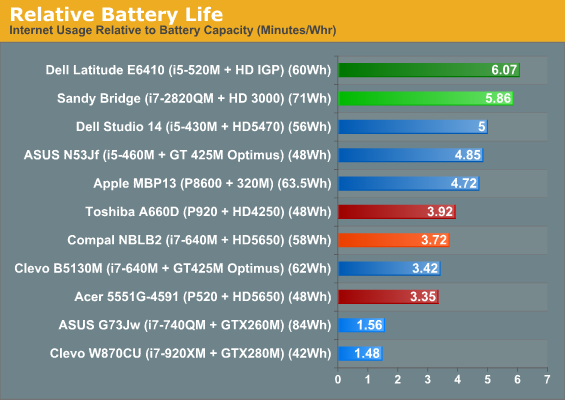
Intel’s use of power gating and variable clock speeds is put to good use, with the result being battery life that is nothing short of exceptional when compared to previous generation products. We’ve seen ULV and Atom netbooks and ultraportables get battery life into the 8+ hour range, but such designs have always required serious compromise in the performance department. SNB certainly won’t beat out Atom for pure battery life, but that doesn’t mean it’s a power hog. Our Compal test system comes with a 71Wh battery, which is larger than what we’ve seen in many 15.6” and smaller designs but still reasonable for a 17.3” chassis. Here are the results of our standard battery life testing.
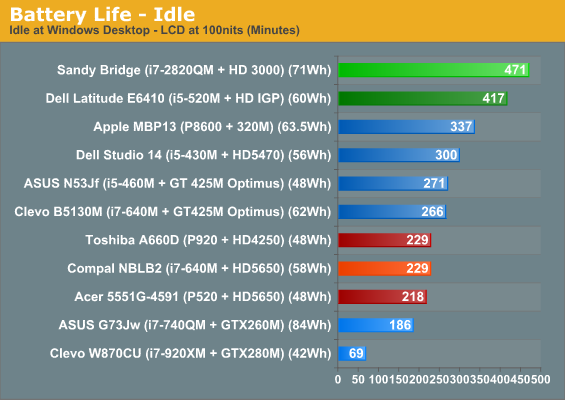
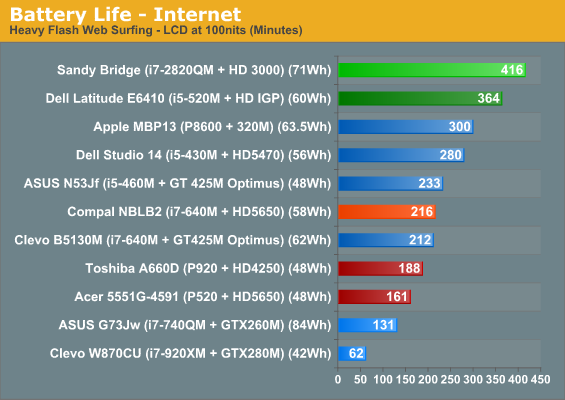
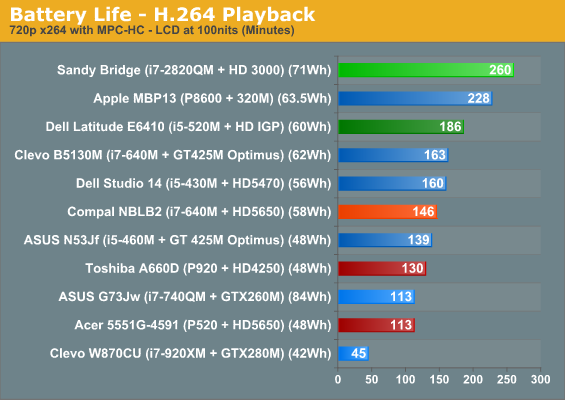
Yes, those figures are accurate. Best-case, running at 100nits, quad-core Sandy Bridge still lasted nearly eight hours on a single charge! What’s more interesting is that our standard Internet battery life test that loads four pages with Flash ads every sixty seconds still checks in just shy of seven hours. Finally, H.264 playback also comes in at the top of our charts, providing more than four hours of demanding video playback. If 240 minutes of content off your HDD/SSD isn’t enough, we also were able to watch a Blu-ray disc and still get 220 minutes of 35Mbit VLC playback. Wow!
So Sandy Bridge comes out on the top of the above charts, but we didn’t include some of the other long battery life alternatives. Just to put things in perspective, ASUS’ U30JC—with an SSD and an 84Wh battery—has long been our king for matching reasonable performance with long battery life. It managed 588 minutes idle, 476 minutes Internet, and 254 minutes H.264 playback. That’s 25% more idle life, but only 14% better Internet and actually slightly lower H.264 battery life, and you need to factor in the 18% higher capacity battery and 13.3” (versus 17.3”) LCD.
We have to wonder just how small of a form factor manufacturers can manage to cram the quad-core Sandy Bridge into. Idle and low usage power requirements are clearly very good, but with maximum TDP still at 45W the chassis needs to be able to handle the heat. We’d really love to see some 14” designs with quad-core CPUs, and the icing on the cake would be sticking a reasonably fast discrete GPU with graphics switching technology into the case as well. Intel doesn’t have any LV/ULV quad-core parts listed—yet!—so we may have to wait for ultraportable quad-core laptops, but certainly 15.6” designs should be able to combine SNB with reasonably fast Optimus GPUs to provide an optimal blend of performance and mobility.
Originally published at https://www.anandtech.com/show/4084/intels-sandy-bridge-upheaval-in-the-mobile-landscape (Wayback Machine).