
Intel’s Sandy Bridge i7-2820QM: Upheaval in the Mobile Landscape
- Posted in
- Laptops
- Intel
- Sandy Bridge
- Compal
Extended Compatibility and Performance Results – Medium Detail
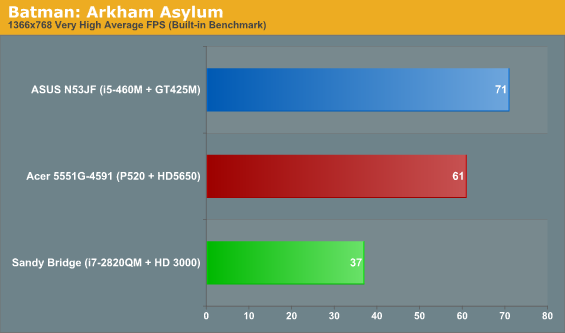
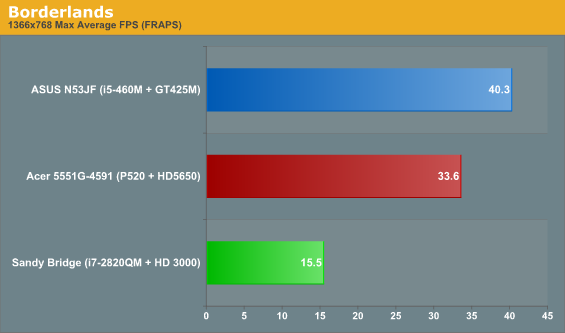
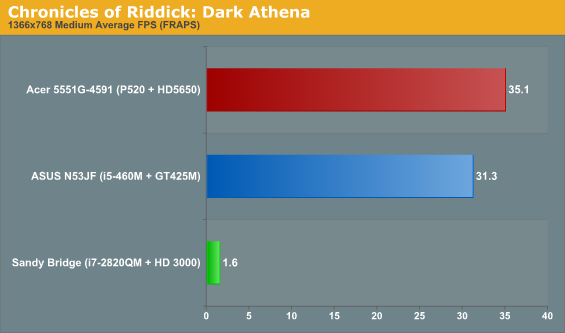
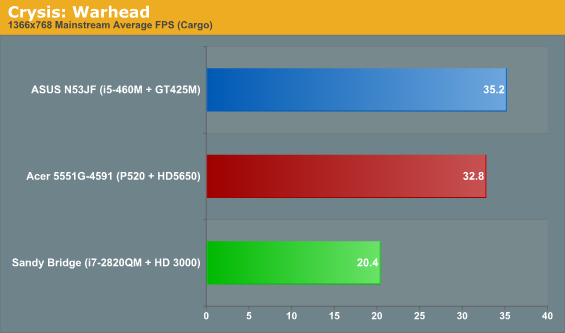
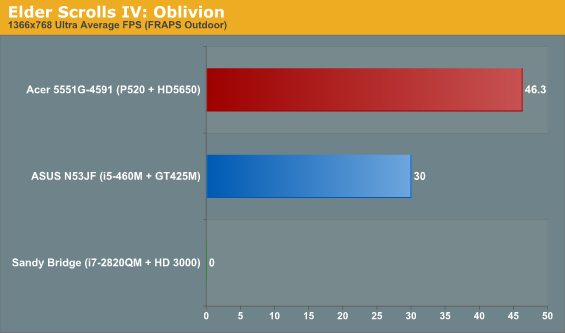
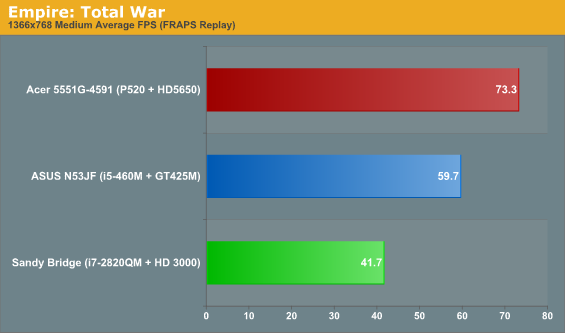
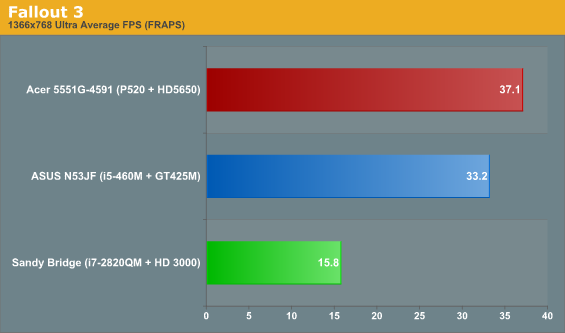
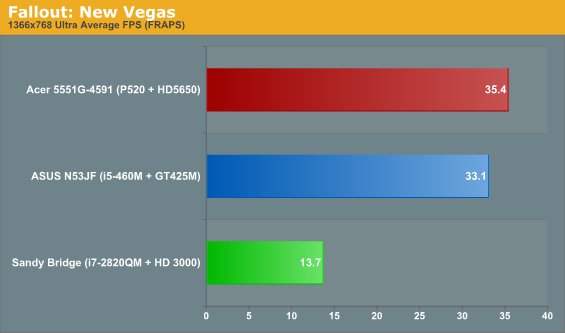
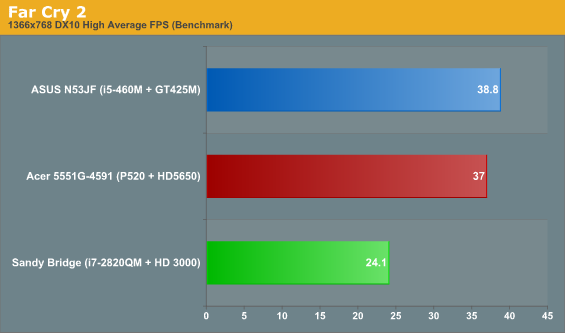
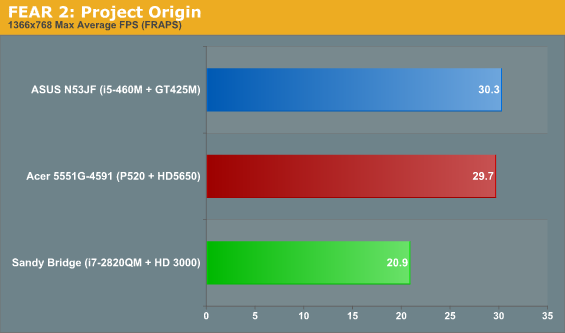
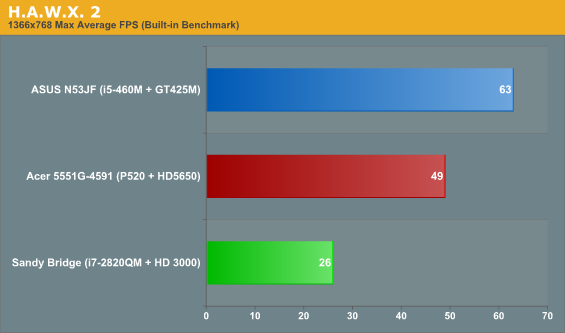
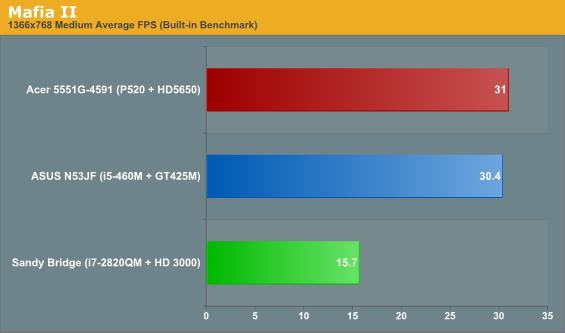
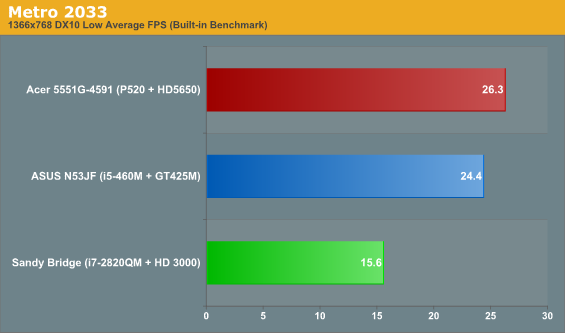
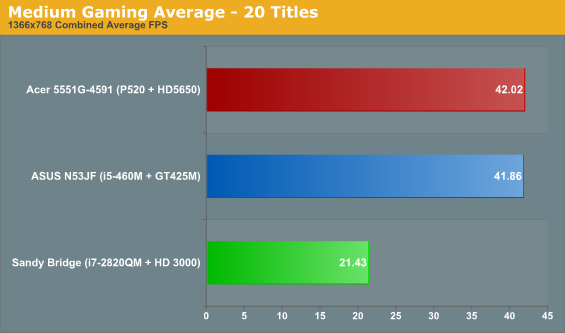
Bumping quality settings up to Medium puts the screws to the HD 3000, dropping nearly every test game below 30FPS. Besides Mass Effect 2 and STALKER (which we mentioned on the previous page), only Empire: Total War breaks the 30FPS mark, and it’s not even a clear victory there. Yes, Intel can run Medium detail at 42FPS, but the game prevents us from selecting the “High” defaults, which is where we would have preferred to test. (This is possibly another case of blacklisting, although not as severe as Fallout 3.)
At our Medium settings, the discrete GPUs easily pull away from Sandy Bridge, with both the Acer 5551G and ASUS N53JF nearly doubling (95-96% faster on average) the HD 3000. Rendering quality also gets worse in HAWX 2, with the entire skybox missing once detail levels are increase, so you get a black sky. (It’s still better than the horribly corrupted rendering that Arrandale’s IGP managed at lower settings.)
Ultimately, Sandy Bridge’s IGP is far more capable than many would have expected. Sure, it doesn’t even try to support DX11 or OpenCL, but at least for gaming DX11 is typically too much for even midrange GPUs. Intel uses 114 million transistors in Sandy Bridge on the graphics, which is quite small considering transistor counts on other GPUs. The HD 5470 for example—a chip that is frequently surpassed by HD 3000—has an estimated count of 242 million transistors.
This is where Intel’s manufacturing prowess comes into play, as SNB uses a refined 32nm process that allows Intel to push clock speeds far higher than other competing offerings. What’s more, late 2011 should bring the follow-up Ivy Bridge processor, which shrinks the process even further to 22nm. At that node, Intel could potentially double the number of EUs (Execution Units) and further increase clocks. If Intel puts the requisite effort into improving driver compatibility and adds DX11 support, and if rumors of high-bandwidth stacked memory prove true, next year we could see integrated graphics reach the point where they match HD 5650/GT 425M, effectively killing off anything less than the upper-midrange and lower-high-end discrete GPUs.
Originally published at https://www.anandtech.com/show/4084/intels-sandy-bridge-upheaval-in-the-mobile-landscape (Wayback Machine).