
HP Mini 5103: Looking at the Dual-Core Atom N550
HP Mini 5103 Performance
The big question we want to answer today is what sort of impact a slower core clock with a dual-core CPU has on performance and battery life. HP says that in general they’re seeing about a 20-25% performance improvement relative to the 5102, though that of course depends on what sort of applications you’re running. Here’s our standard set of general performance benchmarks.
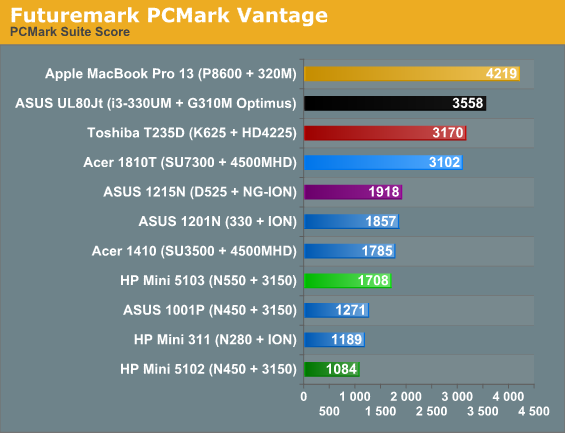
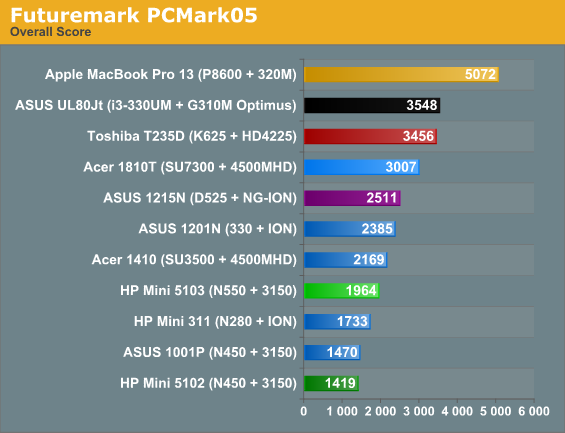
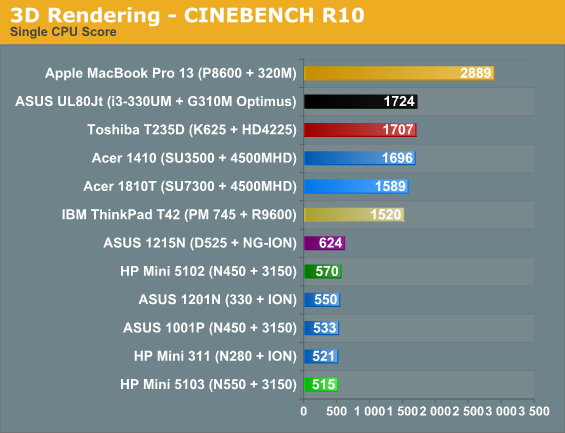
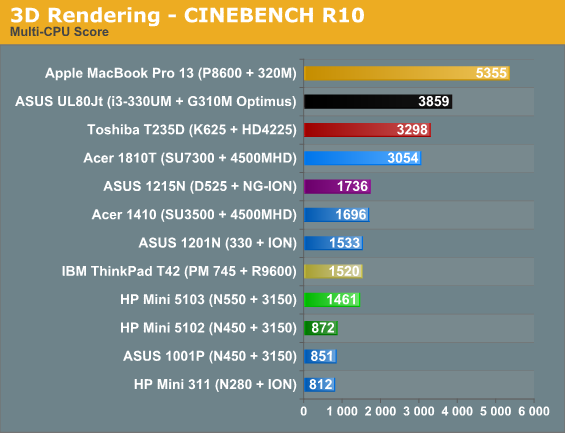
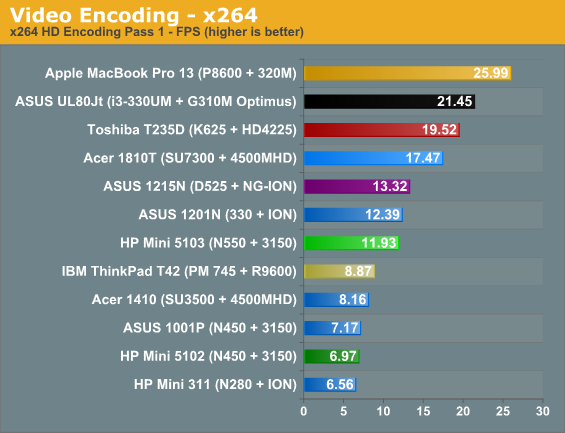
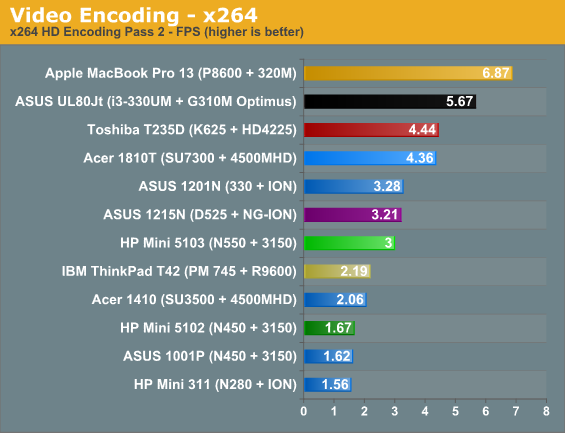
Our test suite tends to overemphasize multi-core processors, which means the dual-core N550 looks a lot better in the above charts than what you’ll experience in general. That’s why we include the single-threaded Cinebench result, because there are still plenty of times where that represents what you’d be doing with a PC, and in particular a netbook. The result is that there are times when the N550 is actually slower than single-core Atom CPUs, and there are other times where it can feel nearly twice as fast. PCMark Vantage ends up 58% faster than the 5102, PCMark05 is 38% faster, and our heavy-threaded testing is even better. Cinebench SMP is 68% faster, first-pass x264 encoding is 71% faster, and the second-pass x264 encode shows an 80% improvement. That’s the good news; the problem is single-threaded Cinebench is nearly 10% slower, and that does show up in general use.
I’ve used enough Atom netbooks to say that this is slightly faster overall, but it’s not a major performance increase. Instead, it’s a slight speed bump in most areas, and when you throw in results like that of an old 1.8GHz Pentium M 745 (i.e. the ThinkPad T42) there are a lot of applications where an old but fast single-core CPU still comes out on top. Windows 7 booted faster and was more responsive on a six-year-old T42 in practice, though like Atom netbooks it really struggles with fullscreen HD H.264 content (which is to say, it’s choppy and generally unwatchable). Unfortunately, I didn’t have enough time with the T42 to run PCMark, as I think the scores there would have shown more of what you see in the 1-CPU Cinebench test (perhaps not quite so dramatic, though).
You can also see a similar state of affairs when you look at performance results from the old CULV laptops like the Acer 1410 and 1810. The dual-core SU7300 completely eclipses the 5103, while the single-core SU3500 in the 1410 still beats the 5103 in every test other than x264 encoding. N550 does include support for SSE3, and that combined with Hyper-Threading gives it enough of a boost to come out on top in that particular test. Overall, however, the N550 can’t keep up. A more telling comparison is the Turion II K625, which boasts much higher overall performance for a lower price; if Brazos can offer a similar level of performance while cutting power requirements to Atom levels, the 2011 netbooks are going to be in for a nice upgrade at last.
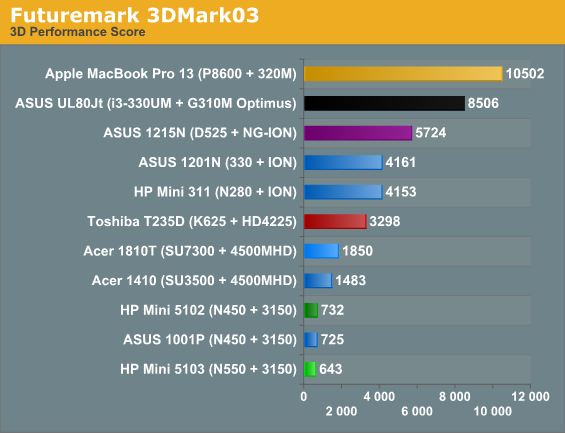
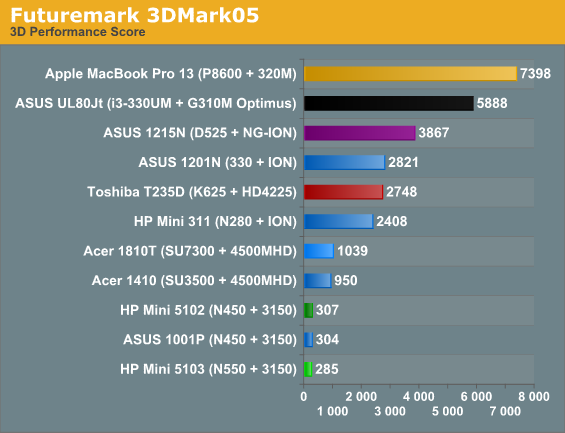
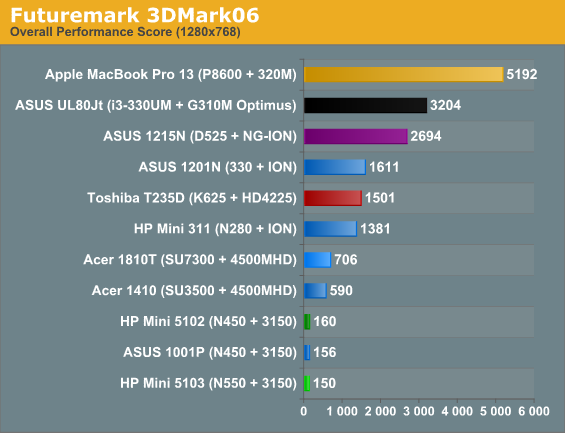
Atom on its own is unfit for most games released this side of 2000, so we didn’t bother with even trying to run any games. 3DMark tells the story well enough for our purposes: the HD 4225 in the Toshiba T235D is five to ten times faster than the anemic GMA 3150 IGP. We’ll have to wait for the next update to Atom to see if Intel is ready to put a bit more GPU performance into their inexpensive processor line. We’d expect they’re ready to make that move, considering AMD’s Brazos targets a similar market segment; if not, we may see a lot more netbook design wins from AMD in 2011.
Originally published at https://www.anandtech.com/show/4066/hp-mini-5103-looking-at-the-dualcore-atom-n550 (Wayback Machine).