
10G Ethernet: More Than a Big Pipe
- Posted in
- IT Computing
- Networking
- 10G Ethernet
Exar's Neterion Solution
SR-IOV will be supported in ESX 5.0 and the successor of Windows Server 2008. Since VMware’s ESX is the dominant hypervisor in most datacenters, that means that a large part of the already virtualized servers will have to wait a year or more before they can get the benefits of SR-IOV.
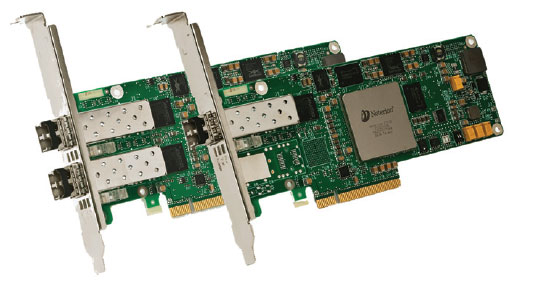
Exar, the pioneer of multiple devices queues, saw a window of opportunity. Besides the standard SR-IOV and VMware NetQueue support, the X3100 NICs also have a proprietary SR-IOV implementation.
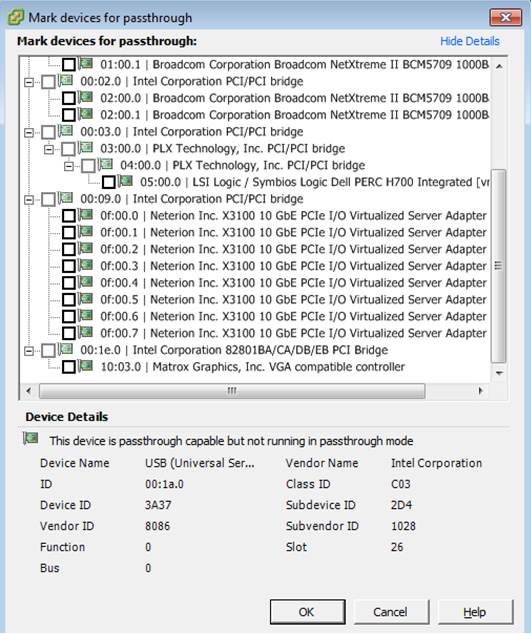
Poprietary solutions only make sense if they offer enough advantages. Neterion claims that the NIC chip has extensive hardware support for network prioritization and quality of service. That hardware support should be superior to hypervisor traffic shaping, especially on the receive side. After all, if bursty traffic causes the NIC to drop packets on the receive side, there is nothing the hypervisor can do: it never saw those packets pass. To underline this, Neterion equips the X3100 with a massive 64MB receive buffer; for comparison, the competitors have in the best case a 512KB receive buffer. This huge receive buffer should ensure that the QoS is guaranteed even if relatively long bursts of network traffic occur.
Neterion NICs can be found in IBM, HP, Dell, Fujitsu, and Hitachi machines. Neterion is part of Exar and has also access to a world distributor channel. The typical price of this NIC is around $745.
The Competition: Solarflare
Solarflare is a relatively young company, founded in 2001. The main philosophy of Solarflare has been been “make Ethernet [over copper] better” (we added “over copper”). Solarflare NICs support optical media too, but Solarflare made headlines with their 10G Ethernet copper products. In 2006, Solarflare was the first with 10GBase-T PHY. 10GBase-T allows 10Gigabit over the very common and cheap CAT5E and the reasonably priced CAT6 and CAT6A UTP cables. Solarflare is also strongly advocating the use of 10GbE in the HPC world with the claim that the latency of 10GbE can be as low as 4 µs. In June of this year, Solarflare launched the SFN5121T, a dual-ported 10Gbase-T NIC which featured a very reasonable 12.9W power consumption, especially for a UTP based 10GbE product. In January of this year, the company decided to start selling NIC adapters directly to the end-user.
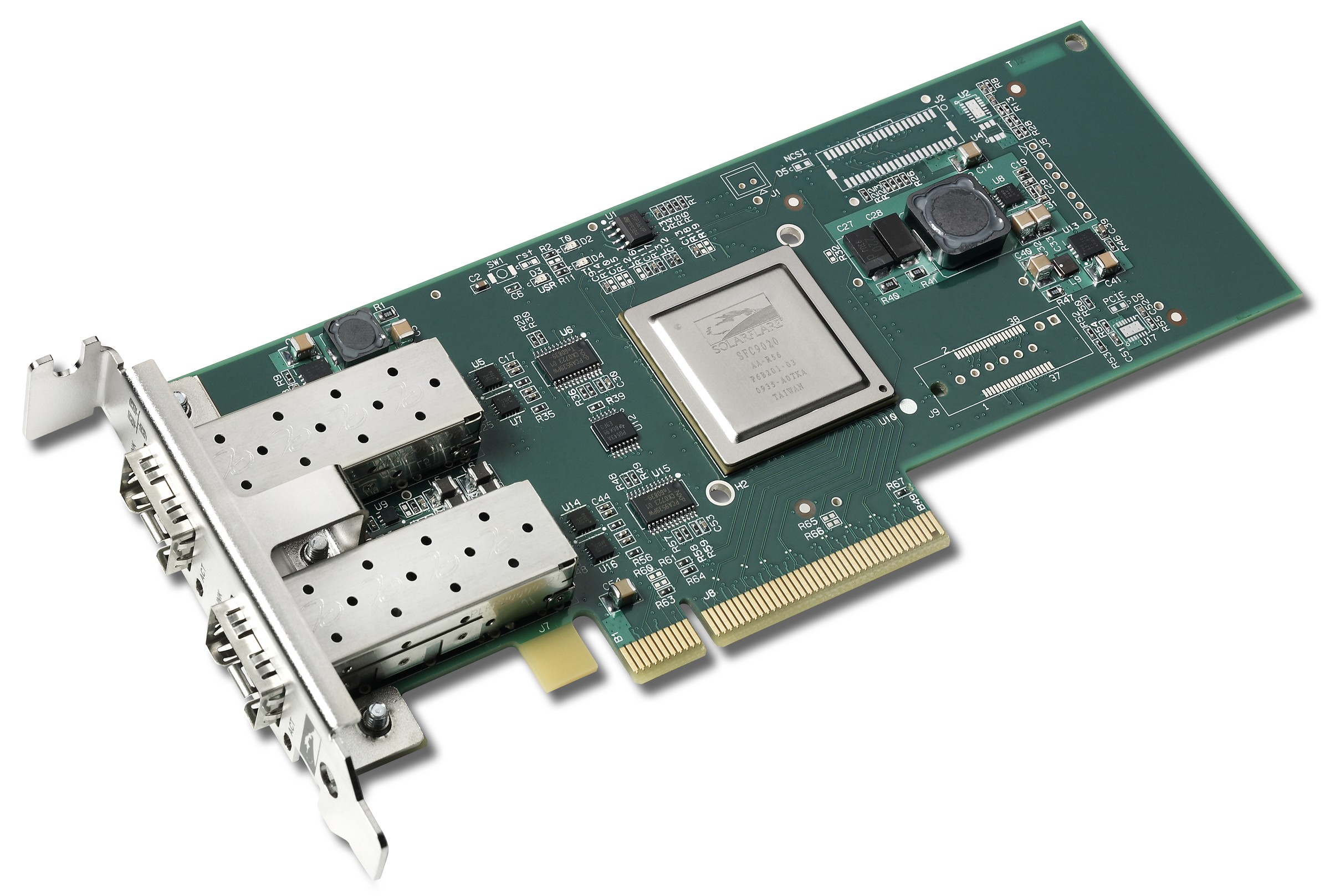
As we got an SFP+ Neterion X3120, we took a look at the optical brother of the SFN5121T, the SFN5122F. Both Solarflare NICs support SR-IOV and and make use of PCIe 2.0. The SFP+ SFN5122F should only consume a very low 4.9W for the complete card. Solarflare pulled this off by designing their own PHYs and reducing the chip count on the NIC. Although our power measurement methods (measured at the wall) are too crude to measure the exact power consumption, we can confirm that the Solarflare NIC consumed the least of the three NICs we tested.
The Solarflare chips are only slightly more expensive than the other NICs. Prices on the web were typically around $815.
The oldies
It is always interesting to get some “historical perspective”. Do these new cards outperform the older ones by a large margin? We included the Neterion XFrame-E for one test, and used the multi-queue pioneer and the Intel 82598, the 10GbE price breaker, as the historical reference for every benchmark. We'll try to add the Intel 82599 which also support SR-IOV, has a larger receive buffer, more queues and is priced around $700. We plugged those NICs in our Supermicro Twin² for testing.
Originally published at https://www.anandtech.com/show/4014/10g-more-than-a-big-pipe (Wayback Machine).