
10G Ethernet: More Than a Big Pipe
- Posted in
- IT Computing
- Networking
- 10G Ethernet
Our Impressions
First of all let's discuss the limitations of this review. The Intel chip was the older 82598; we will update this article with our findings on the 82599 as soon as we can.
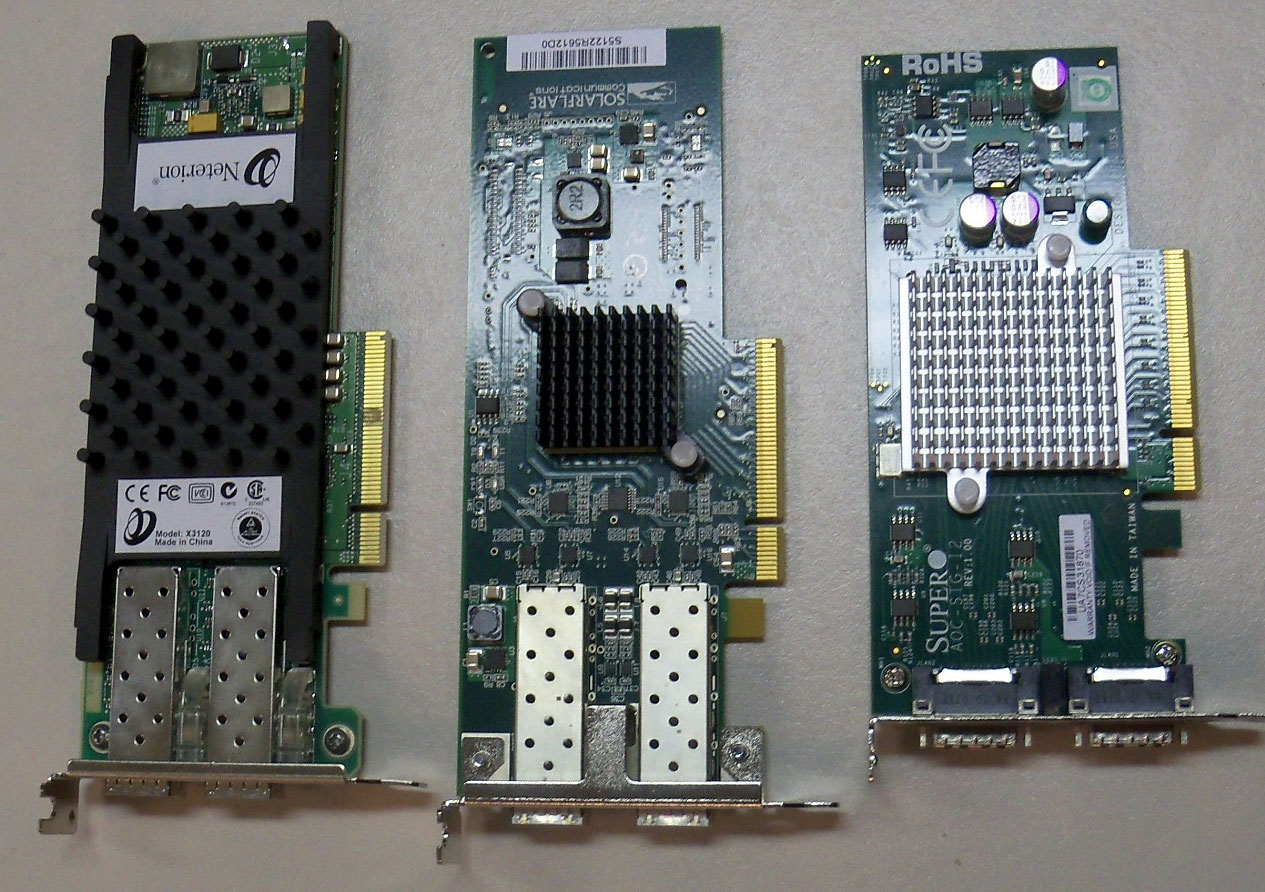
Neterion X3120 on the left, Solarflare SFN5122F in the middle, Intel 82598/ Supermicro NIC on the right.
We would not chose the Solarflare SFN5122F for a native Windows 2008 Server, as the 82598 already beats it there, so there is little doubt that the Intel 82599 will be the more attractive choice in that case. However, the Solarflare is the card that clearly has the lowest power consumption and an impressive SR-IOV implementation (256 VFs and hardware QoS). So the tests of today (Windows 2008, ESX 4.0 without SR-IOV) are not showing the true potential of this NIC. There are strong indications that the SFN5122F should do quite a bit better with Opensource software as it would get SR-IOV support in KVM and Xen, and a low latency TCP/IP stack with linux. To be continued....
The Neterion X3120 has beaten everybody to the VMware ESX punch. By implementing a sort of "pre-SR-IOV" besides the standard SR-IOV support, Neterion can offer virtual functions before anyone else, and it offers tangible advantages. The X3120 provides lower CPU loads and a more fair distribution of bandwidth—even without QoS—among the virtual machines. Add to this the large receive buffer and hardware QoS and it is a lot easier to guarantee a minimum amount of bandwidth to certain performance critical virtual machines. If you have to live up to an SLA, this should reduces costs. The Neterion NIC allows you to size the number of ports and bandwidth for the "usual expected" peak traffic. Without QoS and VFs you will need to add more ports to meet the needs of "extreme peak" traffic to guarantee that certain critical applications can always attain the promised performance.
The X3120 has a few weakness too, though. The relatively large heatsink gives away the fact that the Neterion NIC consumes the most power of our three NICs; Solarflare definitely did a better job there. Also, the Neterion NIC requires more tuning than the other two to really perform well. So the Neterion X3120 is not perfect, but it is the best NIC on VMware vSphere right now unless you are configuring your server for very low power.
A big thanks to Tijl Deneut for his assistance in benchmarking these NICs.
Originally published at https://www.anandtech.com/show/4014/10g-more-than-a-big-pipe (Wayback Machine).