
10G Ethernet: More Than a Big Pipe
- Posted in
- IT Computing
- Networking
- 10G Ethernet
Quality of Service: Looking Closer
The first chip we look at is the Intel 82598.
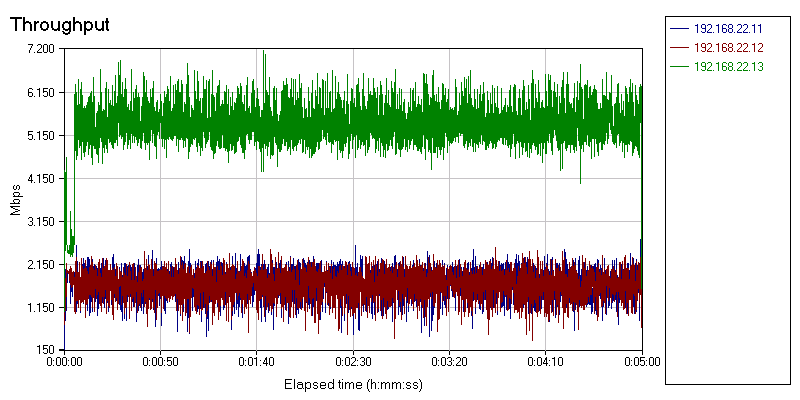
Notice that the blue and red throughput lines vary between 0.5 and 2.2 Gbit per second. As our script consists of 90% receive frames, it is clear that (ingress) software traffic shaping is doing a rather mediocre job. It struggles to keep the bandwidth close to the desired 2 Gbit/s. The same is true for the Solarflare chip.
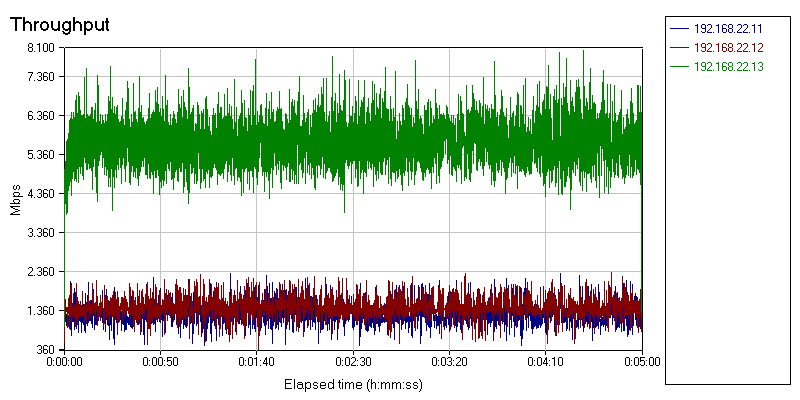
It is important to note that this is only a temporary situation for the Solarflare SF5122F. It does support SR-IOV and can offer up to 256 virtual functions, so the moment ESX supports SR-IOV officialy, the SF5122F should be able to do a lot better. Let us take a look at "Neterion SR-IOV" of the Neterion X3120 NIC.
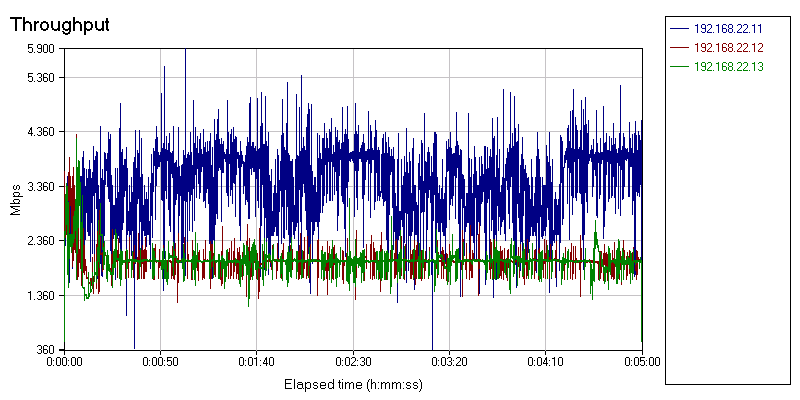
If we ignore the first few seconds, you can clearly see that the red and green line(*) are much closer to the demanded 2 Gbit/s. The two VMs with QoS get 1.4 Gbit/s in the worst case, and most of the time, the bandwidth is very close to 2 gbit/s. The large 64MB receive buffer and hardware QoS in the NIC are paying off.
(*) The blue line is now the VM without any QoS.
Originally published at https://www.anandtech.com/show/4014/10g-more-than-a-big-pipe (Wayback Machine).