
OCZ's Fastest SSD, The IBIS and HSDL Interface Reviewed
Making Random Performance Look Sequential
The four corners of SSD performance are as follows: random read, random write, sequential read and sequential write speed. Random accesses are generally small in size, while sequential accesses tend to be larger and thus we have the four Iometer tests we use in all of our reviews.
Our random tests write 4KB in a completely random pattern over an 8GB space of the drive to simulate the sort of random access that you'd see on an OS drive (even this is more stressful than a normal desktop user would see). Our random read test spans the entirety of the drive. I perform three concurrent IOs and run the test for 3 minutes. The results reported are in average MB/s over the entire time.
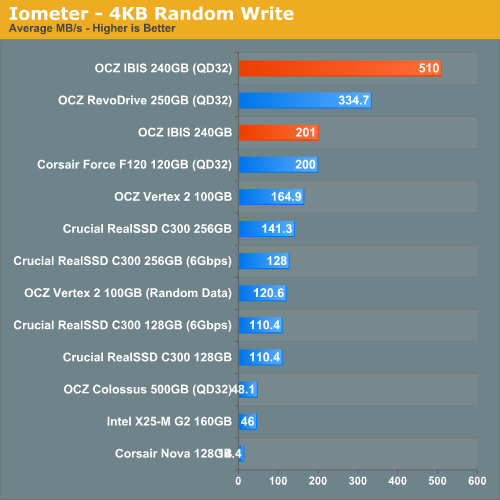
In case you didn't do the math in your head, 510MB/s of 4KB random writes translates to 130,000 IOPS. That's insane. The IBIS can deliver faster random writes than the RevoDrive can manage sequential writes. A fully taxed SandForce drive manages 200MB/s, the performance advantage here is huge. Again I can't stress enough how fast four of these things must be.
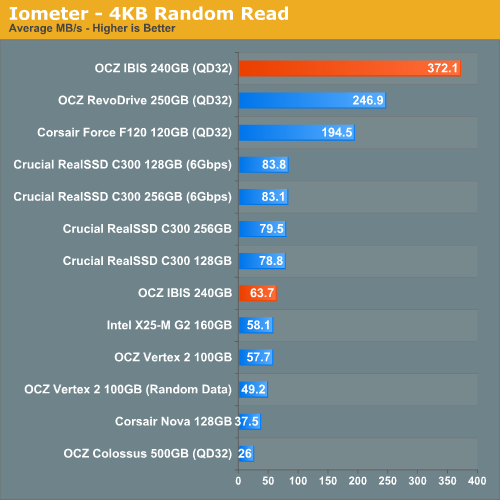
Random read performance across the drive's entire LBA space drops the peak performance a bit but we're still well beyond what 3Gbps SATA can deliver, although technically 6Gbps SATA would be enough here. You'll note that in a desktop workload (QD=3) there's no advantage to the IBIS drive. This thing really only makes sense for very I/O intensive workloads.
Originally published at https://www.anandtech.com/show/3949/oczs-fastest-ssd-the-ibis-and-hsdl-interface-reviewed (Wayback Machine).